Chapter 4: A Carpenter's Problem
๐Ÿ‡ฎ๐Ÿ‡ณ National Curriculum Standard โ–พ
๐Ÿ› Vidyoric Certified โ€ข Prof. Arvind Swaminathan
๐Ÿ”ฅ 0 days
โšก 0 Sparks +
Chapter 4: A Carpenter's Problem

Video Lecture 1: The Angle Sum Invariants of Polygons and Quadrilaterals

STEP 1: VIDEO LESSON ๐Ÿ“ค Uploaded HTML5 Video

๐Ÿ“‘ Interactive Chapter Bookmarks

5 chapters
00:00
Introduction & Overview

Syllabus scope and core objectives

โ–ถ
00:46
Meet The quadrilaterls

Detailed physical mechanism and derivations

โ–ถ
01:53
The Carpenters Problem

High-yield board tips and pitfalls

โ–ถ
03:02
Decoding The Diagonals
โ–ถ
05:02
Exploring The Angles
โ–ถ

๐ŸŽ™๏ธ Synchronized Transcript

๐Ÿ”
Why is a triangular wooden frame rigid, while a four-sided frame can wobble or collapse under pressure? The answer lies in the geometry of polygons. A diagonal support makes a quadrilateral stronger by dividing it into two triangles.

Let us first understand polygons and their types.

A polygon is a simple closed shape made entirely of straight line segments.

A convex polygon has all its interior angles less than 180 degrees. All its diagonals lie inside the polygon.

A concave polygon has at least one interior angle greater than 180 degrees. At least one of its diagonals lies outside the polygon.

A regular polygon has all sides equal and all interior angles equal. A square and an equilateral triangle are common examples.

Now, let us explore an important property: the sum of interior angles.

For any polygon with n sides, the sum of its interior angles is calculated by subtracting two from the number of sides and multiplying the result by 180 degrees.

Let us apply this formula.

For a triangle with three sides, the sum is 180 degrees.

For a quadrilateral with four sides, the sum is 360 degrees.

For a pentagon with five sides, the sum is 540 degrees.

And for a hexagon with six sides, the sum is 720 degrees.

As the number of sides increases, the sum of interior angles also increases.

There is another important rule called the exterior angle theorem. If we take one exterior angle at each vertex of any convex polygon, their total is always 360 degrees, regardless of the number of sides.

Remember these key ideas: polygons are classified as convex, concave and regular. The interior angle sum depends on the number of sides, while the sum of one exterior angle at each vertex of a convex polygon is always 360 degrees.
STEP 2 โ€ข CONCEPT NOTES โฑ๏ธ 3 min read
๐Ÿ“Œ 0 Notes

Polygons: Convexity, Diagonals and the Interior Angle Sum Theorem

1. Classification of Polygons

  • Polygon: A simple closed plane figure bounded by line segments.
  • Convex vs Concave:
  • Convex Polygon: All interior angles $< 180^\circ$; all diagonals lie entirely inside the polygon.
  • Concave Polygon: At least one interior angle $> 180^\circ$ (reflex angle); at least one diagonal lies outside.
  • Regular Polygon: Both equilateral (all sides equal) and equiangular (all angles equal).
                      INTERIOR ANGLE SUM BY TRIANGULATION
       Quadrilateral (n = 4)                 Pentagon (n = 5)
          +-----------+                        +-------+
          | \         |                       / \     / \
          |   \   (2) |                      / (1)\ /(3) \
          | (1) \     |                     /      X      \
          +-------+---+                    +-------+-------+
       2 Triangles = 2 ร— 180ยฐ = 360ยฐ       3 Triangles = 3 ร— 180ยฐ = 540ยฐ

2. General Polygon Formulas

For any $n$-sided polygon:

  1. Sum of Interior Angles:
$$\mathbf{S_{\text{int}} = (n - 2) \times 180^\circ}$$
  1. Number of Diagonals:
$$\mathbf{D = \frac{n(n - 3)}{2}}$$
  • Triangle ($n=3$): $\frac{3(0)}{2} = 0$
  • Quadrilateral ($n=4$): $\frac{4(1)}{2} = 2$
  • Pentagon ($n=5$): $\frac{5(2)}{2} = 5$
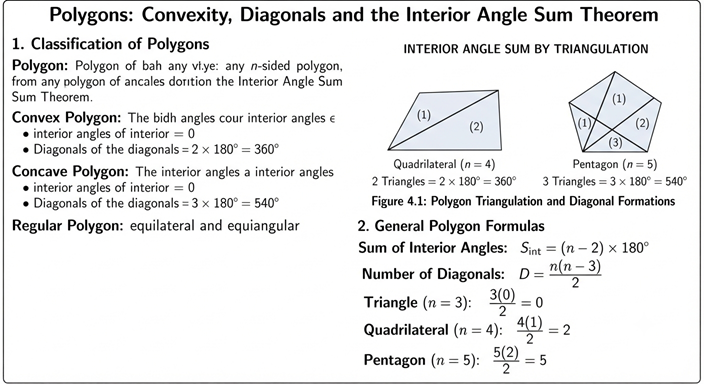
Figure 4.1: Polygon Triangulation and Diagonal Formations

๐Ÿ“
Comprehensive High-Yield Mathematical Relations & Theorems

Complete step-by-step derivations, step traps, and LaTeX formula sheet breakdowns...

๐Ÿ”’

End of Free Notes Preview

Unlock the complete deck to access full LaTeX formula breakdowns, interactive diagrams, exam traps, and personal margin highlights!

๐Ÿ”‘ Sign In / Register Free
๐Ÿง  Review Due (Interval: 1 Day) Card 1 of 8 (SM-2 Active Recall)
QUESTION (FRONT) Space โ†ต to flip
What is the sum of the interior angles of a quadrilateral?
ANSWER & EXPLANATION (BACK) Space โ†ต to flip
360ยฐ [(4 - 2) ร— 180ยฐ = 360ยฐ].
๐Ÿ’ก
Tap Card to Flip & Check Your Answer Active recall prompt: Flip the card or press Space โ†ต to unlock the SM-2 recall difficulty rating.
๐Ÿ”’
Step 4 is Locked

Final Diagnostic Mastery Examination (15 MCQs)

This ๐Ÿ“ LaTeX Concept Notes is part of the full verified curriculum for Chapter 4: A Carpenter's Problem. Unlock the full deck to gain permanent access to all 11 interactive stages, active recall cards, and diagnostic checkpoints.

Deck Access Price
100% Free with Account
Instant Access
โœ“ UPI & Cards Supported
๐Ÿ”‘ Sign In / Register to Unlock Free →
๐Ÿ”’
Step 5 is Locked

Final Diagnostic Mastery Examination (15 MCQs)

This โšก Diagnostic Quiz is part of the full verified curriculum for Chapter 4: A Carpenter's Problem. Unlock the full deck to gain permanent access to all 11 interactive stages, active recall cards, and diagnostic checkpoints.

Deck Access Price
100% Free with Account
Instant Access
โœ“ UPI & Cards Supported
๐Ÿ”‘ Sign In / Register to Unlock Free →
๐Ÿ”’
Step 6 is Locked

Final Diagnostic Mastery Examination (15 MCQs)

This ๐Ÿง  Active Recall Flashcards is part of the full verified curriculum for Chapter 4: A Carpenter's Problem. Unlock the full deck to gain permanent access to all 11 interactive stages, active recall cards, and diagnostic checkpoints.

Deck Access Price
100% Free with Account
Instant Access
โœ“ UPI & Cards Supported
๐Ÿ”‘ Sign In / Register to Unlock Free →
๐Ÿ”’
Step 7 is Locked

Final Diagnostic Mastery Examination (15 MCQs)

This ๐ŸŽฅ Video Lesson is part of the full verified curriculum for Chapter 4: A Carpenter's Problem. Unlock the full deck to gain permanent access to all 11 interactive stages, active recall cards, and diagnostic checkpoints.

Deck Access Price
100% Free with Account
Instant Access
โœ“ UPI & Cards Supported
๐Ÿ”‘ Sign In / Register to Unlock Free →
๐Ÿ”’
Step 8 is Locked

Final Diagnostic Mastery Examination (15 MCQs)

This ๐Ÿ“ LaTeX Concept Notes is part of the full verified curriculum for Chapter 4: A Carpenter's Problem. Unlock the full deck to gain permanent access to all 11 interactive stages, active recall cards, and diagnostic checkpoints.

Deck Access Price
100% Free with Account
Instant Access
โœ“ UPI & Cards Supported
๐Ÿ”‘ Sign In / Register to Unlock Free →
๐Ÿ”’
Step 9 is Locked

Final Diagnostic Mastery Examination (15 MCQs)

This Microlearning Step is part of the full verified curriculum for Chapter 4: A Carpenter's Problem. Unlock the full deck to gain permanent access to all 11 interactive stages, active recall cards, and diagnostic checkpoints.

Deck Access Price
100% Free with Account
Instant Access
โœ“ UPI & Cards Supported
๐Ÿ”‘ Sign In / Register to Unlock Free →
๐Ÿ”’
Step 10 is Locked

Final Diagnostic Mastery Examination (15 MCQs)

This ๐Ÿ“ LaTeX Concept Notes is part of the full verified curriculum for Chapter 4: A Carpenter's Problem. Unlock the full deck to gain permanent access to all 11 interactive stages, active recall cards, and diagnostic checkpoints.

Deck Access Price
100% Free with Account
Instant Access
โœ“ UPI & Cards Supported
๐Ÿ”‘ Sign In / Register to Unlock Free →
๐Ÿ”’
Step 11 is Locked

Final Diagnostic Mastery Examination (15 MCQs)

This โšก Diagnostic Quiz is part of the full verified curriculum for Chapter 4: A Carpenter's Problem. Unlock the full deck to gain permanent access to all 11 interactive stages, active recall cards, and diagnostic checkpoints.

Deck Access Price
100% Free with Account
Instant Access
โœ“ UPI & Cards Supported
๐Ÿ”‘ Sign In / Register to Unlock Free →