Chapter 9: The Baudhāyana-Pythagoras Theorem
🇮🇳 National Curriculum Standard ▾
🏛 Vidyoric Certified • Prof. Arvind Swaminathan
🔥 0 days
⚡ 0 Sparks +
Chapter 9: The Baudhāyana-Pythagoras Theorem

Video Lecture 1: The Cord of Baudhāyana — Vedic Altar Geometry to the Modern Theorem

STEP 1: VIDEO LESSON 📤 Uploaded HTML5 Video

📑 Interactive Chapter Bookmarks

6 chapters
00:00
Introduction & Overview

Syllabus scope and core objectives

▶
00:57
Doubling A Square

Detailed physical mechanism and derivations

▶
01:43
Halving A Square

High-yield board tips and pitfalls

▶
02:22
Discober Hypoyenuse
▶
03:12
Infinte Root Two
▶
04:09
Baudhanayana Triples
▶

🎙️ Synchronized Transcript

🔍
Centuries ago, ancient Indian mathematicians used geometry to design and construct complex fire altars. These structures required accurate measurements and precise geometric calculations.

One important mathematician was Baudhāyana, who recorded an early statement of the relationship between the sides of a right-angled triangle in the Baudhāyana Sulba Sutra.

This relationship is now widely known as the Pythagorean theorem.

Let us understand the theorem.

In a right-angled triangle, one angle measures ninety degrees. The side opposite this right angle is called the hypotenuse. It is the longest side of the triangle. The other two sides are called the base and the perpendicular.

According to the Pythagorean theorem, the square of the hypotenuse is equal to the sum of the squares of the other two sides.

In simple words, the square of the base plus the square of the perpendicular equals the square of the hypotenuse.

Now, let us understand its geometric meaning.

Imagine drawing a square on each side of a right-angled triangle. The area of the square drawn on the hypotenuse is exactly equal to the combined areas of the squares drawn on the other two sides.

This relationship holds true for every right-angled triangle, regardless of its size.

Remember, the Pythagorean theorem applies only to right-angled triangles. It is useful in construction, architecture, land measurement and many real-life problems involving distances and heights.
STEP 2 • CONCEPT NOTES ⏱️ 3 min read
📌 0 Notes

Indian Mathematical Heritage: The Sulba Sūtras & The Cord Principle

1. Baudhāyana's Sulba Sūtra (c. 800 BCE)

Centuries before Greek geometry was documented, Indian Sūtrakāras compiled the Sulba Sūtras (manuals of geometric cord constructions for sacred altars):

$$\mathbf{\text{Diagonal}^2 = \text{Length}^2 + \text{Breadth}^2}$$
  • Translated from Sanskrit:
"The cord stretched across the diagonal of a rectangle produces an area which the vertical and horizontal sides produce together."
                       BAUDHĀYANA'S RECTANGLE CORD PRINCIPLE
                          +-------------------------------+
                          | \                             |
                          |   \                           | b (Breadth)
                          |     \  d (Diagonal Cord)      |
                          |       \                       |
                          +---------\---------------------+
                                     a (Length)
                          Area of Square on d = Area(a) + Area(b)
                                     d^2 = a^2 + b^2
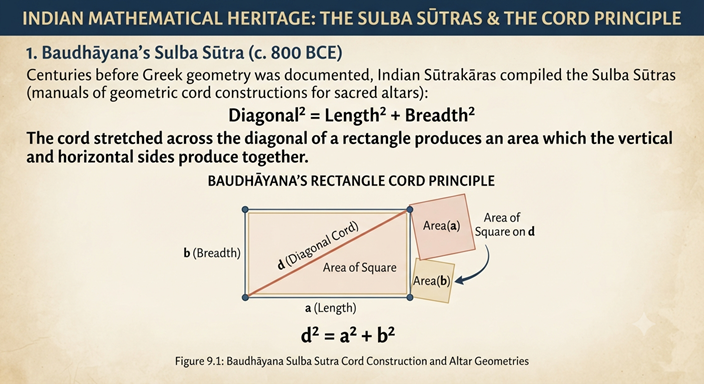
Figure 9.1: Baudhāyana Sulba Sutra Cord Construction and Altar Geometries

📐
Comprehensive High-Yield Mathematical Relations & Theorems

Complete step-by-step derivations, step traps, and LaTeX formula sheet breakdowns...

🔒

End of Free Notes Preview

Unlock the complete deck to access full LaTeX formula breakdowns, interactive diagrams, exam traps, and personal margin highlights!

🔑 Sign In / Register Free
🧠 Review Due (Interval: 1 Day) Card 1 of 8 (SM-2 Active Recall)
QUESTION (FRONT) Space ↵ to flip
Who formulated the diagonal cord theorem in India around 800 BCE?
ANSWER & EXPLANATION (BACK) Space ↵ to flip
Baudhāyana, in the Baudhāyana Sulba Sūtra.
💡
Tap Card to Flip & Check Your Answer Active recall prompt: Flip the card or press Space ↵ to unlock the SM-2 recall difficulty rating.
🔒
Step 4 is Locked

Final Diagnostic Mastery Examination (15 MCQs)

This 📝 LaTeX Concept Notes is part of the full verified curriculum for Chapter 9: The Baudhāyana-Pythagoras Theorem. Unlock the full deck to gain permanent access to all 11 interactive stages, active recall cards, and diagnostic checkpoints.

Deck Access Price
100% Free with Account
Instant Access
✓ UPI & Cards Supported
🔑 Sign In / Register to Unlock Free →
🔒
Step 5 is Locked

Final Diagnostic Mastery Examination (15 MCQs)

This ⚡ Diagnostic Quiz is part of the full verified curriculum for Chapter 9: The Baudhāyana-Pythagoras Theorem. Unlock the full deck to gain permanent access to all 11 interactive stages, active recall cards, and diagnostic checkpoints.

Deck Access Price
100% Free with Account
Instant Access
✓ UPI & Cards Supported
🔑 Sign In / Register to Unlock Free →
🔒
Step 6 is Locked

Final Diagnostic Mastery Examination (15 MCQs)

This 🧠 Active Recall Flashcards is part of the full verified curriculum for Chapter 9: The Baudhāyana-Pythagoras Theorem. Unlock the full deck to gain permanent access to all 11 interactive stages, active recall cards, and diagnostic checkpoints.

Deck Access Price
100% Free with Account
Instant Access
✓ UPI & Cards Supported
🔑 Sign In / Register to Unlock Free →
🔒
Step 7 is Locked

Final Diagnostic Mastery Examination (15 MCQs)

This 🎥 Video Lesson is part of the full verified curriculum for Chapter 9: The Baudhāyana-Pythagoras Theorem. Unlock the full deck to gain permanent access to all 11 interactive stages, active recall cards, and diagnostic checkpoints.

Deck Access Price
100% Free with Account
Instant Access
✓ UPI & Cards Supported
🔑 Sign In / Register to Unlock Free →
🔒
Step 8 is Locked

Final Diagnostic Mastery Examination (15 MCQs)

This 📝 LaTeX Concept Notes is part of the full verified curriculum for Chapter 9: The Baudhāyana-Pythagoras Theorem. Unlock the full deck to gain permanent access to all 11 interactive stages, active recall cards, and diagnostic checkpoints.

Deck Access Price
100% Free with Account
Instant Access
✓ UPI & Cards Supported
🔑 Sign In / Register to Unlock Free →
🔒
Step 9 is Locked

Final Diagnostic Mastery Examination (15 MCQs)

This Microlearning Step is part of the full verified curriculum for Chapter 9: The Baudhāyana-Pythagoras Theorem. Unlock the full deck to gain permanent access to all 11 interactive stages, active recall cards, and diagnostic checkpoints.

Deck Access Price
100% Free with Account
Instant Access
✓ UPI & Cards Supported
🔑 Sign In / Register to Unlock Free →
🔒
Step 10 is Locked

Final Diagnostic Mastery Examination (15 MCQs)

This 📝 LaTeX Concept Notes is part of the full verified curriculum for Chapter 9: The Baudhāyana-Pythagoras Theorem. Unlock the full deck to gain permanent access to all 11 interactive stages, active recall cards, and diagnostic checkpoints.

Deck Access Price
100% Free with Account
Instant Access
✓ UPI & Cards Supported
🔑 Sign In / Register to Unlock Free →
🔒
Step 11 is Locked

Final Diagnostic Mastery Examination (15 MCQs)

This ⚡ Diagnostic Quiz is part of the full verified curriculum for Chapter 9: The Baudhāyana-Pythagoras Theorem. Unlock the full deck to gain permanent access to all 11 interactive stages, active recall cards, and diagnostic checkpoints.

Deck Access Price
100% Free with Account
Instant Access
✓ UPI & Cards Supported
🔑 Sign In / Register to Unlock Free →