Chapter 11: Exploring Some Geometric Themes
๐Ÿ‡ฎ๐Ÿ‡ณ National Curriculum Standard โ–พ
๐Ÿ› Vidyoric Certified โ€ข Prof. Arvind Swaminathan
๐Ÿ”ฅ 0 days
โšก 0 Sparks +
Chapter 11: Exploring Some Geometric Themes

Video Lecture 1: The Geometry of Tilings โ€” Why Bees Build Hexagons

STEP 1: VIDEO LESSON ๐Ÿ“ค Uploaded HTML5 Video

๐Ÿ“‘ Interactive Chapter Bookmarks

4 chapters
00:00
Introduction & Overview

Syllabus scope and core objectives

โ–ถ
01:01
Fractals

Detailed physical mechanism and derivations

โ–ถ
06:42
Fractals In Temple

High-yield board tips and pitfalls

โ–ถ
09:09
imagine The Profile
โ–ถ

๐ŸŽ™๏ธ Synchronized Transcript

๐Ÿ”
Have you ever noticed how honeycombs are made of perfectly connected hexagonal cells? This is an example of a mathematical pattern called tessellation.

A tessellation is a pattern of shapes that covers a flat surface completely without leaving gaps or creating overlaps.

For regular polygons to form a regular tessellation, their interior angles must fit together perfectly around a point. The sum of angles around a point is three hundred and sixty degrees.

Let us explore the three regular polygons that can create this pattern.

First, the equilateral triangle. Each interior angle measures sixty degrees. Six triangles fit perfectly around one point because six multiplied by sixty equals three hundred and sixty degrees.

Second, the square. Each interior angle measures ninety degrees. Four squares fit perfectly around one point because four multiplied by ninety equals three hundred and sixty degrees.

Third, the regular hexagon. Each interior angle measures one hundred and twenty degrees. Three hexagons fit perfectly around one point because three multiplied by one hundred and twenty equals three hundred and sixty degrees.

But why can regular pentagons not form a regular tessellation? Each interior angle measures one hundred and eight degrees. Three hundred and sixty divided by one hundred and eight is not a whole number. Therefore, regular pentagons cannot fit together around a point without leaving gaps or overlapping.

Now, let us explore why honeybees build hexagonal honeycombs.

A regular hexagon encloses a given area using less perimeter than a square or an equilateral triangle of the same area. This means less boundary material is needed to create each cell.

This property helps explain why hexagonal structures are so efficient for storing honey while conserving wax.

Remember, regular triangles, squares and hexagons can tessellate a plane because their interior angles fit perfectly around a point. Mathematics helps us understand the efficient patterns found in nature.
STEP 2 โ€ข CONCEPT NOTES โฑ๏ธ 3 min read
๐Ÿ“Œ 0 Notes

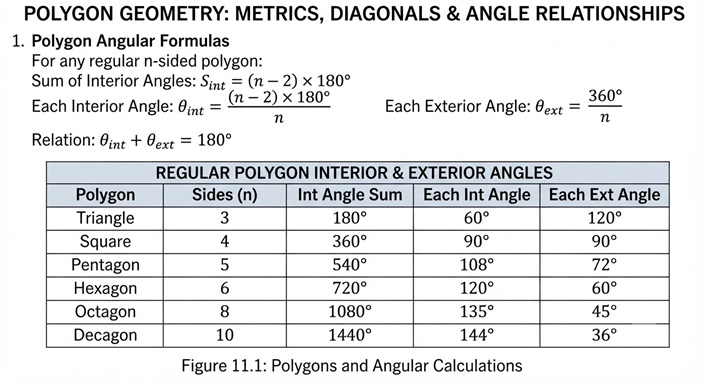
Polygon Geometry: Metrics, Diagonals & Angle Relationships

1. Polygon Angular Formulas

For any regular $n$-sided polygon:

  • Sum of Interior Angles: $S_{\text{int}} = (n - 2) \times 180^\circ$
  • Each Interior Angle: $\theta_{\text{int}} = \frac{(n - 2) \times 180^\circ}{n}$
  • Each Exterior Angle: $\theta_{\text{ext}} = \frac{360^\circ}{n}$
  • Relation: $\theta_{\text{int}} + \theta_{\text{ext}} = 180^\circ$
                   REGULAR POLYGON INTERIOR & EXTERIOR ANGLES
  Polygon           Sides (n)    Int Angle Sum    Each Int Angle    Each Ext Angle
  Triangle              3            180ยฐ              60ยฐ               120ยฐ
  Square                4            360ยฐ              90ยฐ                90ยฐ
  Pentagon              5            540ยฐ             108ยฐ                72ยฐ
  Hexagon               6            720ยฐ             120ยฐ                60ยฐ
  Octagon               8           1080ยฐ             135ยฐ                45ยฐ
  Decagon              10           1440ยฐ             144ยฐ                36ยฐ

Figure 11.1: Polygons and Angular Calculations

๐Ÿ“
Comprehensive High-Yield Mathematical Relations & Theorems

Complete step-by-step derivations, step traps, and LaTeX formula sheet breakdowns...

๐Ÿ”’

End of Free Notes Preview

Unlock the complete deck to access full LaTeX formula breakdowns, interactive diagrams, exam traps, and personal margin highlights!

๐Ÿ”‘ Sign In / Register Free
๐Ÿง  Review Due (Interval: 1 Day) Card 1 of 8 (SM-2 Active Recall)
QUESTION (FRONT) Space โ†ต to flip
What is a tessellation (or tiling)?
ANSWER & EXPLANATION (BACK) Space โ†ต to flip
A repeating pattern of plane figures that covers a surface completely with zero gaps and zero overlaps.
๐Ÿ’ก
Tap Card to Flip & Check Your Answer Active recall prompt: Flip the card or press Space โ†ต to unlock the SM-2 recall difficulty rating.
๐Ÿ”’
Step 4 is Locked

Final Diagnostic Mastery Examination (15 MCQs)

This ๐Ÿ“ LaTeX Concept Notes is part of the full verified curriculum for Chapter 11: Exploring Some Geometric Themes. Unlock the full deck to gain permanent access to all 11 interactive stages, active recall cards, and diagnostic checkpoints.

Deck Access Price
100% Free with Account
Instant Access
โœ“ UPI & Cards Supported
๐Ÿ”‘ Sign In / Register to Unlock Free →
๐Ÿ”’
Step 5 is Locked

Final Diagnostic Mastery Examination (15 MCQs)

This โšก Diagnostic Quiz is part of the full verified curriculum for Chapter 11: Exploring Some Geometric Themes. Unlock the full deck to gain permanent access to all 11 interactive stages, active recall cards, and diagnostic checkpoints.

Deck Access Price
100% Free with Account
Instant Access
โœ“ UPI & Cards Supported
๐Ÿ”‘ Sign In / Register to Unlock Free →
๐Ÿ”’
Step 6 is Locked

Final Diagnostic Mastery Examination (15 MCQs)

This ๐Ÿง  Active Recall Flashcards is part of the full verified curriculum for Chapter 11: Exploring Some Geometric Themes. Unlock the full deck to gain permanent access to all 11 interactive stages, active recall cards, and diagnostic checkpoints.

Deck Access Price
100% Free with Account
Instant Access
โœ“ UPI & Cards Supported
๐Ÿ”‘ Sign In / Register to Unlock Free →
๐Ÿ”’
Step 7 is Locked

Final Diagnostic Mastery Examination (15 MCQs)

This ๐ŸŽฅ Video Lesson is part of the full verified curriculum for Chapter 11: Exploring Some Geometric Themes. Unlock the full deck to gain permanent access to all 11 interactive stages, active recall cards, and diagnostic checkpoints.

Deck Access Price
100% Free with Account
Instant Access
โœ“ UPI & Cards Supported
๐Ÿ”‘ Sign In / Register to Unlock Free →
๐Ÿ”’
Step 8 is Locked

Final Diagnostic Mastery Examination (15 MCQs)

This ๐Ÿ“ LaTeX Concept Notes is part of the full verified curriculum for Chapter 11: Exploring Some Geometric Themes. Unlock the full deck to gain permanent access to all 11 interactive stages, active recall cards, and diagnostic checkpoints.

Deck Access Price
100% Free with Account
Instant Access
โœ“ UPI & Cards Supported
๐Ÿ”‘ Sign In / Register to Unlock Free →
๐Ÿ”’
Step 9 is Locked

Final Diagnostic Mastery Examination (15 MCQs)

This Microlearning Step is part of the full verified curriculum for Chapter 11: Exploring Some Geometric Themes. Unlock the full deck to gain permanent access to all 11 interactive stages, active recall cards, and diagnostic checkpoints.

Deck Access Price
100% Free with Account
Instant Access
โœ“ UPI & Cards Supported
๐Ÿ”‘ Sign In / Register to Unlock Free →
๐Ÿ”’
Step 10 is Locked

Final Diagnostic Mastery Examination (15 MCQs)

This ๐Ÿ“ LaTeX Concept Notes is part of the full verified curriculum for Chapter 11: Exploring Some Geometric Themes. Unlock the full deck to gain permanent access to all 11 interactive stages, active recall cards, and diagnostic checkpoints.

Deck Access Price
100% Free with Account
Instant Access
โœ“ UPI & Cards Supported
๐Ÿ”‘ Sign In / Register to Unlock Free →
๐Ÿ”’
Step 11 is Locked

Final Diagnostic Mastery Examination (15 MCQs)

This โšก Diagnostic Quiz is part of the full verified curriculum for Chapter 11: Exploring Some Geometric Themes. Unlock the full deck to gain permanent access to all 11 interactive stages, active recall cards, and diagnostic checkpoints.

Deck Access Price
100% Free with Account
Instant Access
โœ“ UPI & Cards Supported
๐Ÿ”‘ Sign In / Register to Unlock Free →