Unit 1: Learning Together โ€” Empathy, Resilience & Sensory Discovery
๐Ÿ‡ฎ๐Ÿ‡ณ National Curriculum Standard โ–พ
๐Ÿ› Vidyoric Certified โ€ข Prof. Priya Nair
๐Ÿ”ฅ 0 days
โšก 0 Sparks +
Unit 1: Learning Together โ€” Empathy, Resilience & Sensory Discovery

Video Lecture 1: Listening to the River โ€” Janakiโ€™s Quest for Learning

STEP 1: VIDEO LESSON ๐Ÿ“ค Uploaded HTML5 Video

๐Ÿ“‘ Interactive Chapter Bookmarks

3 chapters
00:00
Introduction & Overview

Syllabus scope and core objectives

โ–ถ
02:30
Core Concept Mechanics

Detailed physical mechanism and derivations

โ–ถ
06:00
Exam Traps & Trajectory

High-yield board tips and pitfalls

โ–ถ

๐ŸŽ™๏ธ Synchronized Transcript

๐Ÿ”
Hello, young scholars!

Have you ever sat beside a flowing river, closed your eyes, and listened carefully? Not just to the sound of splashing water, but to the gentle whispers that nature seems to share with us?

In our opening chapter, The Day the River Spoke, from Poorvi, we meet a young girl named Janaki who lives in a seaside village.

Janaki was born with a physical disability that affects her legs. Because she cannot walk, she is unable to attend school like her brother and the other children in the village.

But there is something special about Janaki. Although she faces physical challenges, her curiosity and desire to learn are limitless.

As the village comes alive each morning, Janaki watches the children leave for school. She cannot join them, but she finds a special companion in the river flowing nearby.

The river becomes more than just a part of the landscape. It becomes her companion, her source of inspiration, and a window to the wider world.

Through Janaki's story, we discover how curiosity, courage, and understanding can help us overcome obstacles.

Janaki and the Teacher: A Journey Towards Education

Every morning, Janaki watches the village children carrying their schoolbags and slates as they walk towards the primary school.

She feels a deep longing to learn. It is not self-pity that fills her heart, but a strong desire to gain knowledge and explore the world around her.

Whenever she sits beside the river, she observes its movement and listens to the sounds of flowing water.

In her imagination, the river seems to speak to her. It encourages her to keep moving forward, just as water continues its journey despite the rocks and obstacles in its path.

Think about this comparison.

When water encounters a stone, it does not simply give up. It finds another way around it and continues flowing.

In the same way, Janaki's physical difficulties do not destroy her determination to learn.

An important turning point comes when the village schoolteacher visits the riverbank and notices Janaki's intelligence and curiosity.

The teacher recognises her ability to observe, understand, and learn about the natural world, including aquatic life.

This moment reminds us of a powerful message: education should not be limited by physical ability. Every child deserves an opportunity to learn, participate, and grow.

Understanding the Themes: Inclusivity and Resilience

Now, let us explore three important ideas presented through Janaki's story.

The first is personification of nature.

Personification is a literary device in which human qualities or actions are given to non-human things.

In this story, the river seems to speak to Janaki and offer her encouragement. This makes the river feel like a living companion and strengthens the emotional connection between Janaki and nature.

The second theme is inclusive education.

Inclusive education means providing equal learning opportunities to every child, regardless of their physical abilities or individual challenges.

Janaki's story reminds us that schools should create an environment where every student feels welcomed, respected, and supported.

When Janaki gets an opportunity to join the classroom, the experience benefits not only her but also her classmates. They learn the importance of empathy, kindness, cooperation, and friendship.

The third theme is resilience and self-advocacy.

Resilience means the ability to face difficulties and continue working towards a goal.

Janaki does not allow her circumstances to destroy her desire for knowledge. Her curiosity and determination show us the importance of believing in ourselves.

While studying this chapter, also pay attention to descriptive adjectives such as turbulent, placid, and unwavering.

Turbulent describes something moving violently or with great disturbance.

Placid describes something calm and peaceful.

Unwavering describes a quality that remains firm and determined.

These words help readers imagine scenes and understand the emotions of the characters.

Also, observe Janaki's actions and thoughts carefully. Sometimes, a character's feelings are not directly explained. Instead, readers understand them through behaviour, reactions, and descriptions.

This is an important skill when answering reading comprehension and literary analysis questions.

Summary and Active Recall

Let us quickly revise what we have learned.

We met Janaki, a young girl who faces physical challenges but has a strong desire to learn.

We explored her special relationship with the river, which becomes a symbol of encouragement, hope, and continuous progress.

We also understood three important themes: personification of nature, inclusive education, and resilience.

Before moving to our conceptual notes in Step 2, think about this question:

How does Janaki's relationship with the river symbolise her journey towards self-reliance?

Try to answer in your own words. Think about how the river continues flowing despite obstacles and how this reflects Janaki's determination to learn.

Keep your notebooks ready. In the next lesson, we will explore important prose extracts, literary devices, and useful vocabulary from this chapter.

Remember, learning is not limited by physical boundaries. A curious mind can always find a path towards knowledge.

Let's continue our journey of learning together!
STEP 2 โ€ข CONCEPT NOTES โฑ๏ธ 3 min read
๐Ÿ“Œ 0 Notes

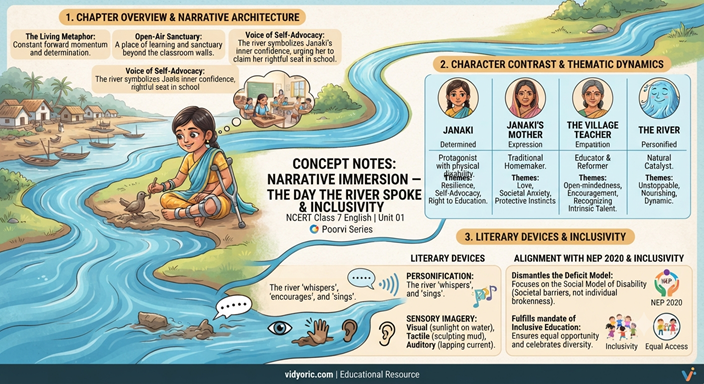
Concept Notes 1: Narrative Immersion โ€” The Day the River Spoke & Inclusivity

Figure 1.1: Sensory Perception & The World of Helen Keller

1. Chapter Overview & Narrative Architecture

In the opening chapter of NCERT Class 7 Poorvi, "The Day the River Spoke", we are introduced to Janaki, a bright, observant girl living in a seaside fishing community. Janaki experiences mobility impairment due to a physical disability, which historically restricted children from participating in formal village schooling.

However, rather than succumbing to isolation, Janaki cultivates a deep, empathetic connection with her natural environmentโ€”specifically the local river. The river serves as:

  1. A Living Metaphor: The river represents constant forward momentum. Just as water carves its way through solid rock and navigates around boulders without halting, human determination can overcome structural and social barriers.
  2. An Open-Air Sanctuary: While the village children study inside the four walls of the school, Janaki discovers the ecosystem of the riverโ€”the iridescent scales of swimming fish, the fine alluvial mud ideal for sculpting, and the shifting tides.
  3. The Voice of Self-Advocacy: The title The Day the River Spoke is symbolic. The river's voice is the external manifestation of Janaki's awakened self-confidence, urging her to speak to the village schoolmaster and claim her rightful seat in the classroom.

2. Character Contrast & Thematic Dynamics

CharacterSocial RoleKey Traits & MotivationsPedagogical Significance
JanakiYoung Protagonist with physical disabilityObservant, determined, artistic, deeply connected to natureEmbodies resilience, self-advocacy, and the right to education regardless of physical ability.
Janaki's MotherTraditional homemakerLoving, protective, anxious about societal prejudiceReflects the protective instincts of parents who fear their differently-abled children will face ridicule.
The Village TeacherEducator & ReformerOpen-minded, observant, encouraging, empatheticDemonstrates the role of an ideal teacher who recognizes intrinsic talent rather than superficial limitations.
The RiverNatural Element (Personified)Unstoppable, vocal, nourishing, dynamicServes as the literary catalyst for Janaki's inner transformation and courage.

3. Literary Devices & Stylistic Analysis

  • Personification: The river is endowed with human attributesโ€”it "whispers", "encourages", and "sings". This device blurs the boundary between human consciousness and ecological vitality.
  • Sensory Imagery:
  • Tactile: "The cool, squelching river mud slipping between her fingers."
  • Visual: "Sunlight dancing in golden diamonds upon the rippling water."
  • Auditory: "The rhythmic lapping of the current against the weathered wooden canoe."
  • Internal Monologue: The author uses Janakiโ€™s internal thoughts to convey her silent yearnings, making her triumph deeply relatable and emotionally resonant.

4. Alignment with National Education Policy (NEP 2020) & Inclusivity

The selection of this chapter in Poorvi directly fulfills the mandate of inclusive education. It dismantles the deficit model of disabilityโ€”where the individual is viewed as "broken"โ€”and replaces it with the social model, where barriers exist in societal attitudes and physical infrastructure, not in the child's potential.

๐Ÿ“
Comprehensive High-Yield Mathematical Relations & Theorems

Complete step-by-step derivations, step traps, and LaTeX formula sheet breakdowns...

๐Ÿ”’

End of Free Notes Preview

Unlock the complete deck to access full LaTeX formula breakdowns, interactive diagrams, exam traps, and personal margin highlights!

๐Ÿ”‘ Sign In / Register Free
๐Ÿง  Review Due (Interval: 1 Day) Card 1 of 8 (SM-2 Active Recall)
QUESTION (FRONT) Space โ†ต to flip
Who is Janaki and what primary obstacle did she confront in "The Day the River Spoke"?
ANSWER & EXPLANATION (BACK) Space โ†ต to flip
Janaki is a curious, observant girl from a seaside fishing village who lives with a mobility impairment (physical disability). Her obstacle was being excluded from school because of societal hesitation and physical access barriers.
๐Ÿ’ก
Tap Card to Flip & Check Your Answer Active recall prompt: Flip the card or press Space โ†ต to unlock the SM-2 recall difficulty rating.
๐Ÿ”’
Step 4 is Locked

Final Comprehensive Diagnostic Assessment (15 MCQs)

This ๐Ÿ“ LaTeX Concept Notes is part of the full verified curriculum for Unit 1: Learning Together โ€” Empathy, Resilience & Sensory Discovery. Unlock the full deck to gain permanent access to all 11 interactive stages, active recall cards, and diagnostic checkpoints.

Deck Access Price
100% Free with Account
Instant Access
โœ“ UPI & Cards Supported
๐Ÿ”‘ Sign In / Register to Unlock Free →
๐Ÿ”’
Step 5 is Locked

Final Comprehensive Diagnostic Assessment (15 MCQs)

This โšก Diagnostic Quiz is part of the full verified curriculum for Unit 1: Learning Together โ€” Empathy, Resilience & Sensory Discovery. Unlock the full deck to gain permanent access to all 11 interactive stages, active recall cards, and diagnostic checkpoints.

Deck Access Price
100% Free with Account
Instant Access
โœ“ UPI & Cards Supported
๐Ÿ”‘ Sign In / Register to Unlock Free →
๐Ÿ”’
Step 6 is Locked

Final Comprehensive Diagnostic Assessment (15 MCQs)

This Microlearning Step is part of the full verified curriculum for Unit 1: Learning Together โ€” Empathy, Resilience & Sensory Discovery. Unlock the full deck to gain permanent access to all 11 interactive stages, active recall cards, and diagnostic checkpoints.

Deck Access Price
100% Free with Account
Instant Access
โœ“ UPI & Cards Supported
๐Ÿ”‘ Sign In / Register to Unlock Free →
๐Ÿ”’
Step 7 is Locked

Final Comprehensive Diagnostic Assessment (15 MCQs)

This ๐ŸŽฅ Video Lesson is part of the full verified curriculum for Unit 1: Learning Together โ€” Empathy, Resilience & Sensory Discovery. Unlock the full deck to gain permanent access to all 11 interactive stages, active recall cards, and diagnostic checkpoints.

Deck Access Price
100% Free with Account
Instant Access
โœ“ UPI & Cards Supported
๐Ÿ”‘ Sign In / Register to Unlock Free →
๐Ÿ”’
Step 8 is Locked

Final Comprehensive Diagnostic Assessment (15 MCQs)

This ๐Ÿ“ LaTeX Concept Notes is part of the full verified curriculum for Unit 1: Learning Together โ€” Empathy, Resilience & Sensory Discovery. Unlock the full deck to gain permanent access to all 11 interactive stages, active recall cards, and diagnostic checkpoints.

Deck Access Price
100% Free with Account
Instant Access
โœ“ UPI & Cards Supported
๐Ÿ”‘ Sign In / Register to Unlock Free →
๐Ÿ”’
Step 9 is Locked

Final Comprehensive Diagnostic Assessment (15 MCQs)

This ๐Ÿง  Active Recall Flashcards is part of the full verified curriculum for Unit 1: Learning Together โ€” Empathy, Resilience & Sensory Discovery. Unlock the full deck to gain permanent access to all 11 interactive stages, active recall cards, and diagnostic checkpoints.

Deck Access Price
100% Free with Account
Instant Access
โœ“ UPI & Cards Supported
๐Ÿ”‘ Sign In / Register to Unlock Free →
๐Ÿ”’
Step 10 is Locked

Final Comprehensive Diagnostic Assessment (15 MCQs)

This ๐Ÿ“ LaTeX Concept Notes is part of the full verified curriculum for Unit 1: Learning Together โ€” Empathy, Resilience & Sensory Discovery. Unlock the full deck to gain permanent access to all 11 interactive stages, active recall cards, and diagnostic checkpoints.

Deck Access Price
100% Free with Account
Instant Access
โœ“ UPI & Cards Supported
๐Ÿ”‘ Sign In / Register to Unlock Free →
๐Ÿ”’
Step 11 is Locked

Final Comprehensive Diagnostic Assessment (15 MCQs)

This โšก Diagnostic Quiz is part of the full verified curriculum for Unit 1: Learning Together โ€” Empathy, Resilience & Sensory Discovery. Unlock the full deck to gain permanent access to all 11 interactive stages, active recall cards, and diagnostic checkpoints.

Deck Access Price
100% Free with Account
Instant Access
โœ“ UPI & Cards Supported
๐Ÿ”‘ Sign In / Register to Unlock Free →