Unit 2: Wit and Humour โ€” Dr. Dolittle, Playful Rhymes & Verbal Wit
๐Ÿ‡ฎ๐Ÿ‡ณ National Curriculum Standard โ–พ
๐Ÿ› Vidyoric Certified โ€ข Prof. Priya Nair
๐Ÿ”ฅ 0 days
โšก 0 Sparks +
Unit 2: Wit and Humour โ€” Dr. Dolittle, Playful Rhymes & Verbal Wit

Video Lecture 1: Polynesiaโ€™s Secret โ€” How Dr. Dolittle Learned Animal Speech

STEP 1: VIDEO LESSON ๐Ÿ“ค Uploaded HTML5 Video

๐Ÿ“‘ Interactive Chapter Bookmarks

3 chapters
00:00
Introduction & Overview

Syllabus scope and core objectives

โ–ถ
01:55
Scolar

Detailed physical mechanism and derivations

โ–ถ
03:38
Bird A B C

High-yield board tips and pitfalls

โ–ถ

๐ŸŽ™๏ธ Synchronized Transcript

๐Ÿ”
Hello, literary explorers!

What if a twitch of a dog's ear was not just a movement, but a meaningful message? What if a cat rubbing against your ankle was actually trying to communicate something important?

Welcome to Unit 2, *Wit and Humour*. In this unit, we enter the fascinating world of Hugh Lofting's famous character, Dr. John Dolittle, a doctor who lives in Puddleby-on-the-Marsh.

Dr. Dolittle loves animals so much that he gradually loses his human patients. Why? Because his house is filled with animals! Hedgehogs rest in his armchair, and mice make their homes in his coat pockets.

But everything changes when his clever parrot, Polynesia, reveals an interesting secret: animals have their own language. They do not speak English; they communicate in their own special ways.

## Story Breakdown: The Porridge Pot Lesson

Let us understand how Hugh Lofting uses humour in this story.

The humour does not come from making fun of others. Instead, it comes from kindness, imagination, and looking at ordinary things from an unusual point of view.

Polynesia explains to Dr. Dolittle that animals communicate through different movements and expressions.

For example, she tells him that when a dog twitches the upper corner of its left eyebrow, it may be communicating something like, "Can't you see it has stopped raining?"

Dr. Dolittle is surprised. He wonders how such a small movement can express so much meaning.

Polynesia explains that dogs do not communicate only through sounds. They use their ears, noses, tails, whiskers, and even the way they tilt their heads.

She also humorously suggests that humans make a great deal of noise just to say something as simple as good morning!

This conversation surprises Dr. Dolittle and changes the way he looks at animals.

It also teaches us an important lesson: communication is not limited to spoken words. Animals can express themselves through movements, sounds, and behaviour.

## Understanding Wit and Humour

Now, let us explore how the author creates humour in this story.

Wit means the ability to express clever ideas through sharp observation, intelligent remarks, and unexpected responses.

It is different from slapstick humour, which usually involves physical actions, accidents, or funny situations.

Hugh Lofting uses three interesting techniques.

First, **incongruity**.

Incongruity means something unusual or unexpected that creates humour.

Imagine a respected doctor sitting on the floor, carefully writing down the sounds and movements explained by a parrot. This unusual situation makes the story amusing.

Second, **animal communication and expressions**.

The author gives special importance to the ways animals communicate. Their movements are presented as meaningful messages, making us think differently about the animal world.

Third, **dialogue and comic timing**.

Notice how Dr. Dolittle asks short questions because he is surprised by Polynesia's explanations. Polynesia responds confidently and humorously.

These quick questions and unexpected answers make the conversation entertaining.

Through these techniques, the author combines intelligence, imagination, and humour to make the story enjoyable.

## Summary and Active Recall

Let us quickly revise what we have learned.

We met Dr. John Dolittle, a doctor who loves animals and gradually becomes more interested in understanding them.

We discovered how Polynesia teaches him that animals communicate through sounds, movements, and expressions.

We also explored the meaning of wit and humour and understood how incongruity, clever dialogue, and unexpected situations make a story entertaining.

Before moving to the conceptual notes in Step 2, think about this question:

**Why did Dr. Dolittle give up treating human patients?**

Try to answer in your own words by remembering his love for animals and the unusual situation in his house.

In our next lesson, we will explore Dr. Dolittle's animal language, the humorous verses of *A Funny Man*, and the role of situational comedy in *Say the Right Thing*.

Keep your pens ready, and let's continue exploring the joyful art of laughter!
STEP 2 โ€ข CONCEPT NOTES โฑ๏ธ 3 min read
๐Ÿ“Œ 0 Notes

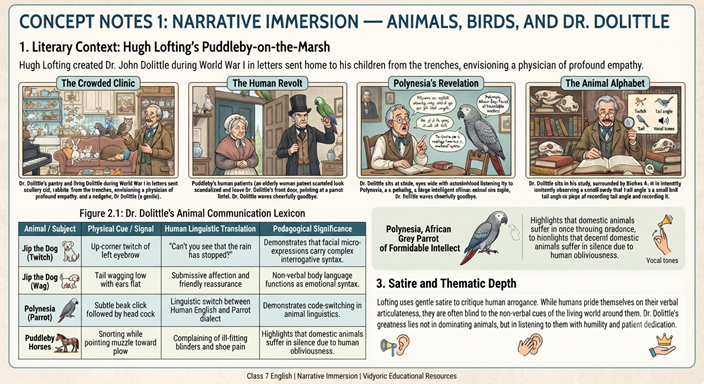
Concept Notes 1: Narrative Immersion โ€” Animals, Birds, and Dr. Dolittle

Figure 2.1: Dr. Dolittle's Animal Communication Lexicon

1. Literary Context: Hugh Loftingโ€™s Puddleby-on-the-Marsh

Hugh Lofting originally created Dr. John Dolittle during World War I in illustrated letters sent home to his children from the trenches of Flanders. Faced with the horrors of industrial warfare, Lofting envisioned a gentle, eccentric physician whose profound empathy embraced all living species.

In Animals, Birds, and Dr. Dolittle, we witness Dr. Dolittle's transformation from an ordinary village doctor into the world's first Animal Linguist and Physician.

Key Narrative Milestones
  1. The Crowded Clinic: Dr. Dolittleโ€™s pantry, sitting room, and garden are overrun with domestic and wild creaturesโ€”goldfish in the scullery, rabbits in the pantry, white mice in his piano, and a hedgehog asleep on the sofa.
  2. The Human Revolt: Puddleby's human patients, alienated by the eccentric animal presence, desert him. His practice collapses financially, yet Dr. Dolittle remains calm and cheerful.
  3. Polynesiaโ€™s Revelation: Polynesia, an African Grey parrot of formidable intellect and multilingual fluency, reveals that animals possess intricate communicative languages composed of sounds, gestures, scent cues, and posture changes.
  4. The Animal Alphabet: Dr. Dolittle sits with his dictionary and notebook, recording the meanings of subtle animal twitches, tail angles, and vocal tones.

2. The Mechanics of Animal Language (Polynesiaโ€™s Lexicon)

Animal / SubjectPhysical Cue / SignalHuman Linguistic TranslationPedagogical Significance
Jip the DogUp-corner twitch of left eyebrow"Can't you see that the rain has stopped?"Demonstrates that facial micro-expressions carry complex interrogative syntax.
Jip the DogTail wagging low with ears flatSubmissive affection and friendly reassuranceNon-verbal body language functions as emotional syntax.
Polynesia (Parrot)Subtle beak click followed by head cockLinguistic switch between Human English and Parrot dialectDemonstrates code-switching in animal linguistics.
Puddleby HorsesSnorting while pointing muzzle toward plowComplaining of ill-fitting blinders and shoe painHighlights that domestic animals suffer in silence due to human obliviousness.

3. Satire and Thematic Depth

Lofting uses gentle satire to critique human arrogance. While humans pride themselves on their verbal articulateness, they are often blind to the non-verbal cues of the living world around them. Dr. Dolittle's greatness lies not in dominating animals, but in listening to them with humility and patient dedication.

๐Ÿ“
Comprehensive High-Yield Mathematical Relations & Theorems

Complete step-by-step derivations, step traps, and LaTeX formula sheet breakdowns...

๐Ÿ”’

End of Free Notes Preview

Unlock the complete deck to access full LaTeX formula breakdowns, interactive diagrams, exam traps, and personal margin highlights!

๐Ÿ”‘ Sign In / Register Free
๐Ÿง  Review Due (Interval: 1 Day) Card 1 of 8 (SM-2 Active Recall)
QUESTION (FRONT) Space โ†ต to flip
Who is Dr. John Dolittle and where does he reside in Hugh Loftingโ€™s story?
ANSWER & EXPLANATION (BACK) Space โ†ต to flip
Dr. John Dolittle is an eccentric, kind-hearted English medical doctor who resides in the small town of Puddleby-on-the-Marsh.
๐Ÿ’ก
Tap Card to Flip & Check Your Answer Active recall prompt: Flip the card or press Space โ†ต to unlock the SM-2 recall difficulty rating.
๐Ÿ”’
Step 4 is Locked

Final Comprehensive Diagnostic Assessment (15 MCQs)

This ๐Ÿ“ LaTeX Concept Notes is part of the full verified curriculum for Unit 2: Wit and Humour โ€” Dr. Dolittle, Playful Rhymes & Verbal Wit. Unlock the full deck to gain permanent access to all 11 interactive stages, active recall cards, and diagnostic checkpoints.

Deck Access Price
100% Free with Account
Instant Access
โœ“ UPI & Cards Supported
๐Ÿ”‘ Sign In / Register to Unlock Free →
๐Ÿ”’
Step 5 is Locked

Final Comprehensive Diagnostic Assessment (15 MCQs)

This โšก Diagnostic Quiz is part of the full verified curriculum for Unit 2: Wit and Humour โ€” Dr. Dolittle, Playful Rhymes & Verbal Wit. Unlock the full deck to gain permanent access to all 11 interactive stages, active recall cards, and diagnostic checkpoints.

Deck Access Price
100% Free with Account
Instant Access
โœ“ UPI & Cards Supported
๐Ÿ”‘ Sign In / Register to Unlock Free →
๐Ÿ”’
Step 6 is Locked

Final Comprehensive Diagnostic Assessment (15 MCQs)

This Microlearning Step is part of the full verified curriculum for Unit 2: Wit and Humour โ€” Dr. Dolittle, Playful Rhymes & Verbal Wit. Unlock the full deck to gain permanent access to all 11 interactive stages, active recall cards, and diagnostic checkpoints.

Deck Access Price
100% Free with Account
Instant Access
โœ“ UPI & Cards Supported
๐Ÿ”‘ Sign In / Register to Unlock Free →
๐Ÿ”’
Step 7 is Locked

Final Comprehensive Diagnostic Assessment (15 MCQs)

This ๐ŸŽฅ Video Lesson is part of the full verified curriculum for Unit 2: Wit and Humour โ€” Dr. Dolittle, Playful Rhymes & Verbal Wit. Unlock the full deck to gain permanent access to all 11 interactive stages, active recall cards, and diagnostic checkpoints.

Deck Access Price
100% Free with Account
Instant Access
โœ“ UPI & Cards Supported
๐Ÿ”‘ Sign In / Register to Unlock Free →
๐Ÿ”’
Step 8 is Locked

Final Comprehensive Diagnostic Assessment (15 MCQs)

This ๐Ÿ“ LaTeX Concept Notes is part of the full verified curriculum for Unit 2: Wit and Humour โ€” Dr. Dolittle, Playful Rhymes & Verbal Wit. Unlock the full deck to gain permanent access to all 11 interactive stages, active recall cards, and diagnostic checkpoints.

Deck Access Price
100% Free with Account
Instant Access
โœ“ UPI & Cards Supported
๐Ÿ”‘ Sign In / Register to Unlock Free →
๐Ÿ”’
Step 9 is Locked

Final Comprehensive Diagnostic Assessment (15 MCQs)

This ๐Ÿง  Active Recall Flashcards is part of the full verified curriculum for Unit 2: Wit and Humour โ€” Dr. Dolittle, Playful Rhymes & Verbal Wit. Unlock the full deck to gain permanent access to all 11 interactive stages, active recall cards, and diagnostic checkpoints.

Deck Access Price
100% Free with Account
Instant Access
โœ“ UPI & Cards Supported
๐Ÿ”‘ Sign In / Register to Unlock Free →
๐Ÿ”’
Step 10 is Locked

Final Comprehensive Diagnostic Assessment (15 MCQs)

This ๐Ÿ“ LaTeX Concept Notes is part of the full verified curriculum for Unit 2: Wit and Humour โ€” Dr. Dolittle, Playful Rhymes & Verbal Wit. Unlock the full deck to gain permanent access to all 11 interactive stages, active recall cards, and diagnostic checkpoints.

Deck Access Price
100% Free with Account
Instant Access
โœ“ UPI & Cards Supported
๐Ÿ”‘ Sign In / Register to Unlock Free →
๐Ÿ”’
Step 11 is Locked

Final Comprehensive Diagnostic Assessment (15 MCQs)

This โšก Diagnostic Quiz is part of the full verified curriculum for Unit 2: Wit and Humour โ€” Dr. Dolittle, Playful Rhymes & Verbal Wit. Unlock the full deck to gain permanent access to all 11 interactive stages, active recall cards, and diagnostic checkpoints.

Deck Access Price
100% Free with Account
Instant Access
โœ“ UPI & Cards Supported
๐Ÿ”‘ Sign In / Register to Unlock Free →