Chapter 6: Number Play
๐Ÿ‡ฎ๐Ÿ‡ณ National Curriculum Standard โ–พ
๐Ÿ› Vidyoric Certified โ€ข Prof. Arvind Swaminathan
๐Ÿ”ฅ 0 days
โšก 0 Sparks +
Chapter 6: Number Play

Video Lecture 1: Numbers at Play โ€” The Symmetry of Parity and Divisibility

STEP 1: VIDEO LESSON ๐Ÿ“ค Uploaded HTML5 Video

๐Ÿ“‘ Interactive Chapter Bookmarks

6 chapters
00:00
Introduction & Overview

Syllabus scope and core objectives

โ–ถ
00:46
The Drama Of Numbers

Detailed physical mechanism and derivations

โ–ถ
02:05
The Parity Puzzle

High-yield board tips and pitfalls

โ–ถ
03:58
Magic Square Mystery
โ–ถ
05:24
Letter Arithmetic
โ–ถ
06:26
Master Math Puzzle
โ–ถ

๐ŸŽ™๏ธ Synchronized Transcript

๐Ÿ”
Welcome, puzzle masters!

Have you ever wondered why numbers behave like characters in a drama? Some numbers love working in pairs, while others always leave someone standing alone.

Let us discover this interesting behaviour through a simple coin game.

Imagine that we have a collection of coins. We arrange them into groups of two.

Look at even numbers: two, four, six, eight, and so on.

Every coin has a partner. Nothing is left alone. All the coins form perfect pairs.

Now, let us consider odd numbers: one, three, five, seven, and so on.

When we arrange these coins into pairs, there is always one coin left without a partner.

This is the fundamental difference between odd and even numbers.

But here comes an interesting question.

What happens when we add two odd numbers?

Imagine that we have two groups of odd numbers. Each group has one coin left without a partner.

When we bring these two unpaired coins together, they form a new pair!

That is why the sum of two odd numbers is always even.

In mathematical language, odd plus odd equals even.

This is not magic. It is the beautiful structural symmetry of mathematics!

Now, let us move towards another important mathematical discovery: the secret behind divisibility tests.

In earlier classes, you learned a useful trick. To check whether a number is divisible by three or nine, simply add its digits.

For example, consider the number three hundred and forty-two.

Add its digits: three plus four plus two equals nine.

Since nine is divisible by nine, three hundred and forty-two is also divisible by nine.

But have you ever wondered why this shortcut works?

Let us uncover the mathematical reasoning behind it.

Our number system is based on ten.

We can express three hundred and forty-two as three multiplied by one hundred, plus four multiplied by ten, plus two.

In mathematical form, this becomes three times one hundred, plus four times ten, plus two.

Now, observe something interesting.

One hundred can be written as ninety-nine plus one.

Similarly, ten can be written as nine plus one.

Why are these expressions useful?

Because ninety-nine and nine are both multiples of nine.

Let us substitute these values into our original expression.

We get three multiplied by ninety-nine plus one, then four multiplied by nine plus one, and finally two.

After expanding the expression, we get three times ninety-nine, plus four times nine, plus three, plus four, plus two.

Now, separate these terms into two groups.

The first group contains three times ninety-nine and four times nine. Both are multiples of nine. Therefore, their sum is also a multiple of nine.

What remains?

Only three plus four plus two, which equals nine!

This proves that the divisibility of three hundred and forty-two by nine depends on the sum of its digits.

That is the mathematical reason behind the divisibility rule of nine.

The same reasoning also explains the divisibility rule of three, because nine is itself divisible by three.

Remember, young mathematicians, we do not simply memorize mathematical rules. We understand the reasoning and uncover the proofs behind them.

Now, let us enter another exciting world of mathematical puzzles: cryptarithms.

In a cryptarithm, letters hide secret numerical values. Each distinct letter represents a unique digit from zero to nine.

Your challenge is to discover the hidden digits using logical reasoning.

Consider this interesting puzzle:

A plus A plus A equals B A.

This means that three times A gives us a two-digit number whose units digit is also A.

In other words, three multiplied by A must end in the same digit A.

Which digit could satisfy this condition?

Let us test five.

Three multiplied by five equals fifteen.

Look carefully! The units digit is five, and the tens digit is one.

Therefore, A equals five, and B equals one.

Our cryptarithm is solved!

Five plus five plus five equals fifteen.

Solving cryptarithms requires careful observation of carry-overs, odd and even patterns, and the final digits of numbers.

Think like a mathematical detective. Every digit gives you a clue!

These puzzles develop logical thinking and problem-solving skills, which are also useful in computer programming.

Now, let us look at our learning roadmap for Chapter Six: Number Play.

We will explore four important stages.

First, parity mathematics, where we understand the properties of odd and even numbers.

Second, divisibility proofs, where we discover why mathematical shortcuts work.

Third, cryptarithms and digit puzzles, where we decode hidden numbers using logical reasoning.

And finally, diagnostic mastery, where we test our understanding through questions and problem-solving activities.

Remember, numbers are not just symbols used for counting. They have patterns, relationships, rhythm, and deep logical beauty.

So, sharpen your mathematical thinking, stay curious, and get ready to discover more.

Let us begin with Concept Notes One!

Thank you, young mathematicians!
STEP 2 โ€ข CONCEPT NOTES โฑ๏ธ 3 min read
๐Ÿ“Œ 0 Notes

Concept Notes 1: The Mathematics of Parity โ€” Even & Odd Numbers

Parity is the mathematical property of an integer being either even or odd. Understanding parity rules provides powerful short-cuts for solving complex numerical problems.
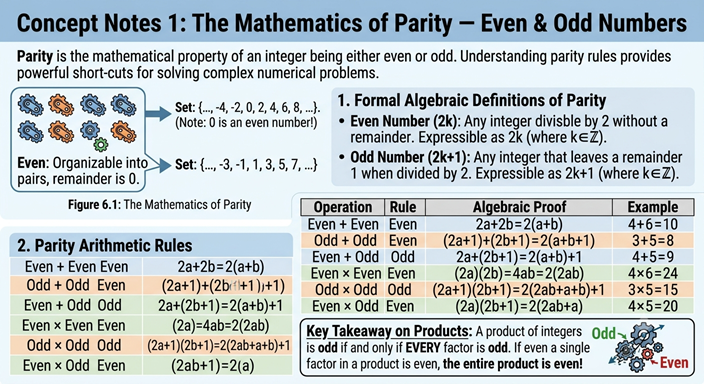
Figure 6.1: The Mathematics of Parity


1. Formal Algebraic Definitions of Parity

  • Even Number ($2k$): Any integer divisible by $2$ without a remainder. Expressible as $2k$ (where $k \in \mathbb{Z}$).

Set: $\{\dots, -4, -2, 0, 2, 4, 6, 8, \dots\}$. (Note: $0$ is an even number!)

  • Odd Number ($2k + 1$): Any integer that leaves a remainder of $1$ when divided by $2$. Expressible as $2k + 1$ (where $k \in \mathbb{Z}$).

Set: $\{\dots, -3, -1, 1, 3, 5, 7, \dots\}$.


2. Parity Arithmetic Rules

OperationRuleAlgebraic ProofExample
Even + EvenEven$2a + 2b = 2(a + b)$$4 + 6 = 10$
Odd + OddEven$(2a + 1) + (2b + 1) = 2(a + b + 1)$$3 + 5 = 8$
Even + OddOdd$2a + (2b + 1) = 2(a + b) + 1$$4 + 5 = 9$
Even $\times$ EvenEven$(2a)(2b) = 4ab = 2(2ab)$$4 \times 6 = 24$
Odd $\times$ OddOdd$(2a + 1)(2b + 1) = 2(2ab + a + b) + 1$$3 \times 5 = 15$
Even $\times$ OddEven$(2a)(2b + 1) = 2(2ab + a)$$4 \times 5 = 20$
Key Takeaway on Products: A product of integers is odd if and only if EVERY factor is odd. If even a single factor in a product is even, the entire product is even!
๐Ÿ“
Comprehensive High-Yield Mathematical Relations & Theorems

Complete step-by-step derivations, step traps, and LaTeX formula sheet breakdowns...

๐Ÿ”’

End of Free Notes Preview

Unlock the complete deck to access full LaTeX formula breakdowns, interactive diagrams, exam traps, and personal margin highlights!

๐Ÿ”‘ Sign In / Register Free
๐Ÿง  Review Due (Interval: 1 Day) Card 1 of 8 (SM-2 Active Recall)
QUESTION (FRONT) Space โ†ต to flip
What is the parity of the sum of two odd numbers?
ANSWER & EXPLANATION (BACK) Space โ†ต to flip
Even. (2a + 1) + (2b + 1) = 2(a + b + 1).
๐Ÿ’ก
Tap Card to Flip & Check Your Answer Active recall prompt: Flip the card or press Space โ†ต to unlock the SM-2 recall difficulty rating.
๐Ÿ”’
Step 4 is Locked

Final Comprehensive Diagnostic Assessment (15 MCQs)

This ๐Ÿ“ LaTeX Concept Notes is part of the full verified curriculum for Chapter 6: Number Play. Unlock the full deck to gain permanent access to all 11 interactive stages, active recall cards, and diagnostic checkpoints.

Deck Access Price
100% Free with Account
Instant Access
โœ“ UPI & Cards Supported
๐Ÿ”‘ Sign In / Register to Unlock Free →
๐Ÿ”’
Step 5 is Locked

Final Comprehensive Diagnostic Assessment (15 MCQs)

This โšก Diagnostic Quiz is part of the full verified curriculum for Chapter 6: Number Play. Unlock the full deck to gain permanent access to all 11 interactive stages, active recall cards, and diagnostic checkpoints.

Deck Access Price
100% Free with Account
Instant Access
โœ“ UPI & Cards Supported
๐Ÿ”‘ Sign In / Register to Unlock Free →
๐Ÿ”’
Step 6 is Locked

Final Comprehensive Diagnostic Assessment (15 MCQs)

This Microlearning Step is part of the full verified curriculum for Chapter 6: Number Play. Unlock the full deck to gain permanent access to all 11 interactive stages, active recall cards, and diagnostic checkpoints.

Deck Access Price
100% Free with Account
Instant Access
โœ“ UPI & Cards Supported
๐Ÿ”‘ Sign In / Register to Unlock Free →
๐Ÿ”’
Step 7 is Locked

Final Comprehensive Diagnostic Assessment (15 MCQs)

This ๐ŸŽฅ Video Lesson is part of the full verified curriculum for Chapter 6: Number Play. Unlock the full deck to gain permanent access to all 11 interactive stages, active recall cards, and diagnostic checkpoints.

Deck Access Price
100% Free with Account
Instant Access
โœ“ UPI & Cards Supported
๐Ÿ”‘ Sign In / Register to Unlock Free →
๐Ÿ”’
Step 8 is Locked

Final Comprehensive Diagnostic Assessment (15 MCQs)

This ๐Ÿ“ LaTeX Concept Notes is part of the full verified curriculum for Chapter 6: Number Play. Unlock the full deck to gain permanent access to all 11 interactive stages, active recall cards, and diagnostic checkpoints.

Deck Access Price
100% Free with Account
Instant Access
โœ“ UPI & Cards Supported
๐Ÿ”‘ Sign In / Register to Unlock Free →
๐Ÿ”’
Step 9 is Locked

Final Comprehensive Diagnostic Assessment (15 MCQs)

This ๐Ÿง  Active Recall Flashcards is part of the full verified curriculum for Chapter 6: Number Play. Unlock the full deck to gain permanent access to all 11 interactive stages, active recall cards, and diagnostic checkpoints.

Deck Access Price
100% Free with Account
Instant Access
โœ“ UPI & Cards Supported
๐Ÿ”‘ Sign In / Register to Unlock Free →
๐Ÿ”’
Step 10 is Locked

Final Comprehensive Diagnostic Assessment (15 MCQs)

This ๐Ÿ“ LaTeX Concept Notes is part of the full verified curriculum for Chapter 6: Number Play. Unlock the full deck to gain permanent access to all 11 interactive stages, active recall cards, and diagnostic checkpoints.

Deck Access Price
100% Free with Account
Instant Access
โœ“ UPI & Cards Supported
๐Ÿ”‘ Sign In / Register to Unlock Free →
๐Ÿ”’
Step 11 is Locked

Final Comprehensive Diagnostic Assessment (15 MCQs)

This โšก Diagnostic Quiz is part of the full verified curriculum for Chapter 6: Number Play. Unlock the full deck to gain permanent access to all 11 interactive stages, active recall cards, and diagnostic checkpoints.

Deck Access Price
100% Free with Account
Instant Access
โœ“ UPI & Cards Supported
๐Ÿ”‘ Sign In / Register to Unlock Free →