Chapter 7: A Tale of Three Intersecting Lines
๐Ÿ‡ฎ๐Ÿ‡ณ National Curriculum Standard โ–พ
๐Ÿ› Vidyoric Certified โ€ข Prof. Arvind Swaminathan
๐Ÿ”ฅ 0 days
โšก 0 Sparks +
Chapter 7: A Tale of Three Intersecting Lines

Concept Notes 1: Core Theorems & Foundations

STEP 1 โ€ข CONCEPT NOTES โฑ๏ธ 3 min read
๐Ÿ“Œ 0 Notes

Concept Notes 1: Triangles โ€” Classification, Medians & Altitudes

A triangle is a three-sided closed rectilinear polygon formed by three line segments joining three non-collinear points.
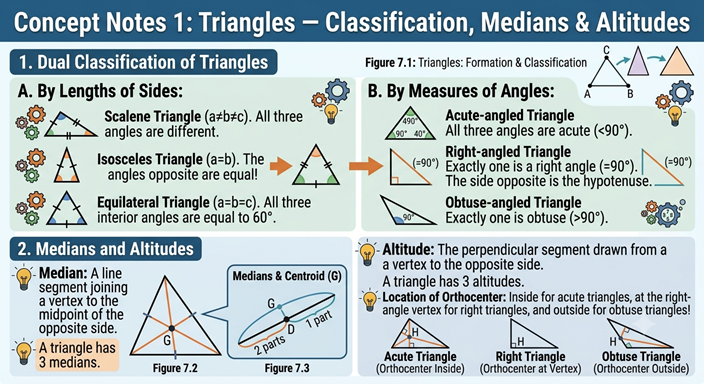
Figure 7.1: Triangles: Formation & Classification


1. Dual Classification of Triangles

A. By Lengths of Sides:
  1. Scalene Triangle: All three sides have different lengths ($a \neq b \neq c$). All three angles are also different.
  2. Isosceles Triangle: Two sides are equal in length ($a = b$). The angles opposite the equal sides are also equal!
  3. Equilateral Triangle: All three sides are equal ($a = b = c$). All three interior angles are equal to $60^\circ$.
B. By Measures of Angles:
  1. Acute-angled Triangle: All three interior angles are acute ($< 90^\circ$).
  2. Right-angled Triangle: Exactly one interior angle is a right angle ($= 90^\circ$). The side opposite is the hypotenuse.
  3. Obtuse-angled Triangle: Exactly one interior angle is obtuse ($> 90^\circ$).

2. Medians and Altitudes

  • Median: A line segment joining a vertex to the midpoint of the opposite side.
  • A triangle has 3 medians.
  • The medians intersect at a single concurrent point called the Centroid ($G$), which divides each median in the ratio $2 : 1$.
  • Altitude: The perpendicular line segment drawn from a vertex to the line containing the opposite side.
  • A triangle has 3 altitudes.
  • The altitudes intersect at a point called the Orthocenter ($H$).
  • Location of Orthocenter: Inside for acute triangles, at the right-angle vertex for right triangles, and outside for obtuse triangles!
๐Ÿ“
Comprehensive High-Yield Mathematical Relations & Theorems

Complete step-by-step derivations, step traps, and LaTeX formula sheet breakdowns...

๐Ÿ”’

End of Free Notes Preview

Unlock the complete deck to access full LaTeX formula breakdowns, interactive diagrams, exam traps, and personal margin highlights!

๐Ÿ”‘ Sign In / Register Free
STEP 2: VIDEO LESSON ๐Ÿ“ค Uploaded HTML5 Video

๐Ÿ“‘ Interactive Chapter Bookmarks

5 chapters
00:00
Introduction & Overview

Syllabus scope and core objectives

โ–ถ
01:20
The Blueprint

Detailed physical mechanism and derivations

โ–ถ
02:41
Limits Of Geometry

High-yield board tips and pitfalls

โ–ถ
04:12
The Internal Magic
โ–ถ
05:11
The Family Tree
โ–ถ

๐ŸŽ™๏ธ Synchronized Transcript

๐Ÿ”
Welcome back, young mathematicians!

Have you ever wondered why triangles are used so frequently in bridges, buildings, cranes, and other engineering structures?

Let us begin with a simple experiment.

Imagine that we have two wooden frames. One is a square frame with four sides, and the other is a triangular frame with three sides.

Now, gently push one corner of the square frame. What happens? The frame starts wobbling and changes its shape. It may even become a slanted four-sided figure called a rhombus.

But now, try pushing the triangular frame. Does it change its shape so easily? No! It remains firm and rigid.

Why does this happen?

The reason is that three fixed side lengths determine a triangle's shape. Its angles cannot change without changing the lengths of its sides.

This property makes a triangle a fundamentally rigid geometric structure.

That is why engineers use interconnected triangles in railway bridges, roof structures, construction cranes, and even aircraft wings.

Triangles provide strength, stability, and support to many structures around us.

When three straight line segments connect to form a closed figure, they create one of the most important building blocks of geometry: the triangle.

Now, let us understand how triangles are classified.

We can classify triangles in two different ways: according to their side lengths and according to their angle measurements.

First, let us classify triangles based on their sides.

A scalene triangle is a triangle in which all three sides have different lengths.

An isosceles triangle has two equal sides. An interesting property of an isosceles triangle is that the angles opposite its equal sides are also equal.

Finally, an equilateral triangle has all three sides equal in length. Since all three sides are equal, all three interior angles are also equal.

And because the sum of the interior angles of a triangle is one hundred and eighty degrees, each angle of an equilateral triangle measures exactly sixty degrees.

Now, let us classify triangles according to their angles.

An acute-angled triangle has all three interior angles smaller than ninety degrees.

A right-angled triangle has exactly one angle equal to ninety degrees.

The side opposite the right angle is called the hypotenuse. It is also the longest side of a right-angled triangle.

An obtuse-angled triangle has one interior angle greater than ninety degrees.

Now, here is an interesting question.

Can a triangle have two right angles or two obtuse angles?

The answer is no!

A triangle cannot have two right angles or two obtuse angles because the sum of its three interior angles is always one hundred and eighty degrees.

We will understand this important property through an exciting hands-on experiment.

Let us take a paper triangle and carefully cut out its three corners.

Now, place all three corners next to one another along a straight line.

Observe what happens!

The three angles fit together to form a straight angle.

And what is the measurement of a straight angle?

It is exactly one hundred and eighty degrees.

This experiment gives us a visual understanding of one of the most important properties of triangles.

The sum of the three interior angles of any triangle is always one hundred and eighty degrees.

In mathematical notation, angle A plus angle B plus angle C equals one hundred and eighty degrees.

It does not matter whether the triangle is tall, short, narrow, or wide. This property remains true for every triangle.

Later in this chapter, we will establish this result mathematically using the concept of parallel lines and geometric reasoning.

Now, let us take a look at our learning roadmap.

This chapter contains four important stages.

First, we will explore triangle anatomy, including different types of triangles, their sides, angles, vertices, altitudes, and other important elements.

Second, we will investigate the angle sum property and the exterior angle theorem to understand the relationships between interior and exterior angles.

Third, we will study the triangle inequality property, which explains the conditions required for three line segments to form a triangle.

Finally, we will test our understanding through diagnostic questions and mathematical problem-solving activities.

From understanding the geometry of altitudes to discovering the triangle inequality rule, this chapter will help us appreciate the beauty and logic of geometric structures.

Remember, mathematics is not just about memorising definitions and formulas. It is about observing patterns, performing experiments, asking questions, and proving why things work.

So, sharpen your geometric thinking and get ready for an exciting journey.

Let us begin with Concept Notes One!

Thank you, young mathematicians!
๐Ÿง  Review Due (Interval: 1 Day) Card 1 of 8 (SM-2 Active Recall)
QUESTION (FRONT) Space โ†ต to flip
What is the sum of the three interior angles of any triangle?
ANSWER & EXPLANATION (BACK) Space โ†ต to flip
180 degrees (two right angles).
๐Ÿ’ก
Tap Card to Flip & Check Your Answer Active recall prompt: Flip the card or press Space โ†ต to unlock the SM-2 recall difficulty rating.
๐Ÿ”’
Step 4 is Locked

Final Comprehensive Diagnostic Assessment (15 MCQs)

This ๐Ÿ“ LaTeX Concept Notes is part of the full verified curriculum for Chapter 7: A Tale of Three Intersecting Lines. Unlock the full deck to gain permanent access to all 11 interactive stages, active recall cards, and diagnostic checkpoints.

Deck Access Price
100% Free with Account
Instant Access
โœ“ UPI & Cards Supported
๐Ÿ”‘ Sign In / Register to Unlock Free →
๐Ÿ”’
Step 5 is Locked

Final Comprehensive Diagnostic Assessment (15 MCQs)

This โšก Diagnostic Quiz is part of the full verified curriculum for Chapter 7: A Tale of Three Intersecting Lines. Unlock the full deck to gain permanent access to all 11 interactive stages, active recall cards, and diagnostic checkpoints.

Deck Access Price
100% Free with Account
Instant Access
โœ“ UPI & Cards Supported
๐Ÿ”‘ Sign In / Register to Unlock Free →
๐Ÿ”’
Step 6 is Locked

Final Comprehensive Diagnostic Assessment (15 MCQs)

This Microlearning Step is part of the full verified curriculum for Chapter 7: A Tale of Three Intersecting Lines. Unlock the full deck to gain permanent access to all 11 interactive stages, active recall cards, and diagnostic checkpoints.

Deck Access Price
100% Free with Account
Instant Access
โœ“ UPI & Cards Supported
๐Ÿ”‘ Sign In / Register to Unlock Free →
๐Ÿ”’
Step 7 is Locked

Final Comprehensive Diagnostic Assessment (15 MCQs)

This ๐ŸŽฅ Video Lesson is part of the full verified curriculum for Chapter 7: A Tale of Three Intersecting Lines. Unlock the full deck to gain permanent access to all 11 interactive stages, active recall cards, and diagnostic checkpoints.

Deck Access Price
100% Free with Account
Instant Access
โœ“ UPI & Cards Supported
๐Ÿ”‘ Sign In / Register to Unlock Free →
๐Ÿ”’
Step 8 is Locked

Final Comprehensive Diagnostic Assessment (15 MCQs)

This ๐Ÿ“ LaTeX Concept Notes is part of the full verified curriculum for Chapter 7: A Tale of Three Intersecting Lines. Unlock the full deck to gain permanent access to all 11 interactive stages, active recall cards, and diagnostic checkpoints.

Deck Access Price
100% Free with Account
Instant Access
โœ“ UPI & Cards Supported
๐Ÿ”‘ Sign In / Register to Unlock Free →
๐Ÿ”’
Step 9 is Locked

Final Comprehensive Diagnostic Assessment (15 MCQs)

This ๐Ÿง  Active Recall Flashcards is part of the full verified curriculum for Chapter 7: A Tale of Three Intersecting Lines. Unlock the full deck to gain permanent access to all 11 interactive stages, active recall cards, and diagnostic checkpoints.

Deck Access Price
100% Free with Account
Instant Access
โœ“ UPI & Cards Supported
๐Ÿ”‘ Sign In / Register to Unlock Free →
๐Ÿ”’
Step 10 is Locked

Final Comprehensive Diagnostic Assessment (15 MCQs)

This ๐Ÿ“ LaTeX Concept Notes is part of the full verified curriculum for Chapter 7: A Tale of Three Intersecting Lines. Unlock the full deck to gain permanent access to all 11 interactive stages, active recall cards, and diagnostic checkpoints.

Deck Access Price
100% Free with Account
Instant Access
โœ“ UPI & Cards Supported
๐Ÿ”‘ Sign In / Register to Unlock Free →
๐Ÿ”’
Step 11 is Locked

Final Comprehensive Diagnostic Assessment (15 MCQs)

This โšก Diagnostic Quiz is part of the full verified curriculum for Chapter 7: A Tale of Three Intersecting Lines. Unlock the full deck to gain permanent access to all 11 interactive stages, active recall cards, and diagnostic checkpoints.

Deck Access Price
100% Free with Account
Instant Access
โœ“ UPI & Cards Supported
๐Ÿ”‘ Sign In / Register to Unlock Free →