Chapter 9: Geometric Twins
๐Ÿ‡ฎ๐Ÿ‡ณ National Curriculum Standard โ–พ
๐Ÿ› Vidyoric Certified โ€ข Prof. Arvind Swaminathan
๐Ÿ”ฅ 0 days
โšก 0 Sparks +
Chapter 9: Geometric Twins

Video Lecture 1: Carbon Copies in Geometry โ€” The Magic of Congruence

STEP 1: VIDEO LESSON ๐Ÿ“ค Uploaded HTML5 Video

๐Ÿ“‘ Interactive Chapter Bookmarks

4 chapters
00:00
Introduction & Overview

Syllabus scope and core objectives

โ–ถ
02:36
Magic Of Superposition

Detailed physical mechanism and derivations

โ–ถ
03:42
Vertex Correspondence

High-yield board tips and pitfalls

โ–ถ
05:31
Congruence Shortcuts
โ–ถ

๐ŸŽ™๏ธ Synchronized Transcript

๐Ÿ”
Welcome to Part Two of Ganita Prakash, young mathematicians!

Today, we are beginning an exciting journey into the world of geometry, where we will explore the fascinating concept of geometric twins.

Let me show you two five-hundred-rupee currency notes.

When I place one note directly over the other, observe what happens. Their corners match perfectly, their edges align, and their printed patterns occupy exactly the same positions.

Neither note is bigger or smaller than the other.

Now, think about two postage stamps from the same sheet, two biscuits from the same packet, or two keys manufactured using the same master template.

In everyday language, we call these identical copies.

But in the precise language of mathematics, we give such figures a special name.

They are called **congruent figures**!

Congruent figures have exactly the same shape and exactly the same size. We can think of them as geometric twins.

### The Method of Superposition

Now, let us understand how mathematicians define congruence.

Imagine two triangles appearing on our glassboard.

The first triangle is ABC, and the second triangle is PQR.

At first, these triangles are positioned separately.

Now, imagine moving triangle ABC through space. We can slide it, rotate it, or turn it without changing its shape or size.

Finally, we place triangle ABC directly over triangle PQR.

Observe carefully!

Vertex A perfectly covers vertex P.

Vertex B perfectly covers vertex Q.

And vertex C perfectly covers vertex R.

All three vertices match, and all the corresponding sides and angles align perfectly.

This mathematical technique is called **superposition**.

The principle is simple: If one geometric figure can be placed over another so that they cover each other completely and exactly, the two figures are congruent.

We represent congruence using a special mathematical symbol.

It looks like an equals sign with a small curved line above it.

The symbol is called the congruence symbol.

Remember its meaning: Same shape and same size!

Unlike ordinary equality, congruence tells us that two geometric figures are identical in both their shape and dimensions.

### Understanding One-to-One Correspondence

Now, let us explore an extremely important rule when writing congruence statements.

Look again at our two triangles, ABC and PQR.

We have already established the matching vertices.

A corresponds to P.

B corresponds to Q.

And C corresponds to R.

This relationship is called one-to-one correspondence.

But why is this important?

Because the order of letters in a congruence statement matters!

If vertex A matches P, vertex B matches Q, and vertex C matches R, we must write:

Triangle ABC is congruent to triangle PQR.

Notice the order carefully.

The first letter of the first triangle corresponds to the first letter of the second triangle.

The second letter corresponds to the second letter, and the third corresponds to the third.

We cannot randomly rearrange these letters.

For example, writing triangle ABC congruent to triangle QPR would indicate a different correspondence.

Now, what does this correspondence tell us?

It tells us that all matching sides and angles are equal.

Therefore, side AB equals side PQ.

Side BC equals side QR.

And side CA equals side RP.

Similarly, angle A equals angle P, angle B equals angle Q, and angle C equals angle R.

There is an important mathematical principle associated with this idea.

It is called **CPCTC**, which stands for Corresponding Parts of Congruent Triangles are Congruent.

In simple words, once we establish that two triangles are congruent, their corresponding sides and corresponding angles are automatically equal.

You do not need to prove each corresponding part separately!

### Roadmap Ahead: The Four Congruence Criteria

Now, here is an interesting question.

To prove that two triangles are congruent, do we need to measure all six parts every time?

That means three sides and three angles?

Fortunately, no!

Mathematicians have discovered that just three carefully selected measurements can be sufficient to establish triangle congruence.

These conditions are known as congruence criteria.

We will explore four important criteria in our upcoming lessons.

First, **SSS โ€“ Side-Side-Side**, where all three corresponding sides are equal.

Second, **SAS โ€“ Side-Angle-Side**, where two corresponding sides and the included angle are equal.

Third, **ASA โ€“ Angle-Side-Angle**, where two corresponding angles and the included side are equal.

And finally, **RHS โ€“ Right-angle-Hypotenuse-Side**, which applies specifically to right-angled triangles.

Each criterion provides a different mathematical method for proving that two triangles are geometric twins.

Young mathematicians, remember that congruence is not simply about two figures looking similar. It is about establishing exact equality of shape and size through mathematical reasoning.

I am Prof. Arvind Swaminathan.

Let us now move into Concept Notes One and discover the four powerful criteria of triangle congruence!
STEP 2 โ€ข CONCEPT NOTES โฑ๏ธ 3 min read
๐Ÿ“Œ 0 Notes

Concept Notes 1: The Principle of Superposition & Geometric Congruence

Two plane geometric figures are called congruent if they have the exact same shape and the exact same size.
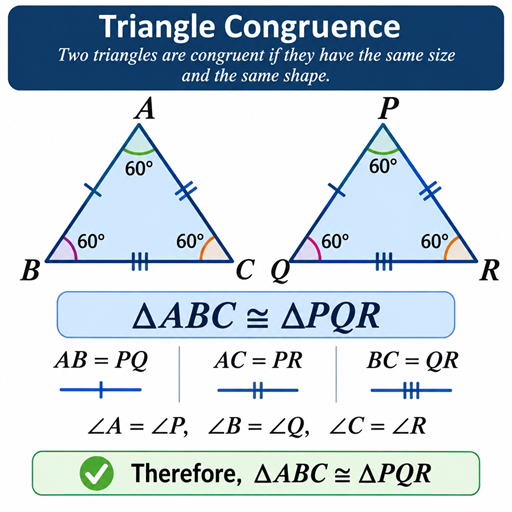
Figure 9.1: Superposition & Triangle Congruence


1. The Superposition Principle & The Congruence Symbol ($\cong$)

  • Superposition: If figure $F_1$ can be moved, rotated, or flipped so that it superimposes (covers exactly) figure $F_2$, then $F_1$ is congruent to $F_2$.
  • The Symbol $\cong$:
  • The tilde $\sim$ represents same shape.
  • The equality $=$ represents same size.
  • Combining them yields $\cong$ ("is congruent to").
Congruence in Simple Plane Figures:
  1. Line Segments: Two line segments are congruent if and only if they have the same length ($AB \cong CD \iff AB = CD$).
  2. Angles: Two angles are congruent if and only if they have the same degree measure ($\angle A \cong \angle B \iff m\angle A = m\angle B$).
  3. Circles: Two circles are congruent if and only if they have the same radius.
  4. Squares: Two squares are congruent if and only if they have the same side length.

2. Congruence of Triangles & One-to-One Correspondence

Two triangles $\triangle ABC$ and $\triangle PQR$ are congruent if their vertices can be matched in a one-to-one correspondence such that all 3 pairs of corresponding sides and all 3 pairs of corresponding angles are equal:

$$\begin{array}{ccc} \text{Vertices} & \text{Sides} & \text{Angles} \\ A \leftrightarrow P & AB = PQ & \angle A = \angle P \\ B \leftrightarrow Q & BC = QR & \angle B = \angle Q \\ C \leftrightarrow R & CA = RP & \angle C = \angle R \end{array}$$
Critical Naming Rule: The statement $\triangle ABC \cong \triangle PQR$ implies that $A$ corresponds to $P$, $B$ to $Q$, and $C$ to $R$. Writing $\triangle ABC \cong \triangle QPR$ is geometrically false unless the triangles are equilateral!
๐Ÿ“
Comprehensive High-Yield Mathematical Relations & Theorems

Complete step-by-step derivations, step traps, and LaTeX formula sheet breakdowns...

๐Ÿ”’

End of Free Notes Preview

Unlock the complete deck to access full LaTeX formula breakdowns, interactive diagrams, exam traps, and personal margin highlights!

๐Ÿ”‘ Sign In / Register Free
๐Ÿง  Review Due (Interval: 1 Day) Card 1 of 8 (SM-2 Active Recall)
QUESTION (FRONT) Space โ†ต to flip
What does it mean for two plane figures to be congruent?
ANSWER & EXPLANATION (BACK) Space โ†ต to flip
They have the exact same shape and the exact same size, superimposing on each other completely.
๐Ÿ’ก
Tap Card to Flip & Check Your Answer Active recall prompt: Flip the card or press Space โ†ต to unlock the SM-2 recall difficulty rating.
๐Ÿ”’
Step 4 is Locked

Final Comprehensive Diagnostic Assessment (15 MCQs)

This ๐Ÿ“ LaTeX Concept Notes is part of the full verified curriculum for Chapter 9: Geometric Twins. Unlock the full deck to gain permanent access to all 11 interactive stages, active recall cards, and diagnostic checkpoints.

Deck Access Price
100% Free with Account
Instant Access
โœ“ UPI & Cards Supported
๐Ÿ”‘ Sign In / Register to Unlock Free →
๐Ÿ”’
Step 5 is Locked

Final Comprehensive Diagnostic Assessment (15 MCQs)

This โšก Diagnostic Quiz is part of the full verified curriculum for Chapter 9: Geometric Twins. Unlock the full deck to gain permanent access to all 11 interactive stages, active recall cards, and diagnostic checkpoints.

Deck Access Price
100% Free with Account
Instant Access
โœ“ UPI & Cards Supported
๐Ÿ”‘ Sign In / Register to Unlock Free →
๐Ÿ”’
Step 6 is Locked

Final Comprehensive Diagnostic Assessment (15 MCQs)

This Microlearning Step is part of the full verified curriculum for Chapter 9: Geometric Twins. Unlock the full deck to gain permanent access to all 11 interactive stages, active recall cards, and diagnostic checkpoints.

Deck Access Price
100% Free with Account
Instant Access
โœ“ UPI & Cards Supported
๐Ÿ”‘ Sign In / Register to Unlock Free →
๐Ÿ”’
Step 7 is Locked

Final Comprehensive Diagnostic Assessment (15 MCQs)

This ๐ŸŽฅ Video Lesson is part of the full verified curriculum for Chapter 9: Geometric Twins. Unlock the full deck to gain permanent access to all 11 interactive stages, active recall cards, and diagnostic checkpoints.

Deck Access Price
100% Free with Account
Instant Access
โœ“ UPI & Cards Supported
๐Ÿ”‘ Sign In / Register to Unlock Free →
๐Ÿ”’
Step 8 is Locked

Final Comprehensive Diagnostic Assessment (15 MCQs)

This ๐Ÿ“ LaTeX Concept Notes is part of the full verified curriculum for Chapter 9: Geometric Twins. Unlock the full deck to gain permanent access to all 11 interactive stages, active recall cards, and diagnostic checkpoints.

Deck Access Price
100% Free with Account
Instant Access
โœ“ UPI & Cards Supported
๐Ÿ”‘ Sign In / Register to Unlock Free →
๐Ÿ”’
Step 9 is Locked

Final Comprehensive Diagnostic Assessment (15 MCQs)

This ๐Ÿง  Active Recall Flashcards is part of the full verified curriculum for Chapter 9: Geometric Twins. Unlock the full deck to gain permanent access to all 11 interactive stages, active recall cards, and diagnostic checkpoints.

Deck Access Price
100% Free with Account
Instant Access
โœ“ UPI & Cards Supported
๐Ÿ”‘ Sign In / Register to Unlock Free →
๐Ÿ”’
Step 10 is Locked

Final Comprehensive Diagnostic Assessment (15 MCQs)

This ๐Ÿ“ LaTeX Concept Notes is part of the full verified curriculum for Chapter 9: Geometric Twins. Unlock the full deck to gain permanent access to all 11 interactive stages, active recall cards, and diagnostic checkpoints.

Deck Access Price
100% Free with Account
Instant Access
โœ“ UPI & Cards Supported
๐Ÿ”‘ Sign In / Register to Unlock Free →
๐Ÿ”’
Step 11 is Locked

Final Comprehensive Diagnostic Assessment (15 MCQs)

This โšก Diagnostic Quiz is part of the full verified curriculum for Chapter 9: Geometric Twins. Unlock the full deck to gain permanent access to all 11 interactive stages, active recall cards, and diagnostic checkpoints.

Deck Access Price
100% Free with Account
Instant Access
โœ“ UPI & Cards Supported
๐Ÿ”‘ Sign In / Register to Unlock Free →