Chapter 10: Operations with Integers
๐Ÿ‡ฎ๐Ÿ‡ณ National Curriculum Standard โ–พ
๐Ÿ› Vidyoric Certified โ€ข Prof. Arvind Swaminathan
๐Ÿ”ฅ 0 days
โšก 0 Sparks +
Chapter 10: Operations with Integers

Video Lecture 1: Facing Both Directions โ€” The Physics of Negative Numbers

STEP 1: VIDEO LESSON ๐Ÿ“ค Uploaded HTML5 Video

๐Ÿ“‘ Interactive Chapter Bookmarks

6 chapters
00:00
Introduction & Overview

Syllabus scope and core objectives

โ–ถ
00:21
Rakesh's Puzzle

Detailed physical mechanism and derivations

โ–ถ
01:42
Carrom Coin Intergers

High-yield board tips and pitfalls

โ–ถ
02:39
Multiplication
โ–ถ
03:57
Finding The pattern
โ–ถ
05:33
The Rules
โ–ถ

๐ŸŽ™๏ธ Synchronized Transcript

๐Ÿ”
Hello, students! Welcome to our mathematics class.

Today, we are going to explore an interesting topic: Integers and their operations.

Have you ever wondered how we represent something that is below zero? For example, a temperature below zero, money owed to someone, or a submarine moving deep beneath the ocean?

We use negative numbers to represent these situations.

Let's understand how positive and negative numbers work in our everyday lives.

### Scene 1: The Mountain and the Submarine

Imagine that we are looking at a picture of the Earth, showing mountains above sea level and the deep ocean below sea level.

First, let's understand the meaning of zero.

We consider sea level as zero.

Anything above sea level is represented by a positive number.

For example, Mount Everest is approximately 8,848 metres above sea level. We represent this elevation as plus 8,848 metres.

Now, think about a research submarine exploring deep underwater.

Suppose the submarine is 400 metres below sea level.

Since it is below sea level, we represent its position as minus 400 metres.

So, positive numbers represent positions above sea level, while negative numbers represent positions below sea level.

Let's consider some more examples.

Imagine you deposit 1,000 rupees into your bank account. This is a positive amount, represented as plus 1,000.

But suppose you have an overdraft or owe someone 500 rupees. This negative amount can be represented as minus 500.

Temperature is another simple example.

On a hot summer day in Delhi, the temperature might reach plus 45 degrees Celsius.

But during a very cold winter night in Ladakh, the temperature might fall to minus 25 degrees Celsius.

So, what do we understand from these examples?

Positive numbers can represent gains, upward movement, or positions in one direction.

Negative numbers can represent losses, downward movement, or positions in the opposite direction.

Numbers such as positive 1, positive 2, negative 1, and negative 2, along with zero, are called integers.

Remember, integers help us represent quantities in opposite directions.

### Scene 2: Understanding Addition and Subtraction Using a Number Line

Now, let's understand how to add and subtract integers using a number line.

Imagine a number line from minus 10 to plus 10.

Zero is in the middle.

Positive numbers are on the right side, and negative numbers are on the left side.

Let's start with our first example.

What happens when we calculate 3 plus 4?

First, stand at the number 3.

Since we are adding a positive 4, move four steps towards the right.

You will reach the number 7.

Therefore, 3 plus 4 equals 7.

Now, let's try another example.

What is 5 plus minus 8?

Start at 5.

Since we are adding negative 8, move eight steps towards the left.

After moving eight steps, you reach minus 3.

Therefore, 5 plus minus 8 equals minus 3.

Now comes an interesting question.

What happens when we subtract a negative number?

Let's take the example 5 minus minus 3.

Remember, subtracting a negative number is equivalent to adding its positive value.

So, we can rewrite this expression as 5 plus 3.

Starting at 5 on the number line, move three steps towards the right.

You will reach 8.

Therefore, 5 minus minus 3 equals 8.

Always remember this important rule:

Subtracting a negative number is the same as adding a positive number.

For example:

5 minus minus 3 becomes 5 plus 3, which equals 8.

This rule will help you solve many integer problems easily.

### Scene 3: Why Does Negative Times Negative Become Positive?

Now, let's understand one of the most interesting rules in integer multiplication.

Why does a negative number multiplied by another negative number give a positive answer?

Let's discover the reason using a pattern.

Look at these calculations carefully.

Three multiplied by minus 4 equals minus 12.

Two multiplied by minus 4 equals minus 8.

One multiplied by minus 4 equals minus 4.

Zero multiplied by minus 4 equals zero.

Now, observe what is happening.

As the first number decreases by 1, the product increases by 4.

From minus 12 to minus 8, the answer increases by 4.

From minus 8 to minus 4, it again increases by 4.

And from minus 4 to zero, it increases by another 4.

So, what should happen next?

If we decrease zero by 1, we get minus 1.

To continue the same pattern, the product must increase by 4.

Therefore, minus 1 multiplied by minus 4 equals positive 4.

Let's continue.

Minus 2 multiplied by minus 4 equals positive 8.

You can see that the pattern continues consistently.

This is why a negative number multiplied by another negative number gives a positive result.

Let's remember the multiplication rules:

Positive multiplied by positive gives positive.

Positive multiplied by negative gives negative.

Negative multiplied by positive gives negative.

And negative multiplied by negative gives positive.

So, when both numbers are negative, the final answer is positive.

### Scene 4: What Will We Learn in This Chapter?

Excellent work, students!

Today, we understood how integers represent opposite directions and how positive and negative numbers are used in real-life situations.

In this chapter, we will explore four important areas.

First, we will understand integers and their directions using number lines.

Second, we will learn the rules for addition, subtraction, multiplication, and division of integers.

Third, we will explore important mathematical properties, including the distributive property and other algebraic laws.

Finally, we will solve different problems to strengthen our understanding of integer operations.

We will also explore the historical contribution of the Indian mathematician Brahmagupta, who explained rules involving positive and negative quantities through the ideas of fortunes and debts.

So, get ready to explore the world of integers!

Let's begin with Concept Notes 1.

Thank you, students!
STEP 2 โ€ข CONCEPT NOTES โฑ๏ธ 3 min read
๐Ÿ“Œ 0 Notes

Concept Notes 1: The Directional Number Line โ€” Addition & Subtraction

The set of Integers ($\mathbb{Z}$) extends the number line bidirectionally from zero into positive and negative infinity:

$$\mathbb{Z} = \{\dots, -4, -3, -2, -1, 0, 1, 2, 3, 4, \dots\}$$
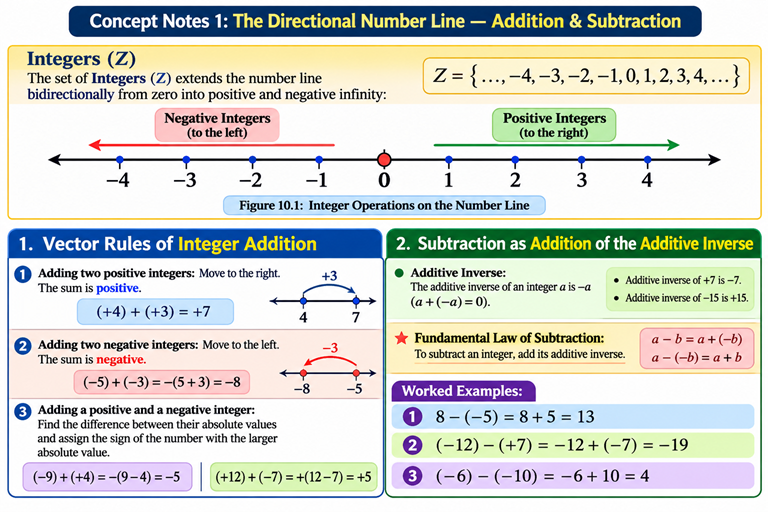
Figure 10.1: Integer Operations on the Number Line


1. Vector Rules of Integer Addition

  1. Adding two positive integers: Move to the right. The sum is positive:
$$(+4) + (+3) = +7$$
  1. Adding two negative integers: Move to the left. The sum is negative:
$$(-5) + (-3) = -(5 + 3) = -8$$
  1. Adding a positive and a negative integer: Find the difference between their absolute values and assign the sign of the number with the larger absolute value:
$$(-9) + (+4) = -(9 - 4) = -5$$
$$(+12) + (-7) = +(12 - 7) = +5$$

2. Subtraction as Addition of the Additive Inverse

  • Additive Inverse: The additive inverse of an integer $a$ is $-a$ ($a + (-a) = 0$).
  • Additive inverse of $+7$ is $-7$.
  • Additive inverse of $-15$ is $+15$.
  • Fundamental Law of Subtraction: To subtract an integer, add its additive inverse:
$$a - b = a + (-b)$$
$$a - (-b) = a + b$$
Worked Examples:
  • $8 - (-5) = 8 + 5 = \mathbf{13}$
  • $(-12) - (+7) = -12 + (-7) = \mathbf{-19}$
  • $(-6) - (-10) = -6 + 10 = \mathbf{4}$
๐Ÿ“
Comprehensive High-Yield Mathematical Relations & Theorems

Complete step-by-step derivations, step traps, and LaTeX formula sheet breakdowns...

๐Ÿ”’

End of Free Notes Preview

Unlock the complete deck to access full LaTeX formula breakdowns, interactive diagrams, exam traps, and personal margin highlights!

๐Ÿ”‘ Sign In / Register Free
๐Ÿง  Review Due (Interval: 1 Day) Card 1 of 8 (SM-2 Active Recall)
QUESTION (FRONT) Space โ†ต to flip
What is the sum of (-12) and (-18)?
ANSWER & EXPLANATION (BACK) Space โ†ต to flip
-30. (Same signs: add absolute values 12 + 18 = 30 and keep negative sign).
๐Ÿ’ก
Tap Card to Flip & Check Your Answer Active recall prompt: Flip the card or press Space โ†ต to unlock the SM-2 recall difficulty rating.
๐Ÿ”’
Step 4 is Locked

Final Comprehensive Diagnostic Assessment (15 MCQs)

This ๐Ÿ“ LaTeX Concept Notes is part of the full verified curriculum for Chapter 10: Operations with Integers. Unlock the full deck to gain permanent access to all 11 interactive stages, active recall cards, and diagnostic checkpoints.

Deck Access Price
100% Free with Account
Instant Access
โœ“ UPI & Cards Supported
๐Ÿ”‘ Sign In / Register to Unlock Free →
๐Ÿ”’
Step 5 is Locked

Final Comprehensive Diagnostic Assessment (15 MCQs)

This โšก Diagnostic Quiz is part of the full verified curriculum for Chapter 10: Operations with Integers. Unlock the full deck to gain permanent access to all 11 interactive stages, active recall cards, and diagnostic checkpoints.

Deck Access Price
100% Free with Account
Instant Access
โœ“ UPI & Cards Supported
๐Ÿ”‘ Sign In / Register to Unlock Free →
๐Ÿ”’
Step 6 is Locked

Final Comprehensive Diagnostic Assessment (15 MCQs)

This Microlearning Step is part of the full verified curriculum for Chapter 10: Operations with Integers. Unlock the full deck to gain permanent access to all 11 interactive stages, active recall cards, and diagnostic checkpoints.

Deck Access Price
100% Free with Account
Instant Access
โœ“ UPI & Cards Supported
๐Ÿ”‘ Sign In / Register to Unlock Free →
๐Ÿ”’
Step 7 is Locked

Final Comprehensive Diagnostic Assessment (15 MCQs)

This ๐ŸŽฅ Video Lesson is part of the full verified curriculum for Chapter 10: Operations with Integers. Unlock the full deck to gain permanent access to all 11 interactive stages, active recall cards, and diagnostic checkpoints.

Deck Access Price
100% Free with Account
Instant Access
โœ“ UPI & Cards Supported
๐Ÿ”‘ Sign In / Register to Unlock Free →
๐Ÿ”’
Step 8 is Locked

Final Comprehensive Diagnostic Assessment (15 MCQs)

This ๐Ÿ“ LaTeX Concept Notes is part of the full verified curriculum for Chapter 10: Operations with Integers. Unlock the full deck to gain permanent access to all 11 interactive stages, active recall cards, and diagnostic checkpoints.

Deck Access Price
100% Free with Account
Instant Access
โœ“ UPI & Cards Supported
๐Ÿ”‘ Sign In / Register to Unlock Free →
๐Ÿ”’
Step 9 is Locked

Final Comprehensive Diagnostic Assessment (15 MCQs)

This ๐Ÿง  Active Recall Flashcards is part of the full verified curriculum for Chapter 10: Operations with Integers. Unlock the full deck to gain permanent access to all 11 interactive stages, active recall cards, and diagnostic checkpoints.

Deck Access Price
100% Free with Account
Instant Access
โœ“ UPI & Cards Supported
๐Ÿ”‘ Sign In / Register to Unlock Free →
๐Ÿ”’
Step 10 is Locked

Final Comprehensive Diagnostic Assessment (15 MCQs)

This ๐Ÿ“ LaTeX Concept Notes is part of the full verified curriculum for Chapter 10: Operations with Integers. Unlock the full deck to gain permanent access to all 11 interactive stages, active recall cards, and diagnostic checkpoints.

Deck Access Price
100% Free with Account
Instant Access
โœ“ UPI & Cards Supported
๐Ÿ”‘ Sign In / Register to Unlock Free →
๐Ÿ”’
Step 11 is Locked

Final Comprehensive Diagnostic Assessment (15 MCQs)

This โšก Diagnostic Quiz is part of the full verified curriculum for Chapter 10: Operations with Integers. Unlock the full deck to gain permanent access to all 11 interactive stages, active recall cards, and diagnostic checkpoints.

Deck Access Price
100% Free with Account
Instant Access
โœ“ UPI & Cards Supported
๐Ÿ”‘ Sign In / Register to Unlock Free →