Chapter 15: Finding the Unknown
๐Ÿ‡ฎ๐Ÿ‡ณ National Curriculum Standard โ–พ
๐Ÿ› Vidyoric Certified โ€ข Prof. Arvind Swaminathan
๐Ÿ”ฅ 0 days
โšก 0 Sparks +
Chapter 15: Finding the Unknown

Video Lecture 1: The Golden Scale of Balance โ€” What Does Solving an Equation Truly Mean?

STEP 1: VIDEO LESSON ๐Ÿ“ค Uploaded HTML5 Video

๐Ÿ“‘ Interactive Chapter Bookmarks

5 chapters
00:00
Introduction & Overview

Syllabus scope and core objectives

โ–ถ
01:01
Balancing The Scale

Detailed physical mechanism and derivations

โ–ถ
02:12
Finding The Pattern

High-yield board tips and pitfalls

โ–ถ
04:01
Framing The Equation
โ–ถ
05:41
Solving Systematically
โ–ถ

๐ŸŽ™๏ธ Synchronized Transcript

๐Ÿ”
Welcome back, detectives of mathematics!

Look at this traditional two-pan balance scale. Notice that the needle is pointing exactly at the centre. This tells us that both sides are perfectly balanced.

On the left pan, we have a mystery gift box with an unknown weight, represented by the variable x. Along with it, there are three metal weights, each weighing one kilogram.

So, the total weight on the left side is x plus three.

On the right pan, there are eight weights, each weighing one kilogram. Therefore, the total weight on the right side is eight kilograms.

Since the scale is balanced, both sides must have equal weights.

We can represent this situation using an equation:

x plus 3 equals 8.

But how can we discover the weight inside the mystery box?

The answer lies in maintaining the balance.

The left side contains three extra kilograms. To remove them, we must also remove three kilograms from the right side. We must perform the same operation on both sides to keep the equation balanced.

So, subtract three from both sides.

On the left, x plus 3 minus 3 leaves us with x.

On the right, 8 minus 3 gives us 5.

Therefore, x equals 5.

The mystery box weighs exactly five kilograms!

This example teaches us an important idea: an equation is like a balance scale. Both sides must always remain equal.

## Expression vs. Equation

Now, let us understand the difference between an algebraic expression and an algebraic equation.

Consider the expression 2x plus 7.

This is an algebraic expression because it contains numbers, a variable, and mathematical operations, but it does not contain an equals sign.

Its value changes depending on the value of x.

For example, if x is 1, then 2 multiplied by 1 plus 7 gives us 9.

If x is 5, then 2 multiplied by 5 plus 7 gives us 17.

So, the expression does not have one fixed value. Its value depends on the variable.

Now, consider another statement:

2x plus 7 equals 19.

This is an algebraic equation because it contains an equals sign.

An equation states that two mathematical quantities have the same value.

The expression on the left side is called the Left Hand Side, or LHS. The expression on the right side is called the Right Hand Side, or RHS.

To solve an equation, we need to find the value of the unknown variable that makes both sides equal.

For this equation, when x equals 6, the left side becomes 2 multiplied by 6 plus 7, which equals 19.

The right side is also 19.

Therefore, x equals 6 is the solution of this equation.

The value that satisfies an equation is also called its root.

## The Four Fundamental Rules of Equality

Now, how do we solve equations systematically?

We use four important rules of equality.

The first rule is addition.

If we add the same number to both sides of an equation, equality remains unchanged.

For example, if both sides are increased by 5, the balance is maintained.

The second rule is subtraction.

If we subtract the same number from both sides, the equation remains balanced.

This is useful when we want to remove an extra number from one side.

The third rule is multiplication.

We can multiply both sides by the same non-zero number without changing the equality.

The fourth rule is division.

Similarly, we can divide both sides by the same non-zero number, and the equality remains true.

These four rules help us isolate the unknown variable.

For example, if an equation contains addition by 5, we can subtract 5 from both sides to undo that addition.

If a number is subtracted from the variable, we can add that number to both sides.

If the variable is multiplied by 4, we can divide both sides by 4.

And if the variable is divided by 3, we can multiply both sides by 3.

Remember one golden principle: whatever operation we perform on one side, we must perform the same operation on the other side.

By applying these rules step by step, we can gradually isolate the unknown value and solve the equation.

## Roadmap to Mastery

Today, we discovered what solving an equation truly means.

We learned that an equation represents a balance between two mathematical quantities.

We also understood the difference between an algebraic expression and an equation, and explored the four fundamental rules of equality.

In the upcoming lessons, we will learn systematic methods for solving equations, understand a useful shortcut called transposition, and convert real-life word problems into mathematical equations.

We will also explore interesting mathematical puzzles inspired by Bhaskaracharya's famous work, Lilavati.

So, sharpen your mathematical thinking and get ready to uncover the unknown.

Thank you!
STEP 2 โ€ข CONCEPT NOTES โฑ๏ธ 3 min read
๐Ÿ“Œ 0 Notes

Concept Notes 1: The Concept of an Equation: Variables, Equality & The Two-Pan Balance Scale

Algebra is the branch of mathematics that uses letters and symbols to represent numbers and generalize arithmetic relationships. In Grade 7, we transition from expressions to Equations.
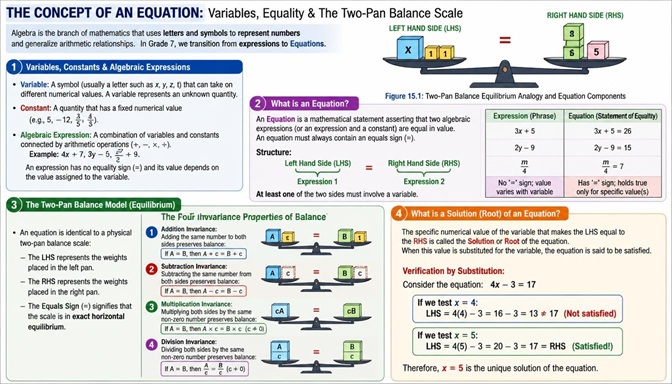
Figure 15.1: Two-Pan Balance Equilibrium Analogy and Equation Components


1. Variables, Constants & Algebraic Expressions

  • Variable: A symbol (usually a letter such as $x, y, z, t$) that can take on different numerical values. A variable represents an unknown quantity.
  • Constant: A quantity that has a fixed numerical value (e.g., $5, -12, \frac{3}{4}$).
  • Algebraic Expression: A combination of variables and constants connected by arithmetic operations ($+, -, \times, \div$).
  • Example: $4x + 7$, $3y - 5$, $\frac{z}{2} + 9$.
  • An expression has no equality sign ($=$) and its value depends on the value assigned to the variable.

2. What is an Equation?

An Equation is a mathematical statement asserting that two algebraic expressions (or an expression and a constant) are equal in value.

  • An equation must always contain an equals sign ($=$).
  • Structure:
$$\underbrace{\text{Left Hand Side (LHS)}}_{\text{Expression 1}} = \underbrace{\text{Right Hand Side (RHS)}}_{\text{Expression 2}}$$
  • At least one of the two sides must involve a variable.
Expression (Phrase)Equation (Statement of Equality)
$3x + 5$$3x + 5 = 26$
$2y - 9$$2y - 9 = 15$
$\frac{m}{4}$$\frac{m}{4} = 7$
No '$=$' sign; value varies with variableHas '$=$' sign; holds true only for specific value(s)

3. The Two-Pan Balance Model (Equilibrium)

An equation is identical to a physical two-pan balance scale:

  • The LHS represents the weights placed in the left pan.
  • The RHS represents the weights placed in the right pan.
  • The Equals Sign ($=$) signifies that the scale is in exact horizontal equilibrium.
The Four Invariance Properties of Balance:
  1. Addition Invariance: Adding the same number to both sides preserves balance:
$$\text{If } A = B, \text{ then } A + c = B + c$$
  1. Subtraction Invariance: Subtracting the same number from both sides preserves balance:
$$\text{If } A = B, \text{ then } A - c = B - c$$
  1. Multiplication Invariance: Multiplying both sides by the same non-zero number preserves balance:
$$\text{If } A = B, \text{ then } A \times c = B \times c \quad (c \ne 0)$$
  1. Division Invariance: Dividing both sides by the same non-zero number preserves balance:
$$\text{If } A = B, \text{ then } \frac{A}{c} = \frac{B}{c} \quad (c \ne 0)$$

4. What is a Solution (Root) of an Equation?

The specific numerical value of the variable that makes the LHS equal to the RHS is called the Solution or Root of the equation. When this value is substituted for the variable, the equation is said to be satisfied.

Verification by Substitution:

Consider the equation:

$$4x - 3 = 17$$
  • If we test $x = 4$:
$$\text{LHS} = 4(4) - 3 = 16 - 3 = 13 \ne 17 \quad (\text{Not satisfied})$$
  • If we test $x = 5$:
$$\text{LHS} = 4(5) - 3 = 20 - 3 = 17 = \text{RHS} \quad (\text{Satisfied!})$$

Therefore, $x = 5$ is the unique solution of the equation.

๐Ÿ“
Comprehensive High-Yield Mathematical Relations & Theorems

Complete step-by-step derivations, step traps, and LaTeX formula sheet breakdowns...

๐Ÿ”’

End of Free Notes Preview

Unlock the complete deck to access full LaTeX formula breakdowns, interactive diagrams, exam traps, and personal margin highlights!

๐Ÿ”‘ Sign In / Register Free
๐Ÿง  Review Due (Interval: 1 Day) Card 1 of 8 (SM-2 Active Recall)
QUESTION (FRONT) Space โ†ต to flip
What is the key difference between an algebraic expression and an equation?
ANSWER & EXPLANATION (BACK) Space โ†ต to flip
An algebraic expression (e.g., 3x + 5) has no equals sign and its value varies. An equation (e.g., 3x + 5 = 14) has an equals sign asserting that LHS equals RHS for specific root(s).
๐Ÿ’ก
Tap Card to Flip & Check Your Answer Active recall prompt: Flip the card or press Space โ†ต to unlock the SM-2 recall difficulty rating.
๐Ÿ”’
Step 4 is Locked

Final Comprehensive Diagnostic Assessment (15 MCQs)

This ๐Ÿ“ LaTeX Concept Notes is part of the full verified curriculum for Chapter 15: Finding the Unknown. Unlock the full deck to gain permanent access to all 11 interactive stages, active recall cards, and diagnostic checkpoints.

Deck Access Price
100% Free with Account
Instant Access
โœ“ UPI & Cards Supported
๐Ÿ”‘ Sign In / Register to Unlock Free →
๐Ÿ”’
Step 5 is Locked

Final Comprehensive Diagnostic Assessment (15 MCQs)

This โšก Diagnostic Quiz is part of the full verified curriculum for Chapter 15: Finding the Unknown. Unlock the full deck to gain permanent access to all 11 interactive stages, active recall cards, and diagnostic checkpoints.

Deck Access Price
100% Free with Account
Instant Access
โœ“ UPI & Cards Supported
๐Ÿ”‘ Sign In / Register to Unlock Free →
๐Ÿ”’
Step 6 is Locked

Final Comprehensive Diagnostic Assessment (15 MCQs)

This Microlearning Step is part of the full verified curriculum for Chapter 15: Finding the Unknown. Unlock the full deck to gain permanent access to all 11 interactive stages, active recall cards, and diagnostic checkpoints.

Deck Access Price
100% Free with Account
Instant Access
โœ“ UPI & Cards Supported
๐Ÿ”‘ Sign In / Register to Unlock Free →
๐Ÿ”’
Step 7 is Locked

Final Comprehensive Diagnostic Assessment (15 MCQs)

This ๐ŸŽฅ Video Lesson is part of the full verified curriculum for Chapter 15: Finding the Unknown. Unlock the full deck to gain permanent access to all 11 interactive stages, active recall cards, and diagnostic checkpoints.

Deck Access Price
100% Free with Account
Instant Access
โœ“ UPI & Cards Supported
๐Ÿ”‘ Sign In / Register to Unlock Free →
๐Ÿ”’
Step 8 is Locked

Final Comprehensive Diagnostic Assessment (15 MCQs)

This ๐Ÿ“ LaTeX Concept Notes is part of the full verified curriculum for Chapter 15: Finding the Unknown. Unlock the full deck to gain permanent access to all 11 interactive stages, active recall cards, and diagnostic checkpoints.

Deck Access Price
100% Free with Account
Instant Access
โœ“ UPI & Cards Supported
๐Ÿ”‘ Sign In / Register to Unlock Free →
๐Ÿ”’
Step 9 is Locked

Final Comprehensive Diagnostic Assessment (15 MCQs)

This ๐Ÿง  Active Recall Flashcards is part of the full verified curriculum for Chapter 15: Finding the Unknown. Unlock the full deck to gain permanent access to all 11 interactive stages, active recall cards, and diagnostic checkpoints.

Deck Access Price
100% Free with Account
Instant Access
โœ“ UPI & Cards Supported
๐Ÿ”‘ Sign In / Register to Unlock Free →
๐Ÿ”’
Step 10 is Locked

Final Comprehensive Diagnostic Assessment (15 MCQs)

This ๐Ÿ“ LaTeX Concept Notes is part of the full verified curriculum for Chapter 15: Finding the Unknown. Unlock the full deck to gain permanent access to all 11 interactive stages, active recall cards, and diagnostic checkpoints.

Deck Access Price
100% Free with Account
Instant Access
โœ“ UPI & Cards Supported
๐Ÿ”‘ Sign In / Register to Unlock Free →
๐Ÿ”’
Step 11 is Locked

Final Comprehensive Diagnostic Assessment (15 MCQs)

This โšก Diagnostic Quiz is part of the full verified curriculum for Chapter 15: Finding the Unknown. Unlock the full deck to gain permanent access to all 11 interactive stages, active recall cards, and diagnostic checkpoints.

Deck Access Price
100% Free with Account
Instant Access
โœ“ UPI & Cards Supported
๐Ÿ”‘ Sign In / Register to Unlock Free →