Chapter 4: The World of Metals and Non-metals
๐Ÿ‡ฎ๐Ÿ‡ณ National Curriculum Standard โ–พ
๐Ÿ› Vidyoric Certified โ€ข Dr. Ananya Sharma
๐Ÿ”ฅ 0 days
โšก 0 Sparks +
Chapter 4: The World of Metals and Non-metals

Video Lecture 1: Unlocking Matter โ€” The Physical Secrets of Metals and Non-Metals

STEP 1: VIDEO LESSON ๐Ÿ“ค Uploaded HTML5 Video

๐Ÿ“‘ Interactive Chapter Bookmarks

6 chapters
00:00
Introduction & Overview

Syllabus scope and core objectives

โ–ถ
00:51
Iron Age Revolution

Detailed physical mechanism and derivations

โ–ถ
01:36
Malleability

High-yield board tips and pitfalls

โ–ถ
03:35
Ductility
โ–ถ
04:38
Conduction
โ–ถ
05:43
Chemical Reaction
โ–ถ

๐ŸŽ™๏ธ Synchronized Transcript

๐Ÿ”
Hello, inquisitive young scientists!

Look closely at the objects around you. Why do we wrap sweets in thin aluminium foil, but never see foil made from sulfur? Why are electric wires made of shiny copper instead of brittle charcoal? And why do metal bells produce a clear, ringing sound when struck?

The answers lie in the classification of materials into two important groups: **metals and non-metals**.

Today, we are going to explore the interesting physical properties that distinguish these two groups of materials.

Let us begin with an important property called **malleability**.

Imagine hitting a piece of coal with a hammer. It breaks into smaller pieces or powder. But when we hammer certain metals, such as iron or aluminium, they can be flattened into thin sheets without breaking easily.

The property of a material that allows it to be beaten into thin sheets is called malleability.

Gold and silver are among the most malleable metals. This is why metals are used to make thin sheets for different purposes.

Next, let us understand another important property called **ductility**.

Ductility is the ability of a material to be drawn into thin wires. Metals such as copper, aluminium, gold, and silver are ductile.

This property makes copper and aluminium useful for manufacturing electrical wires and cables.

Now, let us explore how metals and non-metals conduct heat and electricity.

Have you ever noticed that the handle of a metal spoon becomes hot when it is left inside a hot cup of tea or a bowl of hot soup?

This happens because metals are generally good conductors of heat. They allow heat to pass through them easily.

Metals are also generally good conductors of electricity. That is why copper and aluminium are commonly used in electrical wiring.

On the other hand, many non-metals, such as wood, plastic, and sulfur, are poor conductors of heat and electricity.

Now, let us discover another interesting property of metals: **sonority**.

When you strike a metal object against a hard surface, it often produces a clear ringing sound. This property is called sonority.

That is why metals such as brass, bronze, and steel are used to make bells and musical instruments.

Most non-metals do not produce this ringing sound when struck. Instead, they usually produce a dull sound.

However, remember that science is full of exceptions!

Most metals are solid at room temperature, but **mercury** is an important exception. It is a shiny metal that remains liquid at room temperature.

Another interesting exception is sodium and potassium. These metals are so soft that they can be cut with a knife. However, they are highly reactive and must never be handled without proper laboratory precautions.

Non-metals also have some surprising properties.

Diamond, which is a form of carbon, is the hardest naturally occurring substance.

Iodine is another non-metal, but unlike most non-metals, it has a shiny metallic appearance. This property is called metallic lustre.

And here is one more fascinating exception: graphite, which is commonly found in pencil leads, can conduct electricity even though it is a non-metal.

So, remember that metals are generally malleable, ductile, sonorous, and good conductors of heat and electricity. Non-metals generally have opposite properties, but there are several important exceptions.

Isn't it fascinating how the properties of materials determine their uses in everyday life?

As we continue exploring this topic, we will learn how metals and non-metals react with oxygen, water, and acids. We will also discover displacement reactions and explore the remarkable achievements of ancient Indian metallurgy, including the famous Iron Pillar of Delhi.

Let us continue our journey into the fascinating world of metals and non-metals!
STEP 2 โ€ข CONCEPT NOTES โฑ๏ธ 3 min read
๐Ÿ“Œ 0 Notes

Concept Notes 1: Physical Foundations of Metals and Non-Metals

In our daily lives, we interact with hundreds of materialsโ€”from the stainless steel spoon in our breakfast bowl to the oxygen gas we inhale with every breath. In chemistry, elements are broadly classified into Metals and Non-Metals based on their distinct physical and chemical properties.
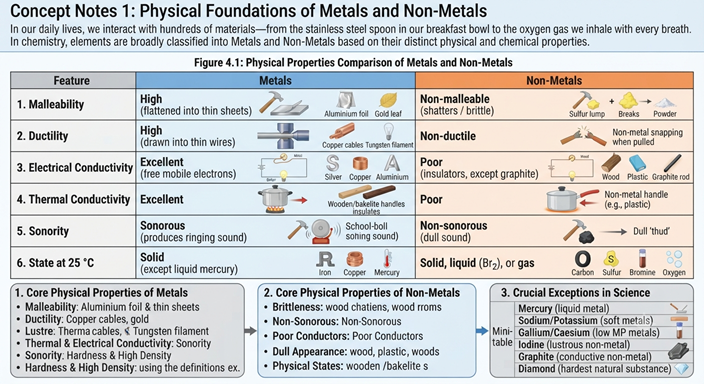
Figure 4.1: Physical Properties Comparison of Metals and Non-Metals


1. Core Physical Properties of Metals

Metals possess a unique combination of structural characteristics arising from their metallic bonding, where positive metal ions are held together in a lattice surrounded by a delocalized "sea of mobile electrons":

  1. Malleability:
  • Definition: The property of materials that allows them to be beaten or hammered into thin sheets without shattering.
  • Examples: Aluminium foil used for wrapping food; silver foil (vark) used to decorate traditional Indian sweets; gold beaten into leaves as thin as 0.0001 mm.
  • Significance: Gold and silver are the most malleable metals.
  1. Ductility:
  • Definition: The property of materials that allows them to be drawn or stretched into long, thin wires.
  • Examples: Copper and aluminium drawn into electrical cables; tungsten drawn into microscopic filaments for incandescent bulbs.
  • Key Fact: Just 1 gram of gold can be drawn into a wire approximately 2 kilometres long!
  1. Lustre (Metallic Shine):
  • In their pure, uncorroded state, metals have a shiny, reflective surface known as metallic lustre.
  • When freshly cut or polished, copper shows a reddish-orange lustre, gold shows yellow lustre, and silver/aluminium show brilliant white lustre.
  1. Thermal & Electrical Conductivity:
  • Metals allow heat and electric current to pass through them rapidly due to their free mobile electrons.
  • Best electrical conductor: Silver ($\text{Ag}$), closely followed by Copper ($\text{Cu}$) and Aluminium ($\text{Al}$).
  • Thermal application: Cooking pots and pans are made of iron, copper, or aluminium, while their handles are made of wood or bakelite (insulators) to prevent burns.
  1. Sonority:
  • When struck with a hard object, metals emit a deep, ringing, resonant sound.
  • This property makes metals the material of choice for school bells, temple bells, guitar strings, and cymbals.
  1. Hardness & High Density:
  • Most metals are hard solids with high tensile strength and high melting points (e.g., iron, copper, chromium).

2. Core Physical Properties of Non-Metals

Non-metals exhibit physical characteristics that are generally the exact opposite of metals:

  1. Brittleness: Non-metals break down into fine pieces or powder when struck with a hammer (e.g., sulfur lumps, charcoal carbon). They lack malleability and ductility.
  2. Non-Sonorous: They produce a dull, muffled thud when tapped rather than a ringing resonance.
  3. Poor Conductors (Insulators): They do not allow heat or electricity to pass through them freely (e.g., wood, sulfur, phosphorus, plastics).
  4. Dull Appearance: They lack metallic shine and appear powdery or matte.
  5. Physical States at Room Temperature: Non-metals exist in all three states of matter:
  • Gases: Oxygen ($\text{O}_2$), Nitrogen ($\text{N}_2$), Chlorine ($\text{Cl}_2$), Hydrogen ($\text{H}_2$), Helium ($\text{He}$).
  • Solid: Carbon ($\text{C}$), Sulfur ($\text{S}$), Phosphorus ($\text{P}$), Iodine ($\text{I}_2$).
  • Liquid: Bromine ($\text{Br}_2$) is the only liquid non-metal at room temperature!

3. Crucial Exceptions in Science

NCERT examinations frequently test exceptions to these general rules:

PropertyGeneral RuleThe Fascinating Exception
Physical State of MetalsAll metals are hard solidsMercury ($\text{Hg}$) is a liquid at room temperature.
Hardness of MetalsMetals are hard and rigidSodium ($\text{Na}$) and Potassium ($\text{K}$) are so soft they can be sliced with an ordinary knife.
Melting Point of MetalsMetals have high melting pointsGallium ($\text{Ga}$) and Caesium ($\text{Cs}$) melt in the palm of your hand ($< 30^\circ\text{C}$).
Lustre of Non-MetalsNon-metals are dullIodine ($\text{I}_2$) crystals have a brilliant metallic sheen and lustre.
Conductivity of Non-MetalsNon-metals are electrical insulatorsGraphite (an allotrope of carbon) is an excellent conductor of electricity!
Hardness of Non-MetalsNon-metals are soft and brittleDiamond (carbon allotrope) is the hardest natural substance known!

4. Comprehensive Comparison Table

FeatureMetalsNon-Metals
MalleabilityHigh (flattened into thin sheets)Non-malleable (shatters / brittle)
DuctilityHigh (drawn into thin wires)Non-ductile
Electrical ConductivityExcellent (free mobile electrons)Poor (insulators, except graphite)
Thermal ConductivityExcellentPoor
SonoritySonorous (produces ringing sound)Non-sonorous (dull sound)
State at $25^\circ\text{C}$Solid (except liquid mercury)Solid, liquid ($\text{Br}_2$), or gas
๐Ÿ“
Comprehensive High-Yield Mathematical Relations & Theorems

Complete step-by-step derivations, step traps, and LaTeX formula sheet breakdowns...

๐Ÿ”’

End of Free Notes Preview

Unlock the complete deck to access full LaTeX formula breakdowns, interactive diagrams, exam traps, and personal margin highlights!

๐Ÿ”‘ Sign In / Register Free
๐Ÿง  Review Due (Interval: 1 Day) Card 1 of 8 (SM-2 Active Recall)
QUESTION (FRONT) Space โ†ต to flip
What is malleability, and which metals are the most malleable?
ANSWER & EXPLANATION (BACK) Space โ†ต to flip
Malleability is the physical property of a substance that allows it to be beaten or hammered into thin sheets without shattering. Gold and silver are the most malleable metals.
๐Ÿ’ก
Tap Card to Flip & Check Your Answer Active recall prompt: Flip the card or press Space โ†ต to unlock the SM-2 recall difficulty rating.
๐Ÿ”’
Step 4 is Locked

Final Comprehensive Diagnostic Assessment (15 MCQs)

This ๐Ÿ“ LaTeX Concept Notes is part of the full verified curriculum for Chapter 4: The World of Metals and Non-metals. Unlock the full deck to gain permanent access to all 11 interactive stages, active recall cards, and diagnostic checkpoints.

Deck Access Price
100% Free with Account
Instant Access
โœ“ UPI & Cards Supported
๐Ÿ”‘ Sign In / Register to Unlock Free →
๐Ÿ”’
Step 5 is Locked

Final Comprehensive Diagnostic Assessment (15 MCQs)

This โšก Diagnostic Quiz is part of the full verified curriculum for Chapter 4: The World of Metals and Non-metals. Unlock the full deck to gain permanent access to all 11 interactive stages, active recall cards, and diagnostic checkpoints.

Deck Access Price
100% Free with Account
Instant Access
โœ“ UPI & Cards Supported
๐Ÿ”‘ Sign In / Register to Unlock Free →
๐Ÿ”’
Step 6 is Locked

Final Comprehensive Diagnostic Assessment (15 MCQs)

This Microlearning Step is part of the full verified curriculum for Chapter 4: The World of Metals and Non-metals. Unlock the full deck to gain permanent access to all 11 interactive stages, active recall cards, and diagnostic checkpoints.

Deck Access Price
100% Free with Account
Instant Access
โœ“ UPI & Cards Supported
๐Ÿ”‘ Sign In / Register to Unlock Free →
๐Ÿ”’
Step 7 is Locked

Final Comprehensive Diagnostic Assessment (15 MCQs)

This ๐ŸŽฅ Video Lesson is part of the full verified curriculum for Chapter 4: The World of Metals and Non-metals. Unlock the full deck to gain permanent access to all 11 interactive stages, active recall cards, and diagnostic checkpoints.

Deck Access Price
100% Free with Account
Instant Access
โœ“ UPI & Cards Supported
๐Ÿ”‘ Sign In / Register to Unlock Free →
๐Ÿ”’
Step 8 is Locked

Final Comprehensive Diagnostic Assessment (15 MCQs)

This ๐Ÿ“ LaTeX Concept Notes is part of the full verified curriculum for Chapter 4: The World of Metals and Non-metals. Unlock the full deck to gain permanent access to all 11 interactive stages, active recall cards, and diagnostic checkpoints.

Deck Access Price
100% Free with Account
Instant Access
โœ“ UPI & Cards Supported
๐Ÿ”‘ Sign In / Register to Unlock Free →
๐Ÿ”’
Step 9 is Locked

Final Comprehensive Diagnostic Assessment (15 MCQs)

This ๐Ÿง  Active Recall Flashcards is part of the full verified curriculum for Chapter 4: The World of Metals and Non-metals. Unlock the full deck to gain permanent access to all 11 interactive stages, active recall cards, and diagnostic checkpoints.

Deck Access Price
100% Free with Account
Instant Access
โœ“ UPI & Cards Supported
๐Ÿ”‘ Sign In / Register to Unlock Free →
๐Ÿ”’
Step 10 is Locked

Final Comprehensive Diagnostic Assessment (15 MCQs)

This ๐Ÿ“ LaTeX Concept Notes is part of the full verified curriculum for Chapter 4: The World of Metals and Non-metals. Unlock the full deck to gain permanent access to all 11 interactive stages, active recall cards, and diagnostic checkpoints.

Deck Access Price
100% Free with Account
Instant Access
โœ“ UPI & Cards Supported
๐Ÿ”‘ Sign In / Register to Unlock Free →
๐Ÿ”’
Step 11 is Locked

Final Comprehensive Diagnostic Assessment (15 MCQs)

This โšก Diagnostic Quiz is part of the full verified curriculum for Chapter 4: The World of Metals and Non-metals. Unlock the full deck to gain permanent access to all 11 interactive stages, active recall cards, and diagnostic checkpoints.

Deck Access Price
100% Free with Account
Instant Access
โœ“ UPI & Cards Supported
๐Ÿ”‘ Sign In / Register to Unlock Free →