Chapter 5: Changes Around Us: Physical and Chemical
๐Ÿ‡ฎ๐Ÿ‡ณ National Curriculum Standard โ–พ
๐Ÿ› Vidyoric Certified โ€ข Dr. Ananya Sharma
๐Ÿ”ฅ 0 days
โšก 0 Sparks +
Chapter 5: Changes Around Us: Physical and Chemical

Video Lecture 1: The Anatomy of Change โ€” From Melting Ice to Dazzling Flames

STEP 1: VIDEO LESSON ๐Ÿ“ค Uploaded HTML5 Video

๐Ÿ“‘ Interactive Chapter Bookmarks

6 chapters
00:00
Introduction & Overview

Syllabus scope and core objectives

โ–ถ
00:47
Everyday Changes

Detailed physical mechanism and derivations

โ–ถ
01:23
Physical Changes

High-yield board tips and pitfalls

โ–ถ
02:14
Chemical Changes
โ–ถ
04:03
Reversibility
โ–ถ
05:00
Nature's Changes
โ–ถ

๐ŸŽ™๏ธ Synchronized Transcript

๐Ÿ”
Hello, curious minds!

Every single moment, the world around us is undergoing different kinds of changes.

Think about the ice in your lemonade. It melts and changes into liquid water. The green leaves on a tree turn yellow and eventually fall to the ground. A matchstick produces a bright flame when struck, and milk changes into curd when left for some time.

But are all these changes the same?

Not at all!

Scientists classify the changes around us into two main categories: **physical changes and chemical changes**.

Today, we will understand the difference between these two types of changes and discover how to identify them in our everyday lives.

Let us begin with physical changes.

Imagine an ice cube kept on a plate. After some time, it melts and changes into liquid water.

When we heat this water, it changes into water vapour. If we allow the vapour to come in contact with a cold surface, it cools down and changes back into liquid water.

What is interesting here?

Whether water is in the form of ice, liquid water, or water vapour, its chemical identity remains the same. It is still Hโ‚‚O.

A change in which the shape, size, colour, or state of a substance changes without forming a new substance is called a **physical change**.

For example, melting ice, boiling water, cutting paper, and breaking chalk into smaller pieces are physical changes.

Most physical changes are reversible, which means the original substance can often be obtained again.

For example, when a rubber band is stretched, its shape changes. When we release it, it returns to its original shape, provided it has not been stretched beyond its limit.

Similarly, when a sheet of paper is torn into smaller pieces, its size and shape change, but the material remains paper.

Now, let us understand the second type of change: **chemical changes**.

Imagine taking a sheet of paper and setting it on fire.

The paper burns and produces heat, light, smoke, and gases. A new substance called ash is also formed.

Can we collect that ash and turn it back into the original sheet of paper? No!

This is because burning paper is a chemical change.

A chemical change is a process in which one or more new substances are formed with properties different from those of the original substances.

During a chemical change, the original substances undergo a chemical reaction, in which their chemical composition changes.

We can observe many examples of chemical changes in everyday life.

When iron reacts with oxygen and moisture, reddish-brown rust is formed.

When our body digests food, complex substances are broken down into simpler substances.

When green mangoes ripen, their colour, taste, and texture change due to several chemical processes.

Similarly, when vinegar reacts with baking soda, new substances are formed, along with the release of carbon dioxide gas.

So, how can we identify whether a chemical change has taken place?

There are some common signs that can help us.

First, the production or absorption of heat, light, or sound may indicate a chemical change.

Second, the formation of gas can be observed through bubbling or effervescence.

Third, a noticeable change in colour may occur.

Fourth, an insoluble solid called a precipitate may form when two solutions react.

Finally, a change in smell or the release of a new aroma may also indicate a chemical change.

Remember, these signs are useful clues, but no single sign alone proves that a chemical change has occurred. We must consider the overall process and whether a new substance has actually formed.

Let us quickly revise.

In a physical change, the form, shape, size, or state of a substance changes, but no new substance is formed.

In a chemical change, one or more new substances are formed with different chemical properties.

Understanding these changes helps us explain many interesting processes happening around us every day.

Now, let us continue exploring the fascinating world of physical and chemical changes!
STEP 2 โ€ข CONCEPT NOTES โฑ๏ธ 3 min read
๐Ÿ“Œ 0 Notes

Concept Notes 1: Physical vs. Chemical Transformations

In nature, matter is constantly shifting, interacting, and transforming. Understanding the distinction between physical and chemical changes is fundamental to all branches of science.
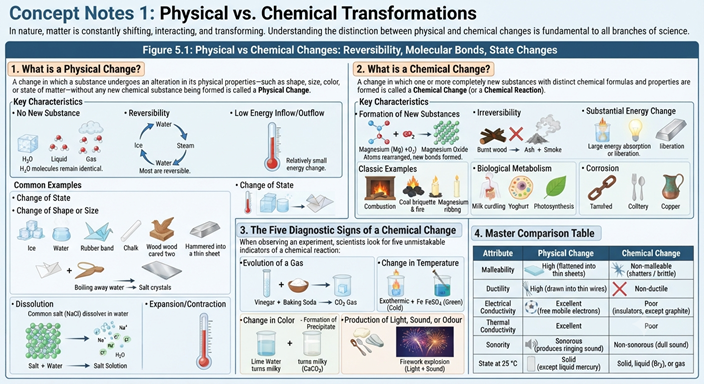
Figure 5.1: Physical vs Chemical Changes: Reversibility, Molecular Bonds, State Changes


1. What is a Physical Change?

A change in which a substance undergoes an alteration in its physical propertiesโ€”such as shape, size, color, or state of matterโ€”without any new chemical substance being formed is called a Physical Change.

Key Characteristics:

  1. No New Substance: The chemical formula and molecular identity of the substance remain completely unchanged before and after the change.
  2. Reversibility: Most physical changes are reversible. By reversing temperature, pressure, or physical conditions, the original substance can be recovered.
  3. Low Energy Inflow/Outflow: Usually involves relatively small amounts of energy absorbed or released (latent heat of fusion or vaporization).

Common Examples:

  • Change of State: Melting of ice into water, freezing of water into ice, evaporation of water into steam, condensation of steam into water, and sublimation of camphor or dry ice.
  • Change of Shape or Size: Folding a sheet of paper, stretching a rubber band, breaking a chalk stick, carving wood, or hammering a metal into a sheet.
  • Dissolution: Dissolving common salt or sugar in water. (Reversible by boiling the water away, leaving the solid crystals behind).
  • Expansion/Contraction: Thermal expansion of mercury in a clinical thermometer.

2. What is a Chemical Change?

A change in which one or more completely new substances with distinct chemical formulas and properties are formed is called a Chemical Change (or a Chemical Reaction).

Key Characteristics:

  1. Formation of New Substances: The atomic bonds of the reactants are broken, and atoms are rearranged into new molecular products.
  2. Irreversibility: Most chemical changes cannot be reversed by simple physical methods.
  3. Substantial Energy Change: Typically accompanied by significant absorption or liberation of energy in the form of heat, light, or sound.

Classic Examples:

  • Combustion: Burning of wood, coal, candle wax, paper, or magnesium ribbon.
  • Biological Metabolism: Digestion of food in the stomach and intestines, cellular respiration, and photosynthesis in green leaves.
  • Food Transformation: Curdling of milk into yoghurt, ripening of raw fruits, and baking bread or cakes.
  • Corrosion: Rusting of an iron gate, tarnishing of silver jewelry, and development of green patina on copper vessels.

3. The Five Diagnostic Signs of a Chemical Change

When observing an experiment, scientists look for five unmistakable indicators of a chemical reaction:

  1. Evolution of a Gas: Rapid bubbling or effervescence (e.g., vinegar + baking soda releasing $\text{CO}_2$ gas).
  2. Change in Temperature: Exothermic reactions produce heat (beaker feels warm); endothermic reactions absorb heat (beaker feels cold).
  3. Change in Color: Clear visual shift (e.g., blue copper sulfate solution turning green when iron is added).
  4. Formation of a Precipitate: An insoluble solid settling out of a clear solution (e.g., lime water turning milky due to $\text{CaCO}_3$).
  5. Production of Light, Sound, or Odour: Explosion of fireworks producing bang and flash, or spoiled food developing a sour stench.

4. Master Comparison Table

AttributePhysical ChangeChemical Change
New Substance Formed?No new substance is formed.One or more new substances are formed.
Nature of TransformationTemporary and usually reversible.Permanent and usually irreversible.
Chemical CompositionRemains strictly identical.Completely altered into new products.
Energy Inflow/OutflowRelatively small (latent heat).Large absorption or evolution of energy.
Classic Laboratory TestBoiling water to steam $\to$ ice.Burning magnesium ribbon in oxygen.
๐Ÿ“
Comprehensive High-Yield Mathematical Relations & Theorems

Complete step-by-step derivations, step traps, and LaTeX formula sheet breakdowns...

๐Ÿ”’

End of Free Notes Preview

Unlock the complete deck to access full LaTeX formula breakdowns, interactive diagrams, exam traps, and personal margin highlights!

๐Ÿ”‘ Sign In / Register Free
๐Ÿง  Review Due (Interval: 1 Day) Card 1 of 8 (SM-2 Active Recall)
QUESTION (FRONT) Space โ†ต to flip
What is the primary difference between a physical change and a chemical change?
ANSWER & EXPLANATION (BACK) Space โ†ต to flip
In a physical change, no new substance is formed (only shape, size, or physical state changes). In a chemical change, one or more completely new substances with different properties are formed.
๐Ÿ’ก
Tap Card to Flip & Check Your Answer Active recall prompt: Flip the card or press Space โ†ต to unlock the SM-2 recall difficulty rating.
๐Ÿ”’
Step 4 is Locked

Final Comprehensive Diagnostic Assessment (15 MCQs)

This ๐Ÿ“ LaTeX Concept Notes is part of the full verified curriculum for Chapter 5: Changes Around Us: Physical and Chemical. Unlock the full deck to gain permanent access to all 11 interactive stages, active recall cards, and diagnostic checkpoints.

Deck Access Price
100% Free with Account
Instant Access
โœ“ UPI & Cards Supported
๐Ÿ”‘ Sign In / Register to Unlock Free →
๐Ÿ”’
Step 5 is Locked

Final Comprehensive Diagnostic Assessment (15 MCQs)

This โšก Diagnostic Quiz is part of the full verified curriculum for Chapter 5: Changes Around Us: Physical and Chemical. Unlock the full deck to gain permanent access to all 11 interactive stages, active recall cards, and diagnostic checkpoints.

Deck Access Price
100% Free with Account
Instant Access
โœ“ UPI & Cards Supported
๐Ÿ”‘ Sign In / Register to Unlock Free →
๐Ÿ”’
Step 6 is Locked

Final Comprehensive Diagnostic Assessment (15 MCQs)

This Microlearning Step is part of the full verified curriculum for Chapter 5: Changes Around Us: Physical and Chemical. Unlock the full deck to gain permanent access to all 11 interactive stages, active recall cards, and diagnostic checkpoints.

Deck Access Price
100% Free with Account
Instant Access
โœ“ UPI & Cards Supported
๐Ÿ”‘ Sign In / Register to Unlock Free →
๐Ÿ”’
Step 7 is Locked

Final Comprehensive Diagnostic Assessment (15 MCQs)

This ๐ŸŽฅ Video Lesson is part of the full verified curriculum for Chapter 5: Changes Around Us: Physical and Chemical. Unlock the full deck to gain permanent access to all 11 interactive stages, active recall cards, and diagnostic checkpoints.

Deck Access Price
100% Free with Account
Instant Access
โœ“ UPI & Cards Supported
๐Ÿ”‘ Sign In / Register to Unlock Free →
๐Ÿ”’
Step 8 is Locked

Final Comprehensive Diagnostic Assessment (15 MCQs)

This ๐Ÿ“ LaTeX Concept Notes is part of the full verified curriculum for Chapter 5: Changes Around Us: Physical and Chemical. Unlock the full deck to gain permanent access to all 11 interactive stages, active recall cards, and diagnostic checkpoints.

Deck Access Price
100% Free with Account
Instant Access
โœ“ UPI & Cards Supported
๐Ÿ”‘ Sign In / Register to Unlock Free →
๐Ÿ”’
Step 9 is Locked

Final Comprehensive Diagnostic Assessment (15 MCQs)

This ๐Ÿง  Active Recall Flashcards is part of the full verified curriculum for Chapter 5: Changes Around Us: Physical and Chemical. Unlock the full deck to gain permanent access to all 11 interactive stages, active recall cards, and diagnostic checkpoints.

Deck Access Price
100% Free with Account
Instant Access
โœ“ UPI & Cards Supported
๐Ÿ”‘ Sign In / Register to Unlock Free →
๐Ÿ”’
Step 10 is Locked

Final Comprehensive Diagnostic Assessment (15 MCQs)

This ๐Ÿ“ LaTeX Concept Notes is part of the full verified curriculum for Chapter 5: Changes Around Us: Physical and Chemical. Unlock the full deck to gain permanent access to all 11 interactive stages, active recall cards, and diagnostic checkpoints.

Deck Access Price
100% Free with Account
Instant Access
โœ“ UPI & Cards Supported
๐Ÿ”‘ Sign In / Register to Unlock Free →
๐Ÿ”’
Step 11 is Locked

Final Comprehensive Diagnostic Assessment (15 MCQs)

This โšก Diagnostic Quiz is part of the full verified curriculum for Chapter 5: Changes Around Us: Physical and Chemical. Unlock the full deck to gain permanent access to all 11 interactive stages, active recall cards, and diagnostic checkpoints.

Deck Access Price
100% Free with Account
Instant Access
โœ“ UPI & Cards Supported
๐Ÿ”‘ Sign In / Register to Unlock Free →