Chapter 6: Adolescence: A Stage of Growth and Change
๐Ÿ‡ฎ๐Ÿ‡ณ National Curriculum Standard โ–พ
๐Ÿ› Vidyoric Certified โ€ข Dr. Ananya Sharma
๐Ÿ”ฅ 0 days
โšก 0 Sparks +
Chapter 6: Adolescence: A Stage of Growth and Change

Video Lecture 1: Stepping into Adolescence โ€” The Biological Blueprint of Puberty

STEP 1: VIDEO LESSON ๐Ÿ“ค Uploaded HTML5 Video

๐Ÿ“‘ Interactive Chapter Bookmarks

6 chapters
00:00
Introduction & Overview

Syllabus scope and core objectives

โ–ถ
00:42
Journey Of Growing Up

Detailed physical mechanism and derivations

โ–ถ
02:25
Visible Physical Changes

High-yield board tips and pitfalls

โ–ถ
03:58
Internal Changes
โ–ถ
04:02
Emotional Shifts
โ–ถ
06:25
Substance Abuse Dangers
โ–ถ

๐ŸŽ™๏ธ Synchronized Transcript

๐Ÿ”
Hello, everyone!

Welcome to an interesting and important stage of human life: adolescence.

Have you noticed that over the past few years, your shoes suddenly feel too tight, your clothes no longer fit the same way, or your voice sometimes cracks while speaking? You may also notice that your thoughts, feelings, and way of looking at the world are changing.

Do not worry! These are natural changes that happen as you grow.

You are entering a stage called **adolescence**. It is the period of life between childhood and adulthood.

During this stage, the human body undergoes several physical, emotional, and mental changes. These changes gradually prepare the body for adulthood.

Let us understand these changes and discover what happens inside our bodies during this important stage.

The period during adolescence when the body undergoes physical and physiological changes leading to reproductive maturity is called **puberty**.

Puberty usually begins around the age of 10 or 11, although the exact age varies from person to person. It continues through the teenage years.

One of the most noticeable changes during puberty is a sudden increase in height. This is called a growth spurt.

The long bones in our arms and legs grow rapidly, making us taller. Generally, girls experience this growth spurt earlier than boys. Boys often experience it later during adolescence.

Another noticeable change is in body shape.

In boys, the shoulders generally become broader, and the muscles develop. In girls, the hips become broader, and the body gradually develops a more mature shape.

Now, let us understand an interesting change that happens in our voice.

Inside our throat, we have an organ called the **larynx**, commonly known as the voice box.

During puberty, the larynx grows in size. In boys, it usually grows more prominently and may become visible as a small bulge at the front of the neck. This is called the **Adam's apple**.

The vocal cords also become longer and thicker, causing the voice to become deeper. During this transition, the voice may crack or sound uneven for some time.

In girls, the larynx also grows, but generally to a smaller extent, so their voices usually remain higher-pitched.

Another common change during puberty is increased activity of sweat glands and oil-producing glands in the skin.

These glands may produce more sweat and oil, which can sometimes lead to pimples and acne. This is a common part of growing up and can be managed with proper skin hygiene.

Now, let us look at some features that develop during puberty and are known as **secondary sexual characteristics**.

In boys, facial hair such as a moustache and beard may begin to grow. Hair also develops in the armpits and pubic region.

In girls, breasts begin to develop, and hair grows in the armpits and pubic region. Another important change is the beginning of menstruation, which is called **menarche**.

Along with physical changes, adolescence also brings emotional and mental development.

Teenagers gradually become more independent and may become more aware of their appearance and surroundings. Their ability to think, reason, solve problems, and understand complex ideas also develops.

These changes are a natural part of growing up.

Remember, every individual develops at their own pace. Some people experience puberty earlier, while others experience it later. Differences in growth and development are completely normal.

There is no need to compare your body or development with others.

Adolescence is an important stage of life that brings physical, emotional, and mental changes.

In our next lesson, we will explore the role of endocrine glands and hormones, the chemical messengers that control many of these changes in our bodies.

Keep learning, keep growing, and stay curious!
STEP 2 โ€ข CONCEPT NOTES โฑ๏ธ 3 min read
๐Ÿ“Œ 0 Notes

Concept Notes 1: Physical Transformations & Puberty

The biological journey of human development proceeds from infancy to childhood, adolescence, and adulthood. Adolescence is one of the most dynamic periods of biological, physiological, and psychological maturation.
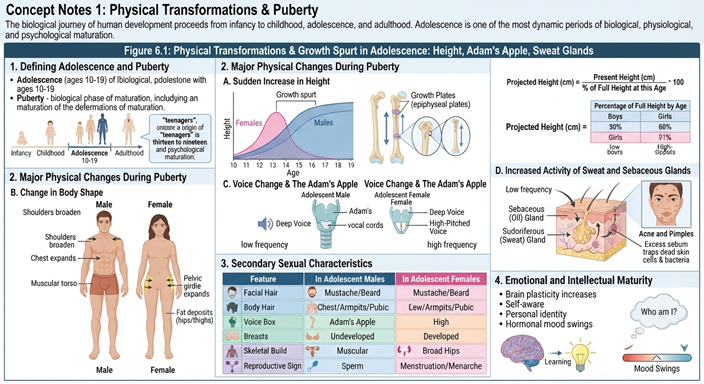
Figure 6.1: Physical Transformations & Growth Spurt in Adolescence: Height, Adam's Apple, Sweat Glands


1. Defining Adolescence and Puberty

  • Adolescence: The transitional developmental phase between childhood and adulthood, generally spanning from ages 10 to 19 years (World Health Organization standard). Adolescents are often referred to as "teenagers" because this span covers ages thirteen to nineteen.
  • Puberty: The specific biological phase within adolescence during which an individual undergoes sexual and physical maturation, becoming capable of sexual reproduction. Puberty ends when an adolescent reaches complete reproductive maturity.

2. Major Physical Changes During Puberty

A. Sudden Increase in Height

  • The most prominent and visible change during puberty is the sudden acceleration in height (the growth spurt).
  • The long bones of the arms (humerus, radius) and legs (femur, tibia) elongate rapidly due to the activity of growth plates (epiphyseal plates).
  • Gender Differences: Girls often grow faster initially, reaching their growth peak between ages 11 and 13. Boys experience their growth spurt slightly later (ages 13 to 15), but continue growing for a longer period, frequently attaining greater average adult height. By approximately age 18, both sexes achieve their maximum genetically determined height.
$$\text{Calculation of Projected Height} = \frac{\text{Present Height (cm)}}{\% \text{ of Full Height at this Age}} \times 100$$

B. Change in Body Shape

  • In Boys: Shoulders broaden, the chest expands, and skeletal muscles develop significantly, creating a broader, more muscular torso.
  • In Girls: The pelvic girdle expands, hips broaden, and fat deposits distribute around the hips and thighs to prepare the anatomical structure for future childbearing.

C. Voice Change & The Adam's Apple

  • During puberty, the voice box or Larynx begins to enlarge significantly.
  • In Boys: The larynx grows considerably larger and protrudes prominently at the anterior throat. This visible bulge is named the Adam's Apple. Because the vocal cords lengthen and become thicker, the voice becomes noticeably deeper and lower in pitch. During the rapid enlargement phase, the muscles of the larynx may momentarily lose coordination, causing the voice to "crack" or become hoarse. This hoarseness is temporary and stabilizes within a few weeks or months.
  • In Girls: The larynx remains smaller and is barely visible from the outside. Consequently, girls develop a higher-pitched, melodic voice.

D. Increased Activity of Sweat and Sebaceous Glands

  • The secretions of Sudoriferous (sweat) glands and Sebaceous (oil) glands increase substantially during puberty under the influence of hormones.
  • Excess sebum (oil) can trap dead skin cells and bacteria in hair follicles, leading to the eruption of acne and pimples on the facial skin of many adolescents.

3. Secondary Sexual Characteristics

Features that help distinguish mature males from mature females, but are not directly part of the reproductive tract, are termed Secondary Sexual Characteristics:

FeatureIn Adolescent MalesIn Adolescent Females
Facial HairGrowth of mustache, beard, and sideburnsAbsent
Body HairProminent hair on chest, armpits, and pubic regionHair in armpits and pubic region
Voice BoxEnlarged larynx (Adam's Apple); low-pitched voiceSmall larynx; high-pitched voice
BreastsRudimentary / undevelopedDevelopment of mammary glands (breasts)
Skeletal BuildBroad shoulders, muscular physiqueBroad hips, wider pelvic structure
Reproductive SignNocturnal emissions; production of viable spermOnset of menstruation (Menarche)

4. Emotional and Intellectual Maturity

Adolescence is also marked by profound neurological growth:

  • Brain plasticity increases, creating a high capacity for learning, critical reasoning, and abstract conceptualization.
  • Adolescents become increasingly self-aware, seeking personal identity, autonomy, and peer connection.
  • Fluctuations in hormonal concentrations can trigger temporary mood swings, anxiety, or emotional sensitivity. Recognizing that these emotional shifts are biological and universal helps adolescents navigate them with confidence.
๐Ÿ“
Comprehensive High-Yield Mathematical Relations & Theorems

Complete step-by-step derivations, step traps, and LaTeX formula sheet breakdowns...

๐Ÿ”’

End of Free Notes Preview

Unlock the complete deck to access full LaTeX formula breakdowns, interactive diagrams, exam traps, and personal margin highlights!

๐Ÿ”‘ Sign In / Register Free
๐Ÿง  Review Due (Interval: 1 Day) Card 1 of 8 (SM-2 Active Recall)
QUESTION (FRONT) Space โ†ต to flip
What is the biological definition of adolescence?
ANSWER & EXPLANATION (BACK) Space โ†ต to flip
Adolescence is the transitional developmental period between childhood and adulthood (ages 10-19) marked by rapid physical, physiological, and emotional changes.
๐Ÿ’ก
Tap Card to Flip & Check Your Answer Active recall prompt: Flip the card or press Space โ†ต to unlock the SM-2 recall difficulty rating.
๐Ÿ”’
Step 4 is Locked

Final Comprehensive Diagnostic Assessment (15 MCQs)

This ๐Ÿ“ LaTeX Concept Notes is part of the full verified curriculum for Chapter 6: Adolescence: A Stage of Growth and Change. Unlock the full deck to gain permanent access to all 11 interactive stages, active recall cards, and diagnostic checkpoints.

Deck Access Price
100% Free with Account
Instant Access
โœ“ UPI & Cards Supported
๐Ÿ”‘ Sign In / Register to Unlock Free →
๐Ÿ”’
Step 5 is Locked

Final Comprehensive Diagnostic Assessment (15 MCQs)

This โšก Diagnostic Quiz is part of the full verified curriculum for Chapter 6: Adolescence: A Stage of Growth and Change. Unlock the full deck to gain permanent access to all 11 interactive stages, active recall cards, and diagnostic checkpoints.

Deck Access Price
100% Free with Account
Instant Access
โœ“ UPI & Cards Supported
๐Ÿ”‘ Sign In / Register to Unlock Free →
๐Ÿ”’
Step 6 is Locked

Final Comprehensive Diagnostic Assessment (15 MCQs)

This Microlearning Step is part of the full verified curriculum for Chapter 6: Adolescence: A Stage of Growth and Change. Unlock the full deck to gain permanent access to all 11 interactive stages, active recall cards, and diagnostic checkpoints.

Deck Access Price
100% Free with Account
Instant Access
โœ“ UPI & Cards Supported
๐Ÿ”‘ Sign In / Register to Unlock Free →
๐Ÿ”’
Step 7 is Locked

Final Comprehensive Diagnostic Assessment (15 MCQs)

This ๐ŸŽฅ Video Lesson is part of the full verified curriculum for Chapter 6: Adolescence: A Stage of Growth and Change. Unlock the full deck to gain permanent access to all 11 interactive stages, active recall cards, and diagnostic checkpoints.

Deck Access Price
100% Free with Account
Instant Access
โœ“ UPI & Cards Supported
๐Ÿ”‘ Sign In / Register to Unlock Free →
๐Ÿ”’
Step 8 is Locked

Final Comprehensive Diagnostic Assessment (15 MCQs)

This ๐Ÿ“ LaTeX Concept Notes is part of the full verified curriculum for Chapter 6: Adolescence: A Stage of Growth and Change. Unlock the full deck to gain permanent access to all 11 interactive stages, active recall cards, and diagnostic checkpoints.

Deck Access Price
100% Free with Account
Instant Access
โœ“ UPI & Cards Supported
๐Ÿ”‘ Sign In / Register to Unlock Free →
๐Ÿ”’
Step 9 is Locked

Final Comprehensive Diagnostic Assessment (15 MCQs)

This ๐Ÿง  Active Recall Flashcards is part of the full verified curriculum for Chapter 6: Adolescence: A Stage of Growth and Change. Unlock the full deck to gain permanent access to all 11 interactive stages, active recall cards, and diagnostic checkpoints.

Deck Access Price
100% Free with Account
Instant Access
โœ“ UPI & Cards Supported
๐Ÿ”‘ Sign In / Register to Unlock Free →
๐Ÿ”’
Step 10 is Locked

Final Comprehensive Diagnostic Assessment (15 MCQs)

This ๐Ÿ“ LaTeX Concept Notes is part of the full verified curriculum for Chapter 6: Adolescence: A Stage of Growth and Change. Unlock the full deck to gain permanent access to all 11 interactive stages, active recall cards, and diagnostic checkpoints.

Deck Access Price
100% Free with Account
Instant Access
โœ“ UPI & Cards Supported
๐Ÿ”‘ Sign In / Register to Unlock Free →
๐Ÿ”’
Step 11 is Locked

Final Comprehensive Diagnostic Assessment (15 MCQs)

This โšก Diagnostic Quiz is part of the full verified curriculum for Chapter 6: Adolescence: A Stage of Growth and Change. Unlock the full deck to gain permanent access to all 11 interactive stages, active recall cards, and diagnostic checkpoints.

Deck Access Price
100% Free with Account
Instant Access
โœ“ UPI & Cards Supported
๐Ÿ”‘ Sign In / Register to Unlock Free →