Chapter 7: Heat Transfer in Nature
๐Ÿ‡ฎ๐Ÿ‡ณ National Curriculum Standard โ–พ
๐Ÿ› Vidyoric Certified โ€ข Dr. Ananya Sharma
๐Ÿ”ฅ 0 days
โšก 0 Sparks +
Chapter 7: Heat Transfer in Nature

Video Lecture 1: The Pathways of Heat โ€” Temperature, Thermometers and Conduction

STEP 1: VIDEO LESSON ๐Ÿ“ค Uploaded HTML5 Video

๐Ÿ“‘ Interactive Chapter Bookmarks

5 chapters
00:00
Introduction & Overview

Syllabus scope and core objectives

โ–ถ
00:45
A tale Of Two Climates

Detailed physical mechanism and derivations

โ–ถ
01:11
Solar Heat And Equator

High-yield board tips and pitfalls

โ–ถ
01:56
Conduction In Solis
โ–ถ
03:56
Land And See Breeze
โ–ถ

๐ŸŽ™๏ธ Synchronized Transcript

๐Ÿ”
Hello, young scientists!

Can we always trust our sense of touch to measure how hot or cold something is?

Let us understand this with a simple experiment. Take three bowls of water. Bowl A contains ice-cold water, Bowl B contains lukewarm water, and Bowl C contains warm water.

Place your left hand in the ice-cold water and your right hand in the warm water for about one minute. Then, place both hands simultaneously into the lukewarm water.

What do you feel? Your left hand senses the lukewarm water as warm, while your right hand senses the same water as cold!

Why does this happen?

Our sense of touch is relative and can sometimes be misleading. Therefore, we cannot depend on it for accurate temperature measurements.

To measure how hot or cold an object is objectively, science uses a physical quantity called **temperature**. The instrument used to measure temperature is called a **thermometer**.

Now, let us explore two commonly used types of thermometers: clinical thermometers and laboratory thermometers.

A **clinical thermometer** is designed to measure human body temperature. A traditional mercury clinical thermometer generally has a range of 35ยฐC to 42ยฐC. The average normal human body temperature is approximately 37ยฐC, or 98.6ยฐF.

Look closely at the clinical thermometer. Just above its bulb, you will notice a narrow constriction called a **kink**.

What is the purpose of this kink?

When the thermometer measures body temperature, the mercury expands and moves up the narrow tube. The kink prevents the mercury from flowing back into the bulb immediately after the thermometer is removed. This allows us to read the temperature conveniently.

A **laboratory thermometer**, on the other hand, is used to measure the temperature of different substances during experiments. A commonly used laboratory thermometer has a range of approximately -10ยฐC to 110ยฐC.

Unlike a clinical thermometer, it does not have a kink. Therefore, its reading should be observed while the bulb remains immersed in the substance being measured.

Today, digital thermometers are also widely used. They use electronic sensors called thermistors to measure temperature and avoid the risks associated with mercury.

Now that we understand temperature and thermometers, let us explore how heat travels from one place to another.

Heat naturally flows from an object at a higher temperature to an object at a lower temperature. This continues until both reach the same temperature. This condition is called **thermal equilibrium**.

One important method of heat transfer is called **conduction**.

Conduction is the transfer of heat through a substance without the substance moving as a whole. It commonly occurs in solids.

Let us understand this through an experiment.

Take a metal rod and attach small metal pins along its length using wax. Now, heat one end of the rod with a flame.

What happens?

The end near the flame becomes hot first. Heat gradually travels through the metal rod. As the wax melts, the pins fall one after another, starting from the heated end.

But how does heat travel through the rod?

When one end of the metal rod is heated, its particles gain energy. They transfer this energy to neighbouring particles. In metals, free electrons also play an important role in transferring thermal energy. In this way, heat travels from the hotter region towards the colder region.

Materials that allow heat to pass through them easily are called **conductors**. Copper, iron, and aluminium are common examples of good heat conductors.

Materials that do not allow heat to pass through them easily are called **insulators**. Wood, plastic, wool, and air are examples of materials that are poor conductors of heat.

Have you ever wondered why two thin blankets can sometimes keep you warmer than one thick blanket?

The reason is the layer of air trapped between the two blankets. Air is a poor conductor of heat. When trapped, it reduces the transfer of heat from your body to the surroundings and helps keep you warm.

Let us quickly revise what we have learned.

Temperature tells us how hot or cold an object is, and a thermometer is used to measure it. Clinical thermometers measure body temperature, while laboratory thermometers measure the temperature of different substances.

Heat flows from a region of higher temperature to a region of lower temperature. Conduction is one method of heat transfer, commonly observed in solids. Conductors allow heat to pass easily, while insulators slow down heat transfer.

But conduction is only one method of heat transfer.

How does heat travel through boiling soup? How does warm air move through the atmosphere and create sea breezes? And how does heat from the Sun travel across the vast emptiness of space?

We will explore these fascinating questions as we learn about convection and radiation in our next lessons.

Keep observing, keep experimenting, and keep exploring the science of heat!

Now, let's explore Concept Notes 1!
STEP 2 โ€ข CONCEPT NOTES โฑ๏ธ 3 min read
๐Ÿ“Œ 0 Notes

Concept Notes 1: Temperature, Thermometry & Conduction

Heat is a form of energy that flows spontaneously from an object at a higher temperature to an object at a lower temperature. Understanding temperature measurement and thermal conduction forms the bedrock of thermal physics.
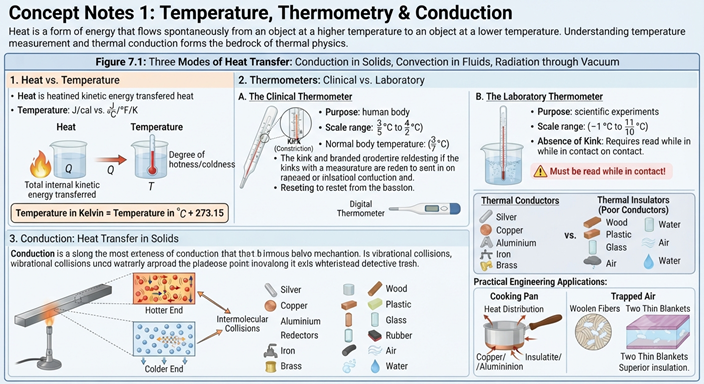
Figure 7.1: Three Modes of Heat Transfer: Conduction in Solids, Convection in Fluids, Radiation through Vacuum


1. Heat vs. Temperature

  • Heat: The total internal kinetic energy transferred between systems due to a temperature difference. Measured in Joules (J) or calories (cal).
  • Temperature: A reliable, objective measure of the degree of hotness or coldness of an object. Measured using the Celsius scale ($^\circ\text{C}$), Fahrenheit scale ($^\circ\text{F}$), or the SI base unit Kelvin ($\text{K}$).
$$\text{Temperature in Kelvin} = \text{Temperature in } ^\circ\text{C} + 273.15$$

2. Thermometers: Clinical vs. Laboratory

Our sense of touch is subjective and easily deceived. Standardized instruments called Thermometers provide accurate, reproducible measurements.

A. The Clinical Thermometer:

  • Purpose: Specifically calibrated to measure the internal temperature of the human body.
  • Temperature Scale Range: $35^\circ\text{C}$ to $42^\circ\text{C}$ (or $94^\circ\text{F}$ to $108^\circ\text{F}$). Normal human body temperature is approximately $37^\circ\text{C}$ ($98.6^\circ\text{F}$).
  • The Kink (Constriction): Features a sharp bend or constriction in the capillary tube just above the mercury bulb.
  • Function: Prevents the mercury thread from falling back into the bulb when the thermometer is removed from the patient's armpit or mouth, allowing accurate reading.
  • To reset the thermometer for another reading, it must be gently jerked downward.
  • Modern Digital Thermometers: Eliminate the use of toxic mercury by utilizing temperature-sensitive electronic thermistors, providing a safe digital readout.

B. The Laboratory Thermometer:

  • Purpose: Used in scientific experiments to measure temperatures of chemical reactions, boiling liquids, and ambient environments.
  • Temperature Scale Range: Typically $-10^\circ\text{C}$ to $110^\circ\text{C}$.
  • Absence of Kink: Does not have a constriction. Therefore, its reading must be recorded while the bulb is still in direct contact with the substance being measured!

3. Conduction: Heat Transfer in Solids

  • Definition: The process by which heat is transferred from the hotter end to the colder end of an object through the progressive vibrational collisions of adjacent atoms or molecules, without any bulk movement of the material itself.
  • Mechanism: When one end of a solid metal bar is heated, particles at that end gain kinetic energy and vibrate intensely. These vibrating particles collide with their neighbors, transferring vibrational energy down the lattice.
  • Thermal Conductors: Substances that allow heat to pass through them readily and rapidly (e.g., Silver, Copper, Aluminium, Iron, Brass).
  • Thermal Insulators (Poor Conductors): Substances that resist the passage of heat (e.g., Wood, Plastic, Glass, Rubber, Cork, Ebonite, Air, Water).

Practical Engineering Applications:

  • Cooking pans are fabricated from copper or aluminium for rapid, uniform heat distribution, but are fitted with handles made of bakelite or wood to protect hands from thermal burns.
  • Trapped Air as an Insulator: Still air has an extremely low thermal conductivity ($k \approx 0.026\text{ W/m}\cdot\text{K}$).
  • Woolen clothing keeps us warm because curly wool fibers trap a high volume of air.
  • Using two thin blankets traps an insulating air layer between them, providing superior thermal protection compared to a single thick blanket of identical total weight!
๐Ÿ“
Comprehensive High-Yield Mathematical Relations & Theorems

Complete step-by-step derivations, step traps, and LaTeX formula sheet breakdowns...

๐Ÿ”’

End of Free Notes Preview

Unlock the complete deck to access full LaTeX formula breakdowns, interactive diagrams, exam traps, and personal margin highlights!

๐Ÿ”‘ Sign In / Register Free
๐Ÿง  Review Due (Interval: 1 Day) Card 1 of 8 (SM-2 Active Recall)
QUESTION (FRONT) Space โ†ต to flip
What is temperature, and what is its standard SI unit?
ANSWER & EXPLANATION (BACK) Space โ†ต to flip
Temperature is an objective measure of the degree of hotness or coldness of an object. Its SI unit is the Kelvin (K), though Celsius (ยฐC) is commonly used.
๐Ÿ’ก
Tap Card to Flip & Check Your Answer Active recall prompt: Flip the card or press Space โ†ต to unlock the SM-2 recall difficulty rating.
๐Ÿ”’
Step 4 is Locked

Final Comprehensive Diagnostic Assessment (15 MCQs)

This ๐Ÿ“ LaTeX Concept Notes is part of the full verified curriculum for Chapter 7: Heat Transfer in Nature. Unlock the full deck to gain permanent access to all 11 interactive stages, active recall cards, and diagnostic checkpoints.

Deck Access Price
100% Free with Account
Instant Access
โœ“ UPI & Cards Supported
๐Ÿ”‘ Sign In / Register to Unlock Free →
๐Ÿ”’
Step 5 is Locked

Final Comprehensive Diagnostic Assessment (15 MCQs)

This โšก Diagnostic Quiz is part of the full verified curriculum for Chapter 7: Heat Transfer in Nature. Unlock the full deck to gain permanent access to all 11 interactive stages, active recall cards, and diagnostic checkpoints.

Deck Access Price
100% Free with Account
Instant Access
โœ“ UPI & Cards Supported
๐Ÿ”‘ Sign In / Register to Unlock Free →
๐Ÿ”’
Step 6 is Locked

Final Comprehensive Diagnostic Assessment (15 MCQs)

This Microlearning Step is part of the full verified curriculum for Chapter 7: Heat Transfer in Nature. Unlock the full deck to gain permanent access to all 11 interactive stages, active recall cards, and diagnostic checkpoints.

Deck Access Price
100% Free with Account
Instant Access
โœ“ UPI & Cards Supported
๐Ÿ”‘ Sign In / Register to Unlock Free →
๐Ÿ”’
Step 7 is Locked

Final Comprehensive Diagnostic Assessment (15 MCQs)

This ๐ŸŽฅ Video Lesson is part of the full verified curriculum for Chapter 7: Heat Transfer in Nature. Unlock the full deck to gain permanent access to all 11 interactive stages, active recall cards, and diagnostic checkpoints.

Deck Access Price
100% Free with Account
Instant Access
โœ“ UPI & Cards Supported
๐Ÿ”‘ Sign In / Register to Unlock Free →
๐Ÿ”’
Step 8 is Locked

Final Comprehensive Diagnostic Assessment (15 MCQs)

This ๐Ÿ“ LaTeX Concept Notes is part of the full verified curriculum for Chapter 7: Heat Transfer in Nature. Unlock the full deck to gain permanent access to all 11 interactive stages, active recall cards, and diagnostic checkpoints.

Deck Access Price
100% Free with Account
Instant Access
โœ“ UPI & Cards Supported
๐Ÿ”‘ Sign In / Register to Unlock Free →
๐Ÿ”’
Step 9 is Locked

Final Comprehensive Diagnostic Assessment (15 MCQs)

This ๐Ÿง  Active Recall Flashcards is part of the full verified curriculum for Chapter 7: Heat Transfer in Nature. Unlock the full deck to gain permanent access to all 11 interactive stages, active recall cards, and diagnostic checkpoints.

Deck Access Price
100% Free with Account
Instant Access
โœ“ UPI & Cards Supported
๐Ÿ”‘ Sign In / Register to Unlock Free →
๐Ÿ”’
Step 10 is Locked

Final Comprehensive Diagnostic Assessment (15 MCQs)

This ๐Ÿ“ LaTeX Concept Notes is part of the full verified curriculum for Chapter 7: Heat Transfer in Nature. Unlock the full deck to gain permanent access to all 11 interactive stages, active recall cards, and diagnostic checkpoints.

Deck Access Price
100% Free with Account
Instant Access
โœ“ UPI & Cards Supported
๐Ÿ”‘ Sign In / Register to Unlock Free →
๐Ÿ”’
Step 11 is Locked

Final Comprehensive Diagnostic Assessment (15 MCQs)

This โšก Diagnostic Quiz is part of the full verified curriculum for Chapter 7: Heat Transfer in Nature. Unlock the full deck to gain permanent access to all 11 interactive stages, active recall cards, and diagnostic checkpoints.

Deck Access Price
100% Free with Account
Instant Access
โœ“ UPI & Cards Supported
๐Ÿ”‘ Sign In / Register to Unlock Free →