Chapter 8: Measurement of Time and Motion
๐Ÿ‡ฎ๐Ÿ‡ณ National Curriculum Standard โ–พ
๐Ÿ› Vidyoric Certified โ€ข Dr. Ananya Sharma
๐Ÿ”ฅ 0 days
โšก 0 Sparks +
Chapter 8: Measurement of Time and Motion

Video Lecture 1: Catching the Seconds โ€” The Story of Time and the Swinging Pendulum

STEP 1: VIDEO LESSON ๐Ÿ“ค Uploaded HTML5 Video

๐Ÿ“‘ Interactive Chapter Bookmarks

4 chapters
00:00
Introduction & Overview

Syllabus scope and core objectives

โ–ถ
01:04
Ancient Clocks

Detailed physical mechanism and derivations

โ–ถ
03:00
The pendulum's Swing

High-yield board tips and pitfalls

โ–ถ
03:45
Calulating Sped
โ–ถ

๐ŸŽ™๏ธ Synchronized Transcript

๐Ÿ”
Hello, young scientists!

Welcome to the fascinating world of time and motion.

Have you ever wondered what time really is? How did people measure time before digital watches and smartphones existed?

Since ancient times, humans have observed that nature follows many repeating and predictable cycles.

The time between one sunrise and the next is called a **day**.

The time between two successive new moons is approximately one **lunar month**.

The time taken by the Earth to complete one revolution around the Sun is called a **year**.

These natural cycles helped our ancestors measure longer periods of time. But how can we measure shorter intervals, such as the time taken to boil an egg or run across a playground?

To measure such intervals accurately, humans developed different instruments based on regular and repeating movements. One important concept behind these instruments is called **periodic motion**.

Let us explore some interesting time-measuring devices used in ancient times.

The first is the **sundial**. It uses the position of the Sun and the shadow cast by a raised object to indicate the time of day. The raised object is called a gnomon.

In India, Maharaja Sawai Jai Singh II built remarkable astronomical instruments at Jantar Mantar in Jaipur. One of the most famous is the Vrihat Samrat Yantra, a massive stone sundial used to measure local solar time.

Another ancient instrument was the **water clock**, also known as the Ghati Yantra. In one traditional design, a small perforated bowl was placed in a larger vessel filled with water. Water gradually entered through the hole, causing the bowl to sink after a measurable interval.

The **hourglass** was another simple time-measuring device. It measures time using sand flowing through a narrow opening from one glass chamber to another under the force of gravity.

All these instruments depended on regular and repeatable physical processes.

Now, let us discover how the swinging pendulum changed the history of time measurement.

In the late sixteenth century, the Italian scientist **Galileo Galilei** studied the motion of a swinging lamp in a cathedral in Pisa. According to the well-known account, he compared its swinging rhythm with his own heartbeat.

His observations helped develop the understanding of an important property of pendulum motion: for small swings, the time taken for each complete oscillation is nearly the same, even when the swing is slightly wider or narrower.

This principle is associated with the **simple pendulum**.

A simple pendulum consists of a small, heavy object called a **bob**, suspended from a fixed support by a light, inextensible thread.

When the bob is pulled slightly to one side and released, it moves to and fro about its mean position. This repeated motion is called oscillatory motion.

The time taken by the pendulum to complete one full oscillation is called its **time period**, represented by the symbol T.

One complete oscillation means the bob moves from one extreme position to the other and returns to its starting position.

The pendulum became an important tool for accurate timekeeping. In 1656, the Dutch scientist Christiaan Huygens developed a practical pendulum clock, making time measurement more reliable.

In this chapter, we will explore the mathematics of pendulum motion, learn how to calculate speed, convert units from kilometres per hour to metres per second, and understand how to interpret distance-time graphs.

These concepts will help us understand how objects move and how their motion can be measured scientifically.

So, let us begin our journey with Concept Notes 1!

Keep observing, keep measuring, and keep discovering the science of time and motion.
STEP 2 โ€ข CONCEPT NOTES โฑ๏ธ 3 min read
๐Ÿ“Œ 0 Notes

Concept Notes 1: Chronometry & Periodic Motion

Time is the continuous progression of existence from the past through the present into the future. The measurement of time relies fundamentally on natural or artificial periodic phenomenaโ€”events that repeat themselves at regular, identical intervals.
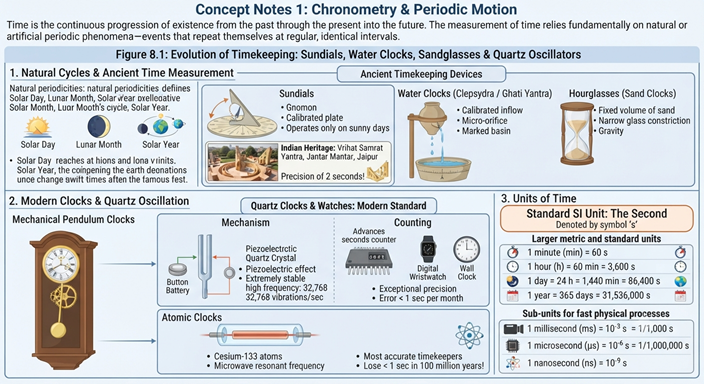
Figure 8.1: Evolution of Timekeeping: Sundials, Water Clocks, Sandglasses & Quartz Oscillators


1. Natural Cycles & Ancient Time Measurement

Before the invention of mechanical timepieces, early civilizations utilized natural celestial periodicities:

  1. A Solar Day: The time interval between one sunrise and the next consecutive sunrise.
  2. A Lunar Month: The time interval from one new moon (Amavasya) to the next consecutive new moon.
  3. A Solar Year: The time taken by the Earth to complete one full orbital revolution around the Sun (approximately 365.25 days).

Ancient Timekeeping Devices:

  • Sundials: Instruments that measure time by observing the position and length of the shadow cast by a central triangular upright (called a Gnomon) onto a calibrated horizontal or hemispherical plate as the Sun crosses the sky.
  • Limitation: Sundials only operate on sunny days and cannot function at night or under overcast skies.
  • Indian Heritage: Maharaja Sawai Jai Singh II built five astronomical observatories (Jantar Mantar) in Jaipur, Delhi, Ujjain, Varanasi, and Mathura in the early 18th century. The Vrihat Samrat Yantra in Jaipur is the world's largest stone sundial, measuring time to an astonishing precision of 2 seconds!
  • Water Clocks (Clepsydra / Ghati Yantra): Measured time by the calibrated inflow or outflow of water through a micro-orifice into a marked basin.
  • Hourglasses (Sand Clocks): Regulated the passage of a fixed volume of uniform sand grains through a narrow glass constriction between two bulbous chambers under gravity.

2. Modern Clocks & Quartz Oscillation

  • Mechanical Pendulum Clocks: Rely on the periodic oscillations of a weighted pendulum regulated by an escapement wheel and gear train.
  • Quartz Clocks & Watches: The modern global standard for timekeeping.
  • Mechanism: They contain a tiny piezoelectric quartz crystal cut into the shape of a miniature tuning fork.
  • When an electric voltage from a button battery is applied, the quartz vibrates at an extremely stable, high frequency (exactly 32,768 times per second).
  • An integrated microchip counts these vibrations and advances the seconds counter, delivering exceptional precision with an error of less than one second per month!
  • Atomic Clocks: The most accurate timekeepers in human history, governed by the ultra-stable microwave resonant frequency of cesium-133 atoms, losing less than 1 second in 100 million years!

3. Units of Time

  • The standard SI base unit of time is the Second, denoted by the lowercase symbol $\text{s}$.
  • Larger metric and standard units:
  • 1 minute ($\text{min}$) = $60\text{ s}$
  • 1 hour ($\text{h}$) = $60\text{ min} = 3,600\text{ s}$
  • 1 day = $24\text{ h} = 1,440\text{ min} = 86,400\text{ s}$
  • 1 year = $365\text{ days} = 31,536,000\text{ s}$
  • Sub-units for fast physical processes:
  • 1 millisecond ($\text{ms}$) = $10^{-3}\text{ s} = \frac{1}{1,000}\text{ s}$
  • 1 microsecond ($\mu\text{s}$) = $10^{-6}\text{ s} = \frac{1}{1,000,000}\text{ s}$
  • 1 nanosecond ($\text{ns}$) = $10^{-9}\text{ s}$
๐Ÿ“
Comprehensive High-Yield Mathematical Relations & Theorems

Complete step-by-step derivations, step traps, and LaTeX formula sheet breakdowns...

๐Ÿ”’

End of Free Notes Preview

Unlock the complete deck to access full LaTeX formula breakdowns, interactive diagrams, exam traps, and personal margin highlights!

๐Ÿ”‘ Sign In / Register Free
๐Ÿง  Review Due (Interval: 1 Day) Card 1 of 8 (SM-2 Active Recall)
QUESTION (FRONT) Space โ†ต to flip
What is periodic motion, and why is it essential for timekeeping?
ANSWER & EXPLANATION (BACK) Space โ†ต to flip
Periodic motion is motion that repeats itself at regular, equal intervals of time. It provides a consistent, reproducible standard to count and measure time units.
๐Ÿ’ก
Tap Card to Flip & Check Your Answer Active recall prompt: Flip the card or press Space โ†ต to unlock the SM-2 recall difficulty rating.
๐Ÿ”’
Step 4 is Locked

Final Comprehensive Diagnostic Assessment (15 MCQs)

This ๐Ÿ“ LaTeX Concept Notes is part of the full verified curriculum for Chapter 8: Measurement of Time and Motion. Unlock the full deck to gain permanent access to all 11 interactive stages, active recall cards, and diagnostic checkpoints.

Deck Access Price
100% Free with Account
Instant Access
โœ“ UPI & Cards Supported
๐Ÿ”‘ Sign In / Register to Unlock Free →
๐Ÿ”’
Step 5 is Locked

Final Comprehensive Diagnostic Assessment (15 MCQs)

This โšก Diagnostic Quiz is part of the full verified curriculum for Chapter 8: Measurement of Time and Motion. Unlock the full deck to gain permanent access to all 11 interactive stages, active recall cards, and diagnostic checkpoints.

Deck Access Price
100% Free with Account
Instant Access
โœ“ UPI & Cards Supported
๐Ÿ”‘ Sign In / Register to Unlock Free →
๐Ÿ”’
Step 6 is Locked

Final Comprehensive Diagnostic Assessment (15 MCQs)

This Microlearning Step is part of the full verified curriculum for Chapter 8: Measurement of Time and Motion. Unlock the full deck to gain permanent access to all 11 interactive stages, active recall cards, and diagnostic checkpoints.

Deck Access Price
100% Free with Account
Instant Access
โœ“ UPI & Cards Supported
๐Ÿ”‘ Sign In / Register to Unlock Free →
๐Ÿ”’
Step 7 is Locked

Final Comprehensive Diagnostic Assessment (15 MCQs)

This ๐ŸŽฅ Video Lesson is part of the full verified curriculum for Chapter 8: Measurement of Time and Motion. Unlock the full deck to gain permanent access to all 11 interactive stages, active recall cards, and diagnostic checkpoints.

Deck Access Price
100% Free with Account
Instant Access
โœ“ UPI & Cards Supported
๐Ÿ”‘ Sign In / Register to Unlock Free →
๐Ÿ”’
Step 8 is Locked

Final Comprehensive Diagnostic Assessment (15 MCQs)

This ๐Ÿ“ LaTeX Concept Notes is part of the full verified curriculum for Chapter 8: Measurement of Time and Motion. Unlock the full deck to gain permanent access to all 11 interactive stages, active recall cards, and diagnostic checkpoints.

Deck Access Price
100% Free with Account
Instant Access
โœ“ UPI & Cards Supported
๐Ÿ”‘ Sign In / Register to Unlock Free →
๐Ÿ”’
Step 9 is Locked

Final Comprehensive Diagnostic Assessment (15 MCQs)

This ๐Ÿง  Active Recall Flashcards is part of the full verified curriculum for Chapter 8: Measurement of Time and Motion. Unlock the full deck to gain permanent access to all 11 interactive stages, active recall cards, and diagnostic checkpoints.

Deck Access Price
100% Free with Account
Instant Access
โœ“ UPI & Cards Supported
๐Ÿ”‘ Sign In / Register to Unlock Free →
๐Ÿ”’
Step 10 is Locked

Final Comprehensive Diagnostic Assessment (15 MCQs)

This ๐Ÿ“ LaTeX Concept Notes is part of the full verified curriculum for Chapter 8: Measurement of Time and Motion. Unlock the full deck to gain permanent access to all 11 interactive stages, active recall cards, and diagnostic checkpoints.

Deck Access Price
100% Free with Account
Instant Access
โœ“ UPI & Cards Supported
๐Ÿ”‘ Sign In / Register to Unlock Free →
๐Ÿ”’
Step 11 is Locked

Final Comprehensive Diagnostic Assessment (15 MCQs)

This โšก Diagnostic Quiz is part of the full verified curriculum for Chapter 8: Measurement of Time and Motion. Unlock the full deck to gain permanent access to all 11 interactive stages, active recall cards, and diagnostic checkpoints.

Deck Access Price
100% Free with Account
Instant Access
โœ“ UPI & Cards Supported
๐Ÿ”‘ Sign In / Register to Unlock Free →