Chapter 9: Life Processes in Animals
๐Ÿ‡ฎ๐Ÿ‡ณ National Curriculum Standard โ–พ
๐Ÿ› Vidyoric Certified โ€ข Dr. Ananya Sharma
๐Ÿ”ฅ 0 days
โšก 0 Sparks +
Chapter 9: Life Processes in Animals

Video Lecture 1: The Engine of Life โ€” Food, Enzymes and the Digestive Canal

STEP 1: VIDEO LESSON ๐Ÿ“ค Uploaded HTML5 Video

๐Ÿ“‘ Interactive Chapter Bookmarks

6 chapters
00:00
Introduction & Overview

Syllabus scope and core objectives

โ–ถ
01:00
Fueling The Body

Detailed physical mechanism and derivations

โ–ถ
01:57
Mouth's Sweet Secret

High-yield board tips and pitfalls

โ–ถ
03:23
Down The food pipe
โ–ถ
03:40
Inside The Stomach
โ–ถ
04:24
Small Intestine Magic
โ–ถ

๐ŸŽ™๏ธ Synchronized Transcript

๐Ÿ”
Hello, young biologists!

Welcome to the fascinating world of life processes in animals.

Every living organism needs energy to survive, grow, and carry out its daily activities. Whether it is an eagle flying through the sky, a tiger running across a field, or a student reading a science textbook, every living organism requires nutrients and oxygen to keep its cells functioning.

Unlike green plants, animals cannot prepare their own food through photosynthesis. They depend on plants or other animals for nutrition. Such organisms are called **heterotrophs**.

Animals take in food, break it down into simpler substances, absorb useful nutrients, and transport them to different parts of the body. These nutrients help the body grow, repair damaged tissues, and obtain energy. Animals also remove waste materials produced during life processes.

In this lesson, we will explore the human digestive system and understand how food travels through the body.

Let us begin by understanding the five main stages of nutrition in animals.

The first stage is **ingestion**. It is the process of taking food into the body through the mouth.

The second stage is **digestion**. During digestion, complex food substances are broken down into simpler, soluble substances that the body can absorb.

The third stage is **absorption**. It is the process by which digested nutrients pass through the intestinal wall into the blood or lymph.

The fourth stage is **assimilation**. During assimilation, absorbed nutrients are used by body cells for energy, growth, repair, and other important functions.

The fifth stage is **egestion**. It is the removal of undigested and unabsorbed food materials from the body through the anus.

Now, let us follow the journey of a bite of food through the human digestive system.

The journey begins in the **mouth**.

Our teeth break food into smaller pieces through chewing. This is called mechanical digestion. At the same time, the salivary glands release saliva, which contains an enzyme called **salivary amylase**.

Salivary amylase begins the digestion of starch by breaking it down into smaller carbohydrate molecules, including maltose.

After chewing, the food mixes with saliva and forms a soft mass called a bolus. It then moves into the oesophagus, also known as the food pipe.

The oesophagus connects the mouth to the stomach. Its muscular walls contract and relax in a wave-like movement to push food downwards. This movement is called **peristalsis**.

Next, the food reaches the **stomach**, a muscular, J-shaped organ.

The stomach churns and mixes food with gastric juice secreted by its gastric glands. Gastric juice contains three important substances.

First, **hydrochloric acid**, or HCl, creates an acidic environment in the stomach. It helps kill many harmful microorganisms that enter with food and provides suitable conditions for the enzyme pepsin.

Second, **pepsin** is an enzyme that begins the digestion of proteins by breaking them into smaller peptides.

Third, **mucus** protects the inner lining of the stomach from the action of acid and digestive enzymes.

After partial digestion in the stomach, food moves into the **small intestine**.

The small intestine is the main site where most chemical digestion and nutrient absorption take place.

It receives digestive secretions from two important organs: the liver and the pancreas.

The **liver** produces a digestive fluid called bile. Bile is stored in the gallbladder and released into the small intestine when needed.

Bile does not contain digestive enzymes. Instead, it helps break large fat globules into smaller droplets through a process called **emulsification**. This increases the surface area available for the action of fat-digesting enzymes.

The **pancreas** releases pancreatic juice into the small intestine. This juice contains enzymes that help digest carbohydrates, proteins, and fats.

The inner wall of the small intestine has millions of tiny, finger-like projections called **villi**.

These villi greatly increase the surface area available for absorption. Each villus contains blood capillaries and a lymph vessel. Digested nutrients are absorbed through the intestinal wall and transported to different parts of the body.

The remaining undigested material then passes into the large intestine, where water and some salts are absorbed. The remaining waste is eventually stored in the rectum and removed through the anus.

Isn't it fascinating how different organs work together to digest food and provide nutrients to the entire body?

In our next lessons, we will explore how cows digest grass with the help of microorganisms, compare respiration in humans, fish, and insects, and understand how blood circulates through the four chambers of the human heart.

So, let us begin with Concept Notes 1!

Keep observing, keep questioning, and keep discovering the science of life!
STEP 2 โ€ข CONCEPT NOTES โฑ๏ธ 3 min read
๐Ÿ“Œ 0 Notes

Concept Notes 1: Animal Nutrition & The Digestive Canal

Animals are heterotrophic organisms that rely on organic nutrients synthesized by plants or other animals. Animal nutrition encompasses nutrient requirements, the mode of food intake, and its biochemical utilization within the organism.
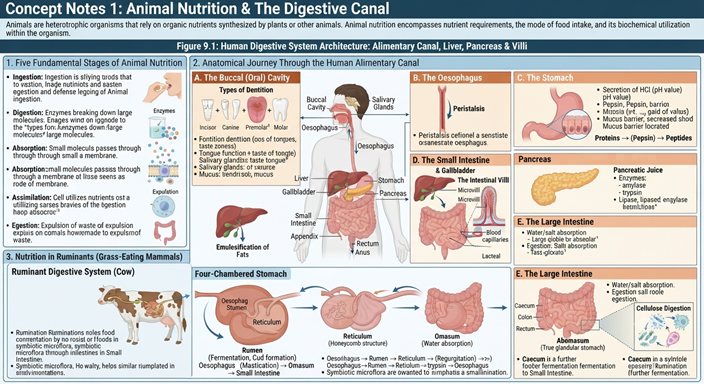
Figure 9.1: Human Digestive System Architecture: Alimentary Canal, Liver, Pancreas & Villi


1. Five Fundamental Stages of Animal Nutrition

  1. Ingestion: The biological process of taking food into the organism through the oral cavity.
  2. Digestion: The mechanical breakdown and enzymatic hydrolysis of complex, insoluble organic macromolecules into simple, soluble, diffusible molecules.
  3. Absorption: The physiological passage of simple digested nutrient molecules across the intestinal mucosal membrane into the vascular and lymphatic circulation.
  4. Assimilation: The transport and uptake of absorbed nutrients by body cells, where they are utilized for cellular respiration, growth, repair, and biosynthesis.
  5. Egestion: The expulsion of undigested, unabsorbed fecal residue from the alimentary canal through the anal orifice.

2. Anatomical Journey Through the Human Alimentary Canal

The human alimentary canal is a continuous, muscular, coiled tubular pathway measuring approximately 8 to 9 metres in length:

A. The Buccal (Oral) Cavity:

  • Dentition: Humans possess diphyodont and heterodont dentition, categorized into four distinct functional dental types:
  • Incisors (8 total): Flat, chisel-edged front teeth for biting and cutting food.
  • Canines (4 total): Sharp, pointed teeth flanking incisors for piercing and tearing food.
  • Premolars (8 total): Broad bicuspid grinding surfaces for crushing food.
  • Molars (12 total): Broad, multi-cusped posterior teeth for masticating and pulverizing food.
  • The Tongue: A voluntary muscular organ that manipulates food during chewing, mixes it with saliva, bears taste buds (sweet, salty, sour, bitter, umami), and initiates swallowing.
  • Salivary Glands: Three pairs of salivary glands secrete Saliva, containing:
  • Salivary Amylase (Ptyalin): Breaks down insoluble starch into soluble disaccharide sugars (maltose):
$$\text{Starch} \xrightarrow{\text{Salivary Amylase}} \text{Maltose}$$
  • Mucus: Lubricates masticated food particles into a soft, cohesive bolus.

B. The Oesophagus:

  • A muscular conduit connecting the pharynx to the stomach.
  • Food moves downward via involuntary, rhythmic wave-like contractions of circular and longitudinal smooth muscles known as Peristalsis. No chemical digestion occurs in the oesophagus.

C. The Stomach:

  • A muscular, J-shaped dilatable sac situated in the upper left abdominal cavity.
  • The stomach wall contains gastric glands that secrete Gastric Juice, which includes:
  1. Hydrochloric Acid ($\text{HCl}$): Kills ingested pathogenic microorganisms and establishes an optimal acidic medium ($pH \approx 1.5 - 2.5$) to activate gastric enzymes.
  2. Pepsin: A proteolytic enzyme that hydrolyzes large protein molecules into smaller peptide chains (peptones and proteoses).
  3. Mucus: Forms a continuous protective barrier along the gastric mucosa, shielding it from autodigestion by hydrochloric acid.

D. The Small Intestine:

  • The longest portion of the alimentary canal (measuring approximately $7.5\text{ m}$ in adults), consisting of the duodenum, jejunum, and ileum. It is the primary site of complete chemical digestion and nutrient absorption.
  • Associated Digestive Glands:
  • The Liver: The largest internal glandular organ. Synthesizes Bile Juice, which is concentrated and stored in the Gallbladder. Bile contains no digestive enzymes but is rich in bile salts that perform Emulsification (breaking large hydrophobic lipid globules into microscopic droplets to enhance lipase action).
  • The Pancreas: A cream-colored gland situated beneath the stomach. Secretes Pancreatic Juice containing pancreatic amylase, trypsin (for protein digestion), and pancreatic lipase (for lipid hydrolysis).
  • The Intestinal Mucosa & Villi:
  • The inner surface of the ileum is folded into millions of microscopic, finger-like projections called Villi (singular: Villus), and each epithelial cell bears microscopic microvilli.
  • Function: Increases the internal absorptive surface area over 600-fold!
  • Each villus is supplied with an extensive network of blood capillaries and a central lymphatic vessel called a Lacteal (which absorbs digested fatty acids and glycerol).

E. The Large Intestine:

  • Measuring approximately $1.5\text{ m}$ in length, it consists of the caecum, colon, and rectum.
  • Does not secrete digestive enzymes; its primary function is the absorption of water and residual mineral salts from the indigestible food mass.
  • Undigested waste is formed into semi-solid feces, stored in the Rectum, and periodically evacuated through the Anus (egestion).

3. Nutrition in Ruminants (Grass-Eating Mammals)

  • Ruminants (cows, buffaloes, sheep, deer) feed on cellulose-rich grass. Mammalian enzymes cannot break down cellulose $\beta$-glycosidic linkages.
  • The Ruminant Stomach Architecture:
  • Has four compartments: Rumen, Reticulum, Omasum, and Abomasum (the true glandular stomach).
  • Swallowed unchewed grass enters the Rumen, where a dense population of symbiotic anaerobic bacteria and ciliate protozoa ferment the cellulose into cud.
  • The semi-digested Cud is regurgitated back into the oral cavity in small boluses for thorough mastication (Rumination).
  • The Caecum: A large blind sac located at the ileocecal junction housing specialized symbiotic microflora that complete cellulose fermentation.
๐Ÿ“
Comprehensive High-Yield Mathematical Relations & Theorems

Complete step-by-step derivations, step traps, and LaTeX formula sheet breakdowns...

๐Ÿ”’

End of Free Notes Preview

Unlock the complete deck to access full LaTeX formula breakdowns, interactive diagrams, exam traps, and personal margin highlights!

๐Ÿ”‘ Sign In / Register Free
๐Ÿง  Review Due (Interval: 1 Day) Card 1 of 8 (SM-2 Active Recall)
QUESTION (FRONT) Space โ†ต to flip
What are the five successive stages of animal nutrition in correct chronological order?
ANSWER & EXPLANATION (BACK) Space โ†ต to flip
1. Ingestion, 2. Digestion, 3. Absorption, 4. Assimilation, and 5. Egestion.
๐Ÿ’ก
Tap Card to Flip & Check Your Answer Active recall prompt: Flip the card or press Space โ†ต to unlock the SM-2 recall difficulty rating.
๐Ÿ”’
Step 4 is Locked

Final Comprehensive Diagnostic Assessment (15 MCQs)

This ๐Ÿ“ LaTeX Concept Notes is part of the full verified curriculum for Chapter 9: Life Processes in Animals. Unlock the full deck to gain permanent access to all 11 interactive stages, active recall cards, and diagnostic checkpoints.

Deck Access Price
100% Free with Account
Instant Access
โœ“ UPI & Cards Supported
๐Ÿ”‘ Sign In / Register to Unlock Free →
๐Ÿ”’
Step 5 is Locked

Final Comprehensive Diagnostic Assessment (15 MCQs)

This โšก Diagnostic Quiz is part of the full verified curriculum for Chapter 9: Life Processes in Animals. Unlock the full deck to gain permanent access to all 11 interactive stages, active recall cards, and diagnostic checkpoints.

Deck Access Price
100% Free with Account
Instant Access
โœ“ UPI & Cards Supported
๐Ÿ”‘ Sign In / Register to Unlock Free →
๐Ÿ”’
Step 6 is Locked

Final Comprehensive Diagnostic Assessment (15 MCQs)

This Microlearning Step is part of the full verified curriculum for Chapter 9: Life Processes in Animals. Unlock the full deck to gain permanent access to all 11 interactive stages, active recall cards, and diagnostic checkpoints.

Deck Access Price
100% Free with Account
Instant Access
โœ“ UPI & Cards Supported
๐Ÿ”‘ Sign In / Register to Unlock Free →
๐Ÿ”’
Step 7 is Locked

Final Comprehensive Diagnostic Assessment (15 MCQs)

This ๐ŸŽฅ Video Lesson is part of the full verified curriculum for Chapter 9: Life Processes in Animals. Unlock the full deck to gain permanent access to all 11 interactive stages, active recall cards, and diagnostic checkpoints.

Deck Access Price
100% Free with Account
Instant Access
โœ“ UPI & Cards Supported
๐Ÿ”‘ Sign In / Register to Unlock Free →
๐Ÿ”’
Step 8 is Locked

Final Comprehensive Diagnostic Assessment (15 MCQs)

This ๐Ÿ“ LaTeX Concept Notes is part of the full verified curriculum for Chapter 9: Life Processes in Animals. Unlock the full deck to gain permanent access to all 11 interactive stages, active recall cards, and diagnostic checkpoints.

Deck Access Price
100% Free with Account
Instant Access
โœ“ UPI & Cards Supported
๐Ÿ”‘ Sign In / Register to Unlock Free →
๐Ÿ”’
Step 9 is Locked

Final Comprehensive Diagnostic Assessment (15 MCQs)

This ๐Ÿง  Active Recall Flashcards is part of the full verified curriculum for Chapter 9: Life Processes in Animals. Unlock the full deck to gain permanent access to all 11 interactive stages, active recall cards, and diagnostic checkpoints.

Deck Access Price
100% Free with Account
Instant Access
โœ“ UPI & Cards Supported
๐Ÿ”‘ Sign In / Register to Unlock Free →
๐Ÿ”’
Step 10 is Locked

Final Comprehensive Diagnostic Assessment (15 MCQs)

This ๐Ÿ“ LaTeX Concept Notes is part of the full verified curriculum for Chapter 9: Life Processes in Animals. Unlock the full deck to gain permanent access to all 11 interactive stages, active recall cards, and diagnostic checkpoints.

Deck Access Price
100% Free with Account
Instant Access
โœ“ UPI & Cards Supported
๐Ÿ”‘ Sign In / Register to Unlock Free →
๐Ÿ”’
Step 11 is Locked

Final Comprehensive Diagnostic Assessment (15 MCQs)

This โšก Diagnostic Quiz is part of the full verified curriculum for Chapter 9: Life Processes in Animals. Unlock the full deck to gain permanent access to all 11 interactive stages, active recall cards, and diagnostic checkpoints.

Deck Access Price
100% Free with Account
Instant Access
โœ“ UPI & Cards Supported
๐Ÿ”‘ Sign In / Register to Unlock Free →