Chapter 10: Life Processes in Plants
๐Ÿ‡ฎ๐Ÿ‡ณ National Curriculum Standard โ–พ
๐Ÿ› Vidyoric Certified โ€ข Dr. Ananya Sharma
๐Ÿ”ฅ 0 days
โšก 0 Sparks +
Chapter 10: Life Processes in Plants

Video Lecture 1: Sunlight into Sugar โ€” The Molecular Symphony of Photosynthesis

STEP 1: VIDEO LESSON ๐Ÿ“ค Uploaded HTML5 Video

๐Ÿ“‘ Interactive Chapter Bookmarks

4 chapters
00:00
Introduction & Overview

Syllabus scope and core objectives

โ–ถ
01:48
Testing Sunlight And Water

Detailed physical mechanism and derivations

โ–ถ
03:27
The Secret Recipe

High-yield board tips and pitfalls

โ–ถ
04:23
The Hidden Mechanism
โ–ถ

๐ŸŽ™๏ธ Synchronized Transcript

๐Ÿ”
Hello, young scientists!

Welcome to the fascinating world of life processes in plants.

Look at the green plants and trees around you. Every living organism, from the smallest insect to the largest elephant, depends directly or indirectly on plants for food.

Plants are the primary producers of most ecosystems. They are called **autotrophs** because they can prepare their own food.

Unlike animals, green plants do not need to search for food. They use sunlight, carbon dioxide from the atmosphere, and water from the soil to prepare glucose and release oxygen. This remarkable process is called **photosynthesis**.

Let us explore how this process takes place inside a leaf.

A leaf acts like a natural food factory. Inside its cells are tiny structures called **chloroplasts**. These chloroplasts contain a green pigment called **chlorophyll**, which absorbs light energy from the Sun. This energy is used to drive the process of photosynthesis.

But how does carbon dioxide enter the leaf?

The surface of a leaf contains many tiny pores called **stomata**. The singular form is stoma. These pores allow gases to move in and out of the leaf.

Each stoma is surrounded by two special cells called **guard cells**. These cells control the opening and closing of the stomata. Carbon dioxide enters through these pores, while oxygen produced during photosynthesis can escape through them. Water vapour also passes out through the stomata during transpiration.

Now, let us understand the chemical equation of photosynthesis.

Six molecules of carbon dioxide combine with six molecules of water in the presence of sunlight and chlorophyll to produce one molecule of glucose and six molecules of oxygen.

The equation is:

6COโ‚‚ + 6Hโ‚‚O โ€”(Sunlight and Chlorophyll)โ†’ Cโ‚†Hโ‚โ‚‚Oโ‚† + 6Oโ‚‚

The glucose produced during photosynthesis is used by the plant for energy and growth. Some of it is converted into starch and stored for future use.

How can we prove that a leaf contains starch?

We can perform a simple iodine test. When iodine solution is added to a leaf containing starch, it turns blue-black. This colour change indicates the presence of starch and provides evidence that photosynthesis has taken place.

Now, you might think that all plants prepare their food in the same way. However, some plants have special methods of obtaining nutrition.

Let us explore three interesting examples.

First, we have **parasitic plants**.

Look at a plant called Cuscuta, commonly known as Amarbel. It has yellow, thread-like stems and lacks chlorophyll. Therefore, it cannot prepare its own food through photosynthesis. Instead, it grows on another plant and absorbs prepared food and water from its host through special structures called **haustoria**.

Second, we have **insectivorous plants**.

The pitcher plant and Venus flytrap are fascinating examples. These plants can perform photosynthesis, but they often grow in soil that lacks sufficient nitrogen.

To obtain additional nutrients, they trap and digest insects.

The pitcher plant has modified leaves shaped like containers. Insects enter these pitchers, become trapped, and are digested by enzymes.

The Venus flytrap has special leaves that close when an insect touches their sensitive trigger structures.

These plants obtain nutrients such as nitrogen from insects, while continuing to prepare their own food through photosynthesis.

Third, let us understand **saprotrophic nutrition and symbiosis**.

Fungi, such as mushrooms, obtain nutrients from dead and decaying organic matter. They release digestive enzymes onto this material and absorb the simpler substances produced. This mode of nutrition is called saprotrophic nutrition.

Another interesting example is **lichen**. Lichens are formed through a close association between a fungus and an alga or a photosynthetic bacterium.

The photosynthetic partner prepares food, while the fungus provides protection and helps retain water and minerals. Both partners benefit from this relationship.

Isn't it fascinating how different organisms have developed different ways of obtaining nutrition?

Let us quickly revise what we have learned.

Green plants are autotrophs because they prepare their own food through photosynthesis. Chlorophyll absorbs light energy, while stomata allow the exchange of gases. Glucose is produced during photosynthesis, and some of it is stored as starch.

Cuscuta is a parasitic plant, pitcher plants and Venus flytraps are insectivorous plants, fungi show saprotrophic nutrition, and lichens demonstrate symbiosis.

Plants are not only responsible for producing food but also play an essential role in maintaining the balance of gases in the atmosphere and supporting life on Earth.

In our next lessons, we will explore how plants transport water and food through specialised tissues and how flowers reproduce through pollination.

Now, let's explore Concept Notes 1 and strengthen our understanding of plant nutrition!

Keep observing, keep questioning, and keep discovering the science of plants!
STEP 2 โ€ข CONCEPT NOTES โฑ๏ธ 3 min read
๐Ÿ“Œ 0 Notes

Concept Notes 1: Photosynthesis & Autotrophic Plant Nutrition

Green plants are the primary energetic foundation of terrestrial ecosystems. By capturing solar photons, plants convert inorganic molecules into complex organic compounds through Photosynthesis.
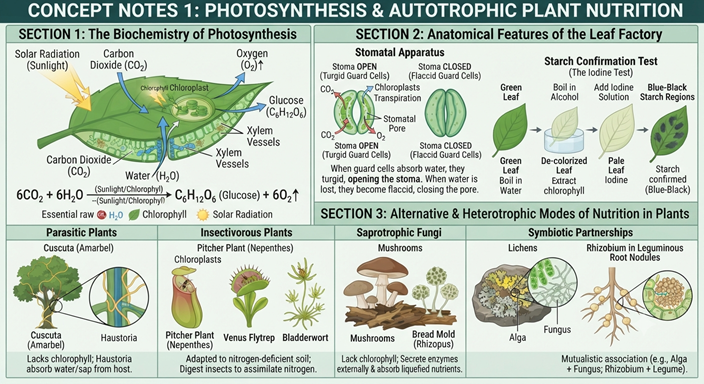
Figure 10.1: Photosynthetic Machinery: Chloroplasts, Stomata Guard Cells & Transpiration


1. The Biochemistry of Photosynthesis

  • Definition: The fundamental biochemical process through which chlorophyll-bearing plant cells synthesize carbohydrates (glucose) from carbon dioxide and water in the presence of sunlight, releasing oxygen as a byproduct.
  • Balanced Chemical Equation:
$$6\text{CO}_2 + 6\text{H}_2\text{O} \xrightarrow[\text{Chlorophyll}]{\text{Sunlight}} \text{C}_6\text{H}_{12}\text{O}_6 \text{ (Glucose)} + 6\text{O}_2\uparrow$$
  • Essential Raw Materials:
  1. Carbon Dioxide ($\text{CO}_2$): Diffuses from atmospheric air into leaf mesophyll via microscopic Stomata.
  2. Water ($\text{H}_2\text{O}$): Absorbed from soil by root hairs and transported upward through Xylem vessels.
  3. Chlorophyll: The green magnesium-porphyrin pigment housed within specialized membrane-bound organelles called Chloroplasts.
  4. Solar Radiation (Sunlight): Provides photons of light energy to drive the endergonic synthesis of chemical bonds.

2. Anatomical Features of the Leaf Factory

  • Stomatal Apparatus:
  • Microscopic pores situated primarily on the abaxial (lower) epidermal layer of leaves.
  • Flanked by a pair of specialized, crescent-shaped Guard Cells containing chloroplasts.
  • Mechanism of Action: When guard cells absorb water by osmosis, they become turgid, bowing outward to open the stomatal aperture. When water is lost, guard cells become flaccid, closing the pore.
  • Functions: Governs atmospheric gas exchange ($\text{CO}_2$ influx and $\text{O}_2$ efflux) and facilitates Transpiration.
  • Starch Confirmation Test (The Iodine Test):
  • A green leaf is boiled in water to denature cell membranes, then de-colorized by boiling in alcohol inside a water bath to extract chlorophyll.
  • When dilute Iodine solution is added to the pale leaf, regions containing starch turn a distinctive blue-black color, confirming that photosynthesis occurred.

3. Alternative & Heterotrophic Modes of Nutrition in Plants

While the majority of plants are autotrophic, several specialized lineages exhibit heterotrophic adaptations:

Plant CategoryRepresentative ExamplesAdaptive Mechanism
Parasitic PlantsCuscuta (Amarbel)Completely lacks chlorophyll; coils yellowish leafless vines around host trees, inserting microscopic sucking roots called Haustoria into host vascular bundles to absorb water and sap.
Insectivorous PlantsPitcher Plant (Nepenthes), Venus Flytrap, BladderwortGrow in nitrogen-deficient waterlogged bogs. Leaves are modified into pitfall pitchers with downward-pointing hairs and digestive enzymes to digest insects and assimilate nitrogen.
Saprotrophic FungiMushrooms, Bread Mold (Rhizopus), YeastLack chlorophyll; secrete extracellular digestive enzymes directly onto decaying organic matter and absorb the liquefied nutrients.
Symbiotic PartnershipsLichens (Alga + Fungus); Rhizobium in Leguminous root nodulesMutualistic association where each partner provides reciprocal benefits: alga synthesizes carbohydrates via photosynthesis; fungus provides structural anchoring, water, and mineral salts.
๐Ÿ“
Comprehensive High-Yield Mathematical Relations & Theorems

Complete step-by-step derivations, step traps, and LaTeX formula sheet breakdowns...

๐Ÿ”’

End of Free Notes Preview

Unlock the complete deck to access full LaTeX formula breakdowns, interactive diagrams, exam traps, and personal margin highlights!

๐Ÿ”‘ Sign In / Register Free
๐Ÿง  Review Due (Interval: 1 Day) Card 1 of 8 (SM-2 Active Recall)
QUESTION (FRONT) Space โ†ต to flip
What is the balanced chemical equation for photosynthesis?
ANSWER & EXPLANATION (BACK) Space โ†ต to flip
6CO2 + 6H2O in the presence of Sunlight and Chlorophyll yields C6H12O6 (Glucose) + 6O2 (Oxygen).
๐Ÿ’ก
Tap Card to Flip & Check Your Answer Active recall prompt: Flip the card or press Space โ†ต to unlock the SM-2 recall difficulty rating.
๐Ÿ”’
Step 4 is Locked

Final Comprehensive Diagnostic Assessment (15 MCQs)

This ๐Ÿ“ LaTeX Concept Notes is part of the full verified curriculum for Chapter 10: Life Processes in Plants. Unlock the full deck to gain permanent access to all 11 interactive stages, active recall cards, and diagnostic checkpoints.

Deck Access Price
100% Free with Account
Instant Access
โœ“ UPI & Cards Supported
๐Ÿ”‘ Sign In / Register to Unlock Free →
๐Ÿ”’
Step 5 is Locked

Final Comprehensive Diagnostic Assessment (15 MCQs)

This โšก Diagnostic Quiz is part of the full verified curriculum for Chapter 10: Life Processes in Plants. Unlock the full deck to gain permanent access to all 11 interactive stages, active recall cards, and diagnostic checkpoints.

Deck Access Price
100% Free with Account
Instant Access
โœ“ UPI & Cards Supported
๐Ÿ”‘ Sign In / Register to Unlock Free →
๐Ÿ”’
Step 6 is Locked

Final Comprehensive Diagnostic Assessment (15 MCQs)

This Microlearning Step is part of the full verified curriculum for Chapter 10: Life Processes in Plants. Unlock the full deck to gain permanent access to all 11 interactive stages, active recall cards, and diagnostic checkpoints.

Deck Access Price
100% Free with Account
Instant Access
โœ“ UPI & Cards Supported
๐Ÿ”‘ Sign In / Register to Unlock Free →
๐Ÿ”’
Step 7 is Locked

Final Comprehensive Diagnostic Assessment (15 MCQs)

This ๐ŸŽฅ Video Lesson is part of the full verified curriculum for Chapter 10: Life Processes in Plants. Unlock the full deck to gain permanent access to all 11 interactive stages, active recall cards, and diagnostic checkpoints.

Deck Access Price
100% Free with Account
Instant Access
โœ“ UPI & Cards Supported
๐Ÿ”‘ Sign In / Register to Unlock Free →
๐Ÿ”’
Step 8 is Locked

Final Comprehensive Diagnostic Assessment (15 MCQs)

This ๐Ÿ“ LaTeX Concept Notes is part of the full verified curriculum for Chapter 10: Life Processes in Plants. Unlock the full deck to gain permanent access to all 11 interactive stages, active recall cards, and diagnostic checkpoints.

Deck Access Price
100% Free with Account
Instant Access
โœ“ UPI & Cards Supported
๐Ÿ”‘ Sign In / Register to Unlock Free →
๐Ÿ”’
Step 9 is Locked

Final Comprehensive Diagnostic Assessment (15 MCQs)

This ๐Ÿง  Active Recall Flashcards is part of the full verified curriculum for Chapter 10: Life Processes in Plants. Unlock the full deck to gain permanent access to all 11 interactive stages, active recall cards, and diagnostic checkpoints.

Deck Access Price
100% Free with Account
Instant Access
โœ“ UPI & Cards Supported
๐Ÿ”‘ Sign In / Register to Unlock Free →
๐Ÿ”’
Step 10 is Locked

Final Comprehensive Diagnostic Assessment (15 MCQs)

This ๐Ÿ“ LaTeX Concept Notes is part of the full verified curriculum for Chapter 10: Life Processes in Plants. Unlock the full deck to gain permanent access to all 11 interactive stages, active recall cards, and diagnostic checkpoints.

Deck Access Price
100% Free with Account
Instant Access
โœ“ UPI & Cards Supported
๐Ÿ”‘ Sign In / Register to Unlock Free →
๐Ÿ”’
Step 11 is Locked

Final Comprehensive Diagnostic Assessment (15 MCQs)

This โšก Diagnostic Quiz is part of the full verified curriculum for Chapter 10: Life Processes in Plants. Unlock the full deck to gain permanent access to all 11 interactive stages, active recall cards, and diagnostic checkpoints.

Deck Access Price
100% Free with Account
Instant Access
โœ“ UPI & Cards Supported
๐Ÿ”‘ Sign In / Register to Unlock Free →