Chapter 11: Light: Shadows and Reflections
๐Ÿ‡ฎ๐Ÿ‡ณ National Curriculum Standard โ–พ
๐Ÿ› Vidyoric Certified โ€ข Dr. Ananya Sharma
๐Ÿ”ฅ 0 days
โšก 0 Sparks +
Chapter 11: Light: Shadows and Reflections

Video Lecture 1: The Arrow of Light โ€” Rectilinear Travel, Mirrors and Lateral Inversion

STEP 1: VIDEO LESSON ๐Ÿ“ค Uploaded HTML5 Video

๐Ÿ“‘ Interactive Chapter Bookmarks

4 chapters
00:00
Introduction & Overview

Syllabus scope and core objectives

โ–ถ
02:02
Sourses Of Light

Detailed physical mechanism and derivations

โ–ถ
02:44
Light in Straight lines

High-yield board tips and pitfalls

โ–ถ
04:00
Material type
โ–ถ

๐ŸŽ™๏ธ Synchronized Transcript

๐Ÿ”
Hello, young physicists! Welcome to our exploration of light, shadows, and reflections.

Light is one of the fastest things in the universe. It travels through the vacuum of space at an incredible speed of nearly 300,000 kilometres per second!

Look at a laser beam passing through the air. Notice how it travels. Does it curve, bend around corners, or move like a winding river? Not at all! Light travels in straight lines. This fundamental property is known as the **Rectilinear Propagation of Light**.

Here is a simple experiment to understand this. Look at a glowing candle through a straight plastic pipe. You can see the flame clearly. But what happens if you bend the pipe into an S-shape? The flame disappears because light cannot travel around sharp corners. It travels in straight lines.

Now, what happens when light strikes a shiny, polished surface? It bounces back into the medium. This phenomenon is called the **Reflection of Light**.

Whenever you look into a mirror, light follows two important laws of reflection.

The first law states that the angle of incidence is always equal to the angle of reflection.

In simple terms, if a light ray strikes a mirror at an angle of 30 degrees to the normal, it reflects at an angle of 30 degrees on the other side.

The second law states that the incident ray, the normal, and the reflected ray all lie in the same plane.

But what exactly is the normal? It is an imaginary line drawn perpendicular to the reflecting surface at the point where the light ray strikes it.

These two laws explain how light reflects from smooth surfaces. A plane mirror has a highly polished reflecting surface, which produces a clear and undistorted image. This type of reflection is known as regular or specular reflection.

Now, let's explore the fascinating properties of images formed by a plane mirror.

Look at your reflection in a normal flat mirror. You will notice four important characteristics.

First, the image is **virtual and erect**. It appears upright, just like the object. However, you cannot capture this image on a paper screen placed behind the mirror. That is why it is called a virtual image.

Second, the image is **the same size as the object**. If you stand in front of a plane mirror, your reflection appears to be exactly as tall as you are.

Third, the image appears at the **same distance behind the mirror as the object is in front of it**. For example, if you stand one metre away from a mirror, your image appears one metre behind it.

Fourth, plane mirrors show a fascinating property called **lateral inversion**. This means the left and right sides appear reversed. When you raise your right hand, your reflection appears to raise its left hand.

Have you ever wondered why the word AMBULANCE is written in reverse on the front of emergency vehicles?

The reason is lateral inversion. When drivers look at an ambulance through their rear-view mirrors, the reversed lettering appears correctly as AMBULANCE. This helps them recognise the emergency vehicle quickly and make way for it.

So, let's quickly revise what we have learned.

Light travels in straight lines. This property is called rectilinear propagation of light. When light strikes a polished surface and bounces back, it is called reflection. The angle of incidence is equal to the angle of reflection. A plane mirror forms a virtual, erect image of the same size as the object, at an equal distance behind the mirror. It also produces lateral inversion.

But flat plane mirrors are just the beginning of our journey into optics!

What happens when mirrors curve inward like a cave or bulge outward like a dome? How do curved mirrors form different kinds of images? And why does a glass prism split white sunlight into a beautiful rainbow of colours?

Let's explore these fascinating questions as we move further into the world of light!
STEP 2 โ€ข CONCEPT NOTES โฑ๏ธ 3 min read
๐Ÿ“Œ 0 Notes

Concept Notes 1: Rectilinear Propagation & Plane Mirror Reflection

Light is a form of radiant energy that stimulates the sensation of sight in our eyes. Optics is the physical science that models the generation, propagation, reflection, and refraction of light rays.
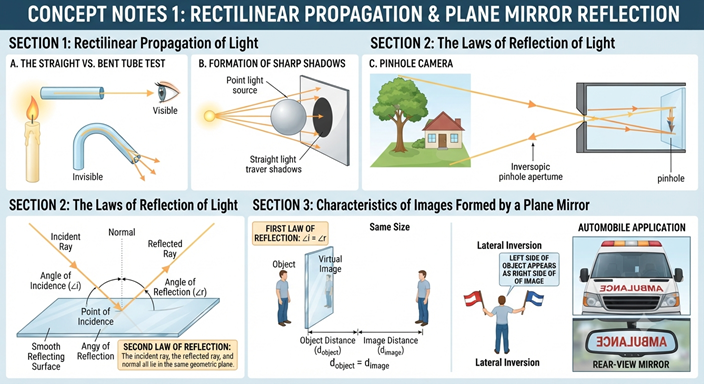
Figure 11.1: Rectilinear Propagation & Law of Reflection: Plane Mirror Image Properties


1. Rectilinear Propagation of Light

  • Definition: The fundamental physical principle that light travels along straight lines in a homogeneous, isotropic medium.
  • Experimental Verifications:
  1. The Straight vs. Bent Tube Test: A glowing candle flame is clearly visible when viewed through a straight hollow pipe, but becomes completely invisible when viewed through a bent pipe.
  2. Formation of Sharp Shadows: When an opaque object is placed in the path of a light source, it casts a sharp, geometrically defined shadow on the screen behind it.
  3. Pinhole Camera: Forms an inverted real image of an external scene on a translucent screen through a microscopic aperture, relying entirely on straight light rays.

2. The Laws of Reflection of Light

When light rays encounter a smooth, polished boundary between two media, they turn back into the originating medium. This process obeys two strict laws:

  1. First Law of Reflection: The Angle of Incidence ($\angle i$) is strictly equal to the Angle of Reflection ($\angle r$):
$$\angle i = \angle r$$

(Where the angle of incidence is measured between the incident ray and the normal, and the angle of reflection is measured between the reflected ray and the normal).

  1. Second Law of Reflection: The incident ray, the reflected ray, and the normal to the reflecting surface at the point of incidence all lie in the same geometric plane.

3. Characteristics of Images Formed by a Plane Mirror

When an object is placed in front of a flat, silvered plane glass mirror:

  1. Virtual and Erect: The image is upright (erect). Because the reflected light rays do not actually intersect but only appear to diverge from a location behind the mirror, the image cannot be obtained on a physical screen (it is a Virtual Image).
  2. Same Size: The linear dimensions (height and width) of the image are strictly equal to the linear dimensions of the object.
  3. Equal Object-Image Distance: The distance of the image behind the mirror surface is equal to the distance of the object in front of the mirror:
$$d_{\text{image}} = d_{\text{object}}$$
  1. Lateral Inversion: A distinctive phenomenon where the left side of the object appears as the right side of the image, and the right side of the object appears as the left side of the image.
  • Automobile Application: The word "AMBULANCE" is written in mirrored, laterally inverted script on the front of emergency paramedic vans so that drivers viewing it through their rear-view mirror can instantly read it correctly as "AMBULANCE" and give way.
๐Ÿ“
Comprehensive High-Yield Mathematical Relations & Theorems

Complete step-by-step derivations, step traps, and LaTeX formula sheet breakdowns...

๐Ÿ”’

End of Free Notes Preview

Unlock the complete deck to access full LaTeX formula breakdowns, interactive diagrams, exam traps, and personal margin highlights!

๐Ÿ”‘ Sign In / Register Free
๐Ÿง  Review Due (Interval: 1 Day) Card 1 of 8 (SM-2 Active Recall)
QUESTION (FRONT) Space โ†ต to flip
What is the rectilinear propagation of light?
ANSWER & EXPLANATION (BACK) Space โ†ต to flip
The fundamental physical property that light travels strictly in straight lines in a uniform, transparent medium.
๐Ÿ’ก
Tap Card to Flip & Check Your Answer Active recall prompt: Flip the card or press Space โ†ต to unlock the SM-2 recall difficulty rating.
๐Ÿ”’
Step 4 is Locked

Final Comprehensive Diagnostic Assessment (15 MCQs)

This ๐Ÿ“ LaTeX Concept Notes is part of the full verified curriculum for Chapter 11: Light: Shadows and Reflections. Unlock the full deck to gain permanent access to all 11 interactive stages, active recall cards, and diagnostic checkpoints.

Deck Access Price
100% Free with Account
Instant Access
โœ“ UPI & Cards Supported
๐Ÿ”‘ Sign In / Register to Unlock Free →
๐Ÿ”’
Step 5 is Locked

Final Comprehensive Diagnostic Assessment (15 MCQs)

This โšก Diagnostic Quiz is part of the full verified curriculum for Chapter 11: Light: Shadows and Reflections. Unlock the full deck to gain permanent access to all 11 interactive stages, active recall cards, and diagnostic checkpoints.

Deck Access Price
100% Free with Account
Instant Access
โœ“ UPI & Cards Supported
๐Ÿ”‘ Sign In / Register to Unlock Free →
๐Ÿ”’
Step 6 is Locked

Final Comprehensive Diagnostic Assessment (15 MCQs)

This Microlearning Step is part of the full verified curriculum for Chapter 11: Light: Shadows and Reflections. Unlock the full deck to gain permanent access to all 11 interactive stages, active recall cards, and diagnostic checkpoints.

Deck Access Price
100% Free with Account
Instant Access
โœ“ UPI & Cards Supported
๐Ÿ”‘ Sign In / Register to Unlock Free →
๐Ÿ”’
Step 7 is Locked

Final Comprehensive Diagnostic Assessment (15 MCQs)

This ๐ŸŽฅ Video Lesson is part of the full verified curriculum for Chapter 11: Light: Shadows and Reflections. Unlock the full deck to gain permanent access to all 11 interactive stages, active recall cards, and diagnostic checkpoints.

Deck Access Price
100% Free with Account
Instant Access
โœ“ UPI & Cards Supported
๐Ÿ”‘ Sign In / Register to Unlock Free →
๐Ÿ”’
Step 8 is Locked

Final Comprehensive Diagnostic Assessment (15 MCQs)

This ๐Ÿ“ LaTeX Concept Notes is part of the full verified curriculum for Chapter 11: Light: Shadows and Reflections. Unlock the full deck to gain permanent access to all 11 interactive stages, active recall cards, and diagnostic checkpoints.

Deck Access Price
100% Free with Account
Instant Access
โœ“ UPI & Cards Supported
๐Ÿ”‘ Sign In / Register to Unlock Free →
๐Ÿ”’
Step 9 is Locked

Final Comprehensive Diagnostic Assessment (15 MCQs)

This ๐Ÿง  Active Recall Flashcards is part of the full verified curriculum for Chapter 11: Light: Shadows and Reflections. Unlock the full deck to gain permanent access to all 11 interactive stages, active recall cards, and diagnostic checkpoints.

Deck Access Price
100% Free with Account
Instant Access
โœ“ UPI & Cards Supported
๐Ÿ”‘ Sign In / Register to Unlock Free →
๐Ÿ”’
Step 10 is Locked

Final Comprehensive Diagnostic Assessment (15 MCQs)

This ๐Ÿ“ LaTeX Concept Notes is part of the full verified curriculum for Chapter 11: Light: Shadows and Reflections. Unlock the full deck to gain permanent access to all 11 interactive stages, active recall cards, and diagnostic checkpoints.

Deck Access Price
100% Free with Account
Instant Access
โœ“ UPI & Cards Supported
๐Ÿ”‘ Sign In / Register to Unlock Free →
๐Ÿ”’
Step 11 is Locked

Final Comprehensive Diagnostic Assessment (15 MCQs)

This โšก Diagnostic Quiz is part of the full verified curriculum for Chapter 11: Light: Shadows and Reflections. Unlock the full deck to gain permanent access to all 11 interactive stages, active recall cards, and diagnostic checkpoints.

Deck Access Price
100% Free with Account
Instant Access
โœ“ UPI & Cards Supported
๐Ÿ”‘ Sign In / Register to Unlock Free →