Chapter 12: Earth, Moon, and the Sun
๐Ÿ‡ฎ๐Ÿ‡ณ National Curriculum Standard โ–พ
๐Ÿ› Vidyoric Certified โ€ข Dr. Ananya Sharma
๐Ÿ”ฅ 0 days
โšก 0 Sparks +
Chapter 12: Earth, Moon, and the Sun

Video Lecture 1: The Cosmic Dance โ€” Earth's Axial Tilt, Day-Night and the Seasons

STEP 1: VIDEO LESSON ๐Ÿ“ค Uploaded HTML5 Video

๐Ÿ“‘ Interactive Chapter Bookmarks

5 chapters
00:00
Introduction & Overview

Syllabus scope and core objectives

โ–ถ
00:27
The Daily Shadow Mystery

Detailed physical mechanism and derivations

โ–ถ
01:24
The Day And Night Cycle

High-yield board tips and pitfalls

โ–ถ
02:29
The Reason Of Seasons
โ–ถ
03:22
The Solar Eclipse
โ–ถ

๐ŸŽ™๏ธ Synchronized Transcript

๐Ÿ”
Hello, young astronomers! Welcome to the grand finale of our Class 7 Science journey: Earth, Moon, and the Sun!

Look at our beautiful blue planet floating in the vastness of space.

Every day, the Sun appears to rise in the east and set in the west. Throughout the year, we experience different seasons, from warm summers and rainy monsoons to cool autumns and chilly winters.

But have you ever wondered why these changes happen? Is Earth closer to the Sun during summer and farther away during winter?

Surprisingly, that is not the reason! In fact, Earth is near its farthest distance from the Sun in early July, around the time when it is summer in the Northern Hemisphere.

The real explanation lies in three important concepts: **Rotation, Revolution, and Earth's axial tilt of approximately 23.5 degrees**.

Let's understand these movements one by one.

First, what is **Rotation**?

Rotation is the movement of Earth as it spins around its imaginary axis, just like a spinning top. Earth rotates from west to east and takes approximately 24 hours to complete one rotation.

This movement is responsible for day and night.

The part of Earth facing the Sun receives sunlight and experiences daytime. At the same time, the opposite side, which faces away from the Sun, experiences nighttime.

Because Earth rotates from west to east, the Sun, Moon, and stars appear to move across the sky from east to west.

Now, let's understand the second movement: **Revolution**.

Revolution is the movement of Earth around the Sun along its orbit. Earth takes approximately 365 days and 6 hours to complete one revolution. This period makes up one year.

But there is something fascinating about Earth's movement. Its axis is not perfectly upright. It is tilted by approximately 23.5 degrees from the perpendicular to the plane of its orbit around the Sun.

This tilt remains pointed in nearly the same direction in space throughout Earth's revolution. It points approximately towards the North Star, also known as Polaris.

Now comes the most interesting question: How does this axial tilt create seasons?

Imagine Earth travelling around the Sun while maintaining its tilted axis. As Earth moves along its orbit, different hemispheres receive different amounts of sunlight.

Let's observe what happens in June.

During June, the Northern Hemisphere is tilted towards the Sun. Sunlight falls more directly on this region, concentrating solar energy over a smaller area. The days are also longer, and the nights are shorter.

As a result, the Northern Hemisphere experiences summer.

At the same time, the Southern Hemisphere is tilted away from the Sun. It receives less direct sunlight and experiences shorter days and longer nights. Therefore, it experiences winter.

Now, let's move forward to December.

The situation is reversed!

During December, the Northern Hemisphere is tilted away from the Sun. Sunlight falls at a more slanting angle, spreading the same amount of energy over a larger area. The days become shorter, and the nights become longer.

This brings winter to India and other countries in the Northern Hemisphere.

Meanwhile, the Southern Hemisphere is tilted towards the Sun and experiences summer. That is why countries such as Australia enjoy summer during December.

There are also two special points in Earth's journey around the Sun: the **Equinoxes**.

These occur around March 20 or 21 and September 22 or 23.

During an equinox, neither hemisphere is tilted towards or away from the Sun. Day and night are nearly equal in length across most places on Earth, with approximately 12 hours of daylight and 12 hours of darkness.

So, let's quickly revise what we have learned.

Earth's rotation is responsible for day and night. It takes approximately 24 hours and happens from west to east.

Earth's revolution around the Sun takes approximately 365 days and 6 hours, making one year.

Earth's axis is tilted by approximately 23.5 degrees, and this tilt, together with its revolution, causes the seasons.

During June, the Northern Hemisphere experiences summer while the Southern Hemisphere experiences winter. During December, the situation is reversed.

Equinoxes occur around March and September, when day and night are nearly equal in length.

Isn't it fascinating how Earth's rotation, revolution, and a simple axial tilt influence our daily lives, weather patterns, agriculture, and festivals?

But our cosmic journey is far from over!

In our next lessons, we will explore the changing phases of the Moon, uncover the fascinating science behind solar and lunar eclipses, and discover how the ancient Indian astronomer Aryabhata explained these celestial phenomena more than 1,500 years ago.

Let's continue exploring the wonders of our universe!
STEP 2 โ€ข CONCEPT NOTES โฑ๏ธ 3 min read
๐Ÿ“Œ 0 Notes

Concept Notes 1: Earth's Orbital Geometry & The Dance of Seasons

Our planet Earth is not an isolated resting rock; it is a dynamic celestial vessel travelling through space. Understanding Earth's rotation, revolution, and axial tilt explains why we experience day, night, and the cycle of seasons.
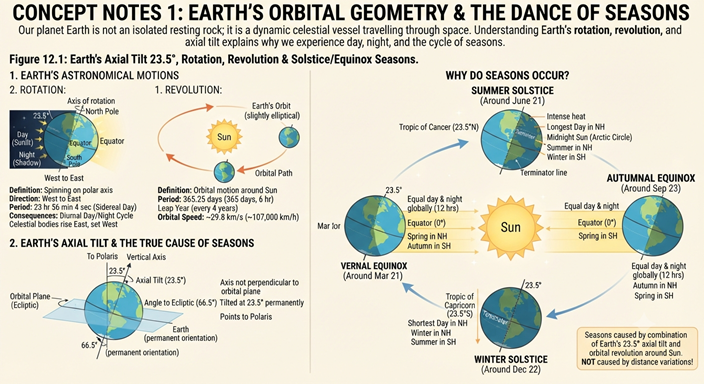
Figure 12.1: Earth's Axial Tilt 23.5ยฐ, Rotation, Revolution & Solstice/Equinox Seasons


1. Earth's Astronomical Motions

  1. Rotation:
  • Definition: The spinning of planet Earth on its imaginary polar axis.
  • Direction: From West to East (anticlockwise when viewed from above the North Pole).
  • Period: Exactly 23 hours, 56 minutes, and 4 seconds (one sidereal day; approximated as 24 hours for a solar day).
  • Consequences: Creates the diurnal cycle of Day and Night. The side facing the Sun experiences daylight; the opposing side experiences night. Causes celestial bodies (Sun, Moon, stars) to appear to rise in the east and set in the west.
  1. Revolution:
  • Definition: The orbital motion of Earth travelling around the Sun in a slightly elliptical orbit.
  • Period: Exactly $365\frac{1}{4}$ days (365 days and 6 hours). Every four years, the four quarter-days accumulate into an additional 24-hour day, creating a Leap Year with 366 days (February having 29 days).
  • Orbital Speed: Approximately $29.8\text{ km/s}$ ($107,000\text{ km/h}$).

2. Earth's Axial Tilt & The True Cause of Seasons

Earth's rotational axis is not perpendicular to its orbital plane. It is permanently tilted at an angle of $23.5^\circ$ from the vertical (or $66.5^\circ$ to the plane of the ecliptic). This axial orientation remains constant in space, pointing toward the North Star (Polaris).

Why Do Seasons Occur?

Seasons are caused by the combination of Earth's $23.5^\circ$ axial tilt and its orbital revolution around the Sun. Seasons are NOT caused by distance variations to the Sun!

  1. Summer Solstice (Around June 21):
  • The Northern Hemisphere is tilted toward the Sun.
  • Solar rays strike the Tropic of Cancer ($23.5^\circ\text{ N}$) vertically. Solar energy is concentrated, producing intense heat.
  • Days are longest and nights are shortest in the Northern Hemisphere. It is Summer in India and Europe, while the Southern Hemisphere experiences Winter.
  • Regions north of the Arctic Circle experience continuous 24-hour daylight ("Midnight Sun").
  1. Winter Solstice (Around December 22):
  • The Southern Hemisphere is tilted toward the Sun, while the Northern Hemisphere is tilted away from the Sun.
  • Solar rays strike the Northern Hemisphere at an oblique, shallow angle, dispersing heat over a larger area.
  • Days are shortest and nights are longest in the Northern Hemisphere: Winter in India, while Australia experiences Summer.
  1. Equinoxes (March 21 - Vernal Equinox; September 23 - Autumnal Equinox):
  • Neither hemisphere is tilted toward or away from the Sun; solar rays fall vertically on the Equator ($0^\circ$).
  • Every location across the globe experiences exactly equal day and equal night (12 hours each).
๐Ÿ“
Comprehensive High-Yield Mathematical Relations & Theorems

Complete step-by-step derivations, step traps, and LaTeX formula sheet breakdowns...

๐Ÿ”’

End of Free Notes Preview

Unlock the complete deck to access full LaTeX formula breakdowns, interactive diagrams, exam traps, and personal margin highlights!

๐Ÿ”‘ Sign In / Register Free
๐Ÿง  Review Due (Interval: 1 Day) Card 1 of 8 (SM-2 Active Recall)
QUESTION (FRONT) Space โ†ต to flip
What is the period of Earth's rotation, and what does it cause?
ANSWER & EXPLANATION (BACK) Space โ†ต to flip
Earth rotates on its axis from West to East once every 24 hours, causing the diurnal cycle of day and night.
๐Ÿ’ก
Tap Card to Flip & Check Your Answer Active recall prompt: Flip the card or press Space โ†ต to unlock the SM-2 recall difficulty rating.
๐Ÿ”’
Step 4 is Locked

Final Comprehensive Diagnostic Assessment (15 MCQs)

This ๐Ÿ“ LaTeX Concept Notes is part of the full verified curriculum for Chapter 12: Earth, Moon, and the Sun. Unlock the full deck to gain permanent access to all 11 interactive stages, active recall cards, and diagnostic checkpoints.

Deck Access Price
100% Free with Account
Instant Access
โœ“ UPI & Cards Supported
๐Ÿ”‘ Sign In / Register to Unlock Free →
๐Ÿ”’
Step 5 is Locked

Final Comprehensive Diagnostic Assessment (15 MCQs)

This โšก Diagnostic Quiz is part of the full verified curriculum for Chapter 12: Earth, Moon, and the Sun. Unlock the full deck to gain permanent access to all 11 interactive stages, active recall cards, and diagnostic checkpoints.

Deck Access Price
100% Free with Account
Instant Access
โœ“ UPI & Cards Supported
๐Ÿ”‘ Sign In / Register to Unlock Free →
๐Ÿ”’
Step 6 is Locked

Final Comprehensive Diagnostic Assessment (15 MCQs)

This Microlearning Step is part of the full verified curriculum for Chapter 12: Earth, Moon, and the Sun. Unlock the full deck to gain permanent access to all 11 interactive stages, active recall cards, and diagnostic checkpoints.

Deck Access Price
100% Free with Account
Instant Access
โœ“ UPI & Cards Supported
๐Ÿ”‘ Sign In / Register to Unlock Free →
๐Ÿ”’
Step 7 is Locked

Final Comprehensive Diagnostic Assessment (15 MCQs)

This ๐ŸŽฅ Video Lesson is part of the full verified curriculum for Chapter 12: Earth, Moon, and the Sun. Unlock the full deck to gain permanent access to all 11 interactive stages, active recall cards, and diagnostic checkpoints.

Deck Access Price
100% Free with Account
Instant Access
โœ“ UPI & Cards Supported
๐Ÿ”‘ Sign In / Register to Unlock Free →
๐Ÿ”’
Step 8 is Locked

Final Comprehensive Diagnostic Assessment (15 MCQs)

This ๐Ÿ“ LaTeX Concept Notes is part of the full verified curriculum for Chapter 12: Earth, Moon, and the Sun. Unlock the full deck to gain permanent access to all 11 interactive stages, active recall cards, and diagnostic checkpoints.

Deck Access Price
100% Free with Account
Instant Access
โœ“ UPI & Cards Supported
๐Ÿ”‘ Sign In / Register to Unlock Free →
๐Ÿ”’
Step 9 is Locked

Final Comprehensive Diagnostic Assessment (15 MCQs)

This ๐Ÿง  Active Recall Flashcards is part of the full verified curriculum for Chapter 12: Earth, Moon, and the Sun. Unlock the full deck to gain permanent access to all 11 interactive stages, active recall cards, and diagnostic checkpoints.

Deck Access Price
100% Free with Account
Instant Access
โœ“ UPI & Cards Supported
๐Ÿ”‘ Sign In / Register to Unlock Free →
๐Ÿ”’
Step 10 is Locked

Final Comprehensive Diagnostic Assessment (15 MCQs)

This ๐Ÿ“ LaTeX Concept Notes is part of the full verified curriculum for Chapter 12: Earth, Moon, and the Sun. Unlock the full deck to gain permanent access to all 11 interactive stages, active recall cards, and diagnostic checkpoints.

Deck Access Price
100% Free with Account
Instant Access
โœ“ UPI & Cards Supported
๐Ÿ”‘ Sign In / Register to Unlock Free →
๐Ÿ”’
Step 11 is Locked

Final Comprehensive Diagnostic Assessment (15 MCQs)

This โšก Diagnostic Quiz is part of the full verified curriculum for Chapter 12: Earth, Moon, and the Sun. Unlock the full deck to gain permanent access to all 11 interactive stages, active recall cards, and diagnostic checkpoints.

Deck Access Price
100% Free with Account
Instant Access
โœ“ UPI & Cards Supported
๐Ÿ”‘ Sign In / Register to Unlock Free →