Part 1 โ€ข Chapter 2: Understanding the Weather
๐Ÿ‡ฎ๐Ÿ‡ณ National Curriculum Standard โ–พ
๐Ÿ› Vidyoric Certified โ€ข Dr. Meenakshi Sundaram
๐Ÿ”ฅ 0 days
โšก 0 Sparks +
Part 1 โ€ข Chapter 2: Understanding the Weather

Video Lecture 1: The Restless Sky โ€” Decoding the Elements of Weather

STEP 1: VIDEO LESSON ๐Ÿ“ค Uploaded HTML5 Video

๐Ÿ“‘ Interactive Chapter Bookmarks

6 chapters
00:00
Introduction & Overview

Syllabus scope and core objectives

โ–ถ
01:03
Human Whether Experience

Detailed physical mechanism and derivations

โ–ถ
01:34
Where Wether Happens

High-yield board tips and pitfalls

โ–ถ
02:33
Natures ForceCaster
โ–ถ
04:40
Five Whether Elements
โ–ถ
06:04
Measuring Our World
โ–ถ

๐ŸŽ™๏ธ Synchronized Transcript

๐Ÿ”
Namaste, students!

Have you ever planned a cricket match on a sunny morning, only to see dark clouds appear and heavy rain begin a few hours later?

These sudden changes in the atmosphere are part of our everyday experience. We live at the bottom of a vast layer of gases surrounding the Earth, called the atmosphere.

The condition of the atmosphere at a particular place and time is known as weather. It includes changes in temperature, rainfall, wind, humidity, and atmospheric pressure.

Today, we will learn about the main elements of weather, the instruments used to measure them, and the different types of rainfall.

First, let us understand the difference between weather and climate.

Weather refers to the day-to-day condition of the atmosphere. For example, today may be sunny, tomorrow may be cloudy, and the day after may bring heavy rainfall.

Climate refers to the average pattern of weather conditions in a particular region over a long period, usually around thirty years or more.

Now, let us explore the five important elements of weather.

The first element is temperature.

Temperature tells us how hot or cold the air is. It is commonly measured in degrees Celsius using a thermometer. A maximum and minimum thermometer records the highest and lowest temperatures during a particular period.

The second element is atmospheric pressure.

Atmospheric pressure is the force exerted by the weight of the air above a particular area. It is measured using an instrument called a barometer. Pressure is commonly expressed in units called millibars or hectopascals.

The third element is humidity.

Humidity refers to the amount of water vapour present in the air. When the air contains a large amount of water vapour, humidity is high. When it contains less water vapour, humidity is low.

Humidity is measured using instruments such as a hygrometer or a wet-and-dry bulb psychrometer. It is generally expressed as a percentage called relative humidity.

The fourth element is wind.

Wind is the movement of air, mainly from areas of higher atmospheric pressure towards areas of lower atmospheric pressure.

A wind vane shows the direction from which the wind is blowing. An anemometer measures wind speed.

The fifth element is precipitation.

Precipitation refers to water falling from the atmosphere to the Earth's surface. It can occur as rain, snow, sleet, or hail.

A rain gauge is used to measure rainfall, usually in millimetres.

Now, let us understand how temperature and atmospheric pressure influence wind.

When the Sun heats the Earth's surface, the air above it also becomes warm. Warm air expands, becomes less dense, and tends to rise. This can create an area of relatively low pressure near the surface.

On the other hand, cooler air is generally denser and tends to sink, creating relatively higher pressure.

Air moves from areas of higher pressure towards areas of lower pressure. This movement of air is called wind.

However, actual wind patterns are also influenced by other factors, such as the Earth's rotation and the shape of the land.

Next, let us learn about the three main types of rainfall.

The first type is convectional rainfall.

During hot weather, the Sun heats the ground. The air above the ground becomes warm and rises. As it rises, it expands and cools. When the water vapour in the air condenses, clouds form. These clouds may produce heavy rainfall, sometimes accompanied by thunder and lightning.

This type of rainfall is common in hot and humid regions.

The second type is orographic rainfall, also called relief rainfall.

This occurs when moisture-laden air is forced to rise over a mountain range.

As the air rises along the mountain slope, it cools and condenses, producing rainfall on the windward side.

After crossing the mountain, the air descends on the other side. It becomes warmer and drier, so the leeward side receives much less rainfall. This relatively dry region is called a rain-shadow area.

An example can be seen along the Western Ghats, where some areas on the western side receive heavy monsoon rainfall, while parts of the Deccan Plateau lie in the rain shadow.

The third type is cyclonic or frontal rainfall.

This type of rainfall occurs when different air masses meet. When warm, moist air meets colder, denser air, the warm air is forced to rise above it. As the warm air rises, it cools and the water vapour condenses to form clouds.

This process can produce widespread rainfall over a large area.

Students, let us quickly revise what we have learned.

Weather describes the day-to-day condition of the atmosphere, while climate describes the long-term pattern of weather in a region.

The five important elements of weather are temperature, atmospheric pressure, humidity, wind, and precipitation.

We use thermometers to measure temperature, barometers for atmospheric pressure, hygrometers for humidity, anemometers for wind speed, and rain gauges for rainfall.

The three main types of rainfall are convectional rainfall, orographic rainfall, and cyclonic or frontal rainfall.

Before we finish, think about this question: Why does atmospheric pressure decrease as we climb a high mountain?

The reason is that as we move higher, there is less air above us. Therefore, the weight of the air pressing down becomes smaller, and atmospheric pressure decreases.

For revision, observe the weather in your area and try to identify changes in temperature, wind, clouds, and rainfall.

In our next lesson, we will explore the layers of the atmosphere and understand how different atmospheric conditions influence our planet.

Thank you, students. Keep observing, keep questioning, and keep exploring the world around you!
STEP 2 โ€ข CONCEPT NOTES โฑ๏ธ 3 min read
๐Ÿ“Œ 0 Notes

Concept Notes 1: Atmospheric Structure & Meteorological Elements
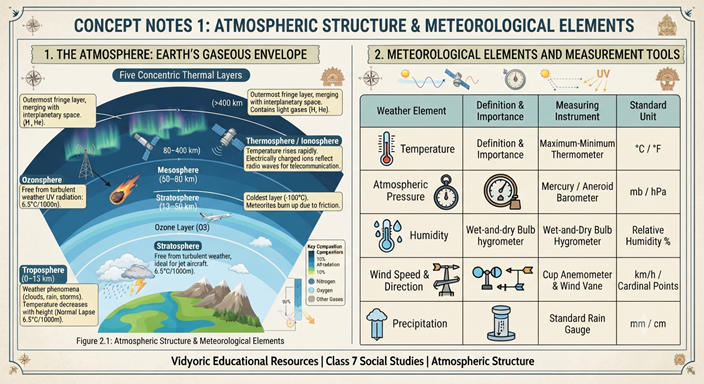
Figure 2.1: Atmospheric Structure & Meteorological Elements

1. The Atmosphere: Earthโ€™s Gaseous Envelope

The atmosphere is a blanket of gases surrounding the Earth, retained by gravitational attraction. It extends up to approximately 10,000 km, though 99% of its mass is concentrated within the lowest 32 km.

The Five Concentric Thermal Layers:
  1. Troposphere (0โ€“13 km): The lowest and densest layer where all weather phenomena (clouds, rain, storms, fog) occur. Temperature decreases with height at the Normal Lapse Rate of $6.5^\circ\text{C}$ per 1,000 meters ($1^\circ\text{C}$ per 165 m).
  2. Stratosphere (13โ€“50 km): Free from clouds and turbulent weather, making it ideal for flying jet aircraft. Contains the vital Ozone Layer ($O_3$), which absorbs harmful ultraviolet (UV) solar radiation.
  3. Mesosphere (50โ€“80 km): The coldest atmospheric layer (temperatures plunge to $-100^\circ\text{C}$). Meteorites burn up upon entering this layer due to friction.
  4. Thermosphere / Ionosphere (80โ€“400 km): Temperature rises rapidly with height due to high solar radiation absorption. Contains electrically charged ions that reflect radio waves back to Earth, enabling global wireless telecommunication.
  5. Exosphere (>400 km): The outermost, extremely rarefied fringe layer merging gradually with interplanetary space, containing light gases like hydrogen and helium.

2. Meteorological Elements and Measurement Tools

Weather ElementDefinition & ImportanceMeasuring InstrumentStandard Unit
TemperatureDegree of hotness or coldness of the atmosphere.Maximum-Minimum ThermometerDegrees Celsius ($^\circ\text{C}$) / Fahrenheit ($^\circ\text{F}$)
Atmospheric PressureWeight exerted by the vertical column of air above a unit surface.Mercury / Aneroid BarometerMillibars (mb) / Hectopascals (hPa)
HumidityAmount of water vapor present in the atmosphere.Wet-and-Dry Bulb HygrometerRelative Humidity percentage (%)
Wind Speed & DirectionMotion of air from high pressure to low pressure.Cup Anemometer (Speed) & Wind Vane (Direction)Kilometers per hour (km/h) / Cardinal Points
PrecipitationCondensed atmospheric moisture falling to earth.Standard Rain GaugeMillimeters (mm) / Centimeters (cm)
๐Ÿ“
Comprehensive High-Yield Mathematical Relations & Theorems

Complete step-by-step derivations, step traps, and LaTeX formula sheet breakdowns...

๐Ÿ”’

End of Free Notes Preview

Unlock the complete deck to access full LaTeX formula breakdowns, interactive diagrams, exam traps, and personal margin highlights!

๐Ÿ”‘ Sign In / Register Free
๐Ÿง  Review Due (Interval: 1 Day) Card 1 of 8 (SM-2 Active Recall)
QUESTION (FRONT) Space โ†ต to flip
What is the primary difference between Weather and Climate?
ANSWER & EXPLANATION (BACK) Space โ†ต to flip
Weather refers to the short-term (hour-to-hour, day-to-day) state of the atmosphere in a localized area. Climate represents the average weather conditions of a large region observed over a long duration (30โ€“35 years).
๐Ÿ’ก
Tap Card to Flip & Check Your Answer Active recall prompt: Flip the card or press Space โ†ต to unlock the SM-2 recall difficulty rating.
๐Ÿ”’
Step 4 is Locked

Final Comprehensive Diagnostic Assessment (15 MCQs)

This ๐Ÿ“ LaTeX Concept Notes is part of the full verified curriculum for Part 1 โ€ข Chapter 2: Understanding the Weather. Unlock the full deck to gain permanent access to all 11 interactive stages, active recall cards, and diagnostic checkpoints.

Deck Access Price
100% Free with Account
Instant Access
โœ“ UPI & Cards Supported
๐Ÿ”‘ Sign In / Register to Unlock Free →
๐Ÿ”’
Step 5 is Locked

Final Comprehensive Diagnostic Assessment (15 MCQs)

This โšก Diagnostic Quiz is part of the full verified curriculum for Part 1 โ€ข Chapter 2: Understanding the Weather. Unlock the full deck to gain permanent access to all 11 interactive stages, active recall cards, and diagnostic checkpoints.

Deck Access Price
100% Free with Account
Instant Access
โœ“ UPI & Cards Supported
๐Ÿ”‘ Sign In / Register to Unlock Free →
๐Ÿ”’
Step 6 is Locked

Final Comprehensive Diagnostic Assessment (15 MCQs)

This Microlearning Step is part of the full verified curriculum for Part 1 โ€ข Chapter 2: Understanding the Weather. Unlock the full deck to gain permanent access to all 11 interactive stages, active recall cards, and diagnostic checkpoints.

Deck Access Price
100% Free with Account
Instant Access
โœ“ UPI & Cards Supported
๐Ÿ”‘ Sign In / Register to Unlock Free →
๐Ÿ”’
Step 7 is Locked

Final Comprehensive Diagnostic Assessment (15 MCQs)

This ๐ŸŽฅ Video Lesson is part of the full verified curriculum for Part 1 โ€ข Chapter 2: Understanding the Weather. Unlock the full deck to gain permanent access to all 11 interactive stages, active recall cards, and diagnostic checkpoints.

Deck Access Price
100% Free with Account
Instant Access
โœ“ UPI & Cards Supported
๐Ÿ”‘ Sign In / Register to Unlock Free →
๐Ÿ”’
Step 8 is Locked

Final Comprehensive Diagnostic Assessment (15 MCQs)

This ๐Ÿ“ LaTeX Concept Notes is part of the full verified curriculum for Part 1 โ€ข Chapter 2: Understanding the Weather. Unlock the full deck to gain permanent access to all 11 interactive stages, active recall cards, and diagnostic checkpoints.

Deck Access Price
100% Free with Account
Instant Access
โœ“ UPI & Cards Supported
๐Ÿ”‘ Sign In / Register to Unlock Free →
๐Ÿ”’
Step 9 is Locked

Final Comprehensive Diagnostic Assessment (15 MCQs)

This ๐Ÿง  Active Recall Flashcards is part of the full verified curriculum for Part 1 โ€ข Chapter 2: Understanding the Weather. Unlock the full deck to gain permanent access to all 11 interactive stages, active recall cards, and diagnostic checkpoints.

Deck Access Price
100% Free with Account
Instant Access
โœ“ UPI & Cards Supported
๐Ÿ”‘ Sign In / Register to Unlock Free →
๐Ÿ”’
Step 10 is Locked

Final Comprehensive Diagnostic Assessment (15 MCQs)

This ๐Ÿ“ LaTeX Concept Notes is part of the full verified curriculum for Part 1 โ€ข Chapter 2: Understanding the Weather. Unlock the full deck to gain permanent access to all 11 interactive stages, active recall cards, and diagnostic checkpoints.

Deck Access Price
100% Free with Account
Instant Access
โœ“ UPI & Cards Supported
๐Ÿ”‘ Sign In / Register to Unlock Free →
๐Ÿ”’
Step 11 is Locked

Final Comprehensive Diagnostic Assessment (15 MCQs)

This โšก Diagnostic Quiz is part of the full verified curriculum for Part 1 โ€ข Chapter 2: Understanding the Weather. Unlock the full deck to gain permanent access to all 11 interactive stages, active recall cards, and diagnostic checkpoints.

Deck Access Price
100% Free with Account
Instant Access
โœ“ UPI & Cards Supported
๐Ÿ”‘ Sign In / Register to Unlock Free →