Concept Notes 1: Climatic Controls & The Monsoon Phenomenon
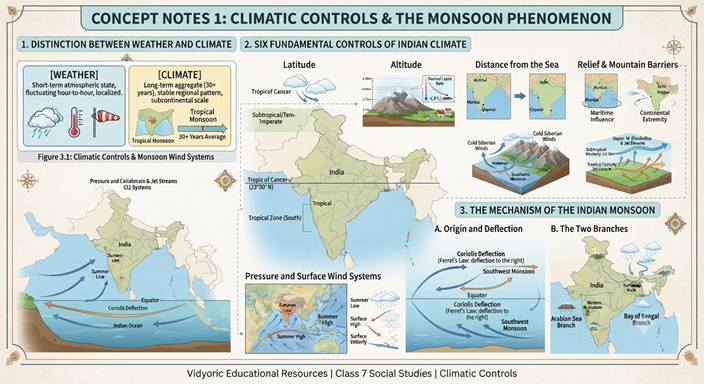
1. Distinction Between Weather and Climate
- Weather: Refers to the day-to-day state of the atmosphere at a specific location regarding temperature, pressure, humidity, wind, and precipitation. It is dynamic and fluctuates hourly.
- Climate: Represents the aggregate statistical average of weather conditions and variations over a vast geographical area for a prolonged period, typically 30 years or more.
                ATMOSPHERIC DISTINCTION
        ┌──────────────────┴──────────────────┐
        ▼                                     ▼
   [ WEATHER ]                           [ CLIMATE ]
• Short-term atmospheric state         • Long-term aggregate (30+ years)
• Fluctuates hour-to-hour              • Stable regional pattern
• Localized (city / district)          • Regional / subcontinental scale
• Measured: thermometer, barometer     • Classified: Tropical Monsoon, Arid
2. Six Fundamental Controls of Indian Climate
- Latitude: The Tropic of Cancer ($23^\circ 30' \text{ N}$) bisects India into two climatic zones:
- South of the Tropic of Cancer: Tropical zone (hot, minimal annual temperature range).
- North of the Tropic of Cancer: Subtropical and temperate zone (hot summers, chilly winters).
- Altitude: With increasing elevation, air density decreases and temperature drops at the Normal Environmental Lapse Rate of approximately $6.5^\circ \text{C}$ per 1,000 meters ($1^\circ \text{C}$ per 165 meters).
- Distance from the Sea (Continentality): Oceans exert a moderating maritime influence through sea and land breezes. Coastal cities like Mumbai and Chennai exhibit a small annual range of temperature, whereas continental inland centers like Delhi and Nagpur experience extreme scorching summers and biting winters.
- Relief & Mountain Barriers: The Himalayan chain acts as a dual barrier:
- It intercepts Siberian arctic winds, preventing them from freezing northern India.
- It forces the moisture-laden Southwest Monsoon winds to shed precipitation on the subcontinent.
- Pressure and Surface Wind Systems: Driven by differential thermal heating between the Asian landmass and the Indian Ocean.
- Upper Air Circulation & Jet Streams: High-velocity westerly and easterly winds in the upper troposphere steer cyclonic depressions and govern the abrupt onset and retreat of monsoons.
3. The Mechanism of the Indian Monsoon
- Origin of Term: Derived from the Arabic noun Mausim, meaning season.
- Thermal Contrast: During May–June, intense insolation creates an intense low-pressure cell over the Thar Desert and northwest India. Simultaneously, high pressure persists over the southern Indian Ocean.
- Coriolis Deflection: Air drawn northward across the Equator is deflected toward the right (Ferrel's Law), blowing from the southwest as the Southwest Monsoon.
- The Two Branches:
- Arabian Sea Branch: Hits the Western Ghats; causes heavy orographic rain on the windward coast; crosses to Central India.
- Bay of Bengal Branch: Trapped by the Arakan Yoma and Meghalaya hills; deflected westwards up the Ganga Valley.