Part 1 โ€ข Chapter 5: The Rise of Empires
๐Ÿ‡ฎ๐Ÿ‡ณ National Curriculum Standard โ–พ
๐Ÿ› Vidyoric Certified โ€ข Dr. Meenakshi Sundaram
๐Ÿ”ฅ 0 days
โšก 0 Sparks +
Part 1 โ€ข Chapter 5: The Rise of Empires

Video Lecture 1: From Kingdom to Empire โ€” The Architectural Genius of the Mauryas

STEP 1: VIDEO LESSON ๐Ÿ“ค Uploaded HTML5 Video

๐Ÿ“‘ Interactive Chapter Bookmarks

4 chapters
00:00
Introduction & Overview

Syllabus scope and core objectives

โ–ถ
02:30
Core Concept Mechanics

Detailed physical mechanism and derivations

โ–ถ
06:00
Arthshatra

High-yield board tips and pitfalls

โ–ถ
08:18
Edict
โ–ถ

๐ŸŽ™๏ธ Synchronized Transcript

๐Ÿ”
What is the difference between a kingdom and an empire?

A kingdom generally controls a smaller territory under a king. An empire covers a much larger area, bringing different regions, communities, languages, and trade networks under one central ruler, known as an emperor.

Around 321 BCE, **Chandragupta Maurya**, guided by the strategist **Chanakya**, overthrew the Nanda dynasty and established the Mauryan Empire. It became one of the largest empires in ancient Indian history, extending across much of the Indian subcontinent.

Two important sources help us understand Mauryan administration and society: the *Arthashastra* and *Indica*.

The *Arthashastra*, traditionally associated with Chanakya, discusses statecraft, administration, taxation, diplomacy, espionage, and economic management. It explains how a ruler should govern and maintain a strong state.

Another important source is *Indica*, written by the Greek ambassador **Megasthenes**, who visited the court of Chandragupta Maurya. His account describes the city of Pataliputra, the royal court, and aspects of Mauryan administration. However, his original work has not survived completely, and historians study it through later quotations and references.

The Mauryan Empire was governed through a network of provinces. Pataliputra was the imperial capital, while important provincial centres included Taxila in the northwest, Ujjayini in central India, Tosali in the east, and Suvarnagiri in the south.

These centres helped the emperor administer distant regions, maintain communication, and control important trade routes.

The empire also collected resources to support its administration and army. In core regions, officials collected regular taxes from agriculture, trade, and other economic activities.

In distant areas, particularly forest regions, local communities sometimes provided tribute in the form of valuable goods such as timber, elephants, honey, and other forest products.

This combination of central administration, provincial governance, taxation, and regional relationships helped the Mauryan rulers manage a vast territory.

The Mauryan Empire was not just a political achievement. It also left a lasting legacy in administration, architecture, art, and Indian history.

In the next step, we will explore Emperor Ashoka and discover how the Kalinga War transformed his approach to ruling the empire.
STEP 2 โ€ข CONCEPT NOTES โฑ๏ธ 3 min read
๐Ÿ“Œ 0 Notes

!

Concept Notes 1: The Mauryan Empire & Foundations of Statecraft
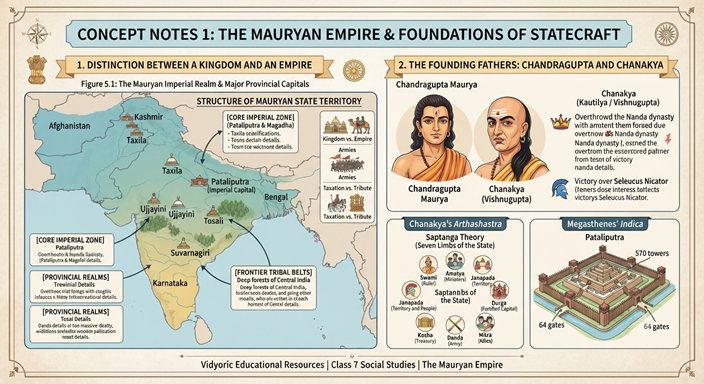
Figure 5.1: The Mauryan Imperial Realm & Major Provincial Capitals

1. Distinction Between a Kingdom and an Empire

  • Scale and Territory: An empire is vastly larger than a kingdom, encompassing multiple physiographic regions, cultures, and ethnic groups under a single sovereign sovereign authority.
  • Resource Mobilization: Emperors require vastly greater armies to guard long frontiers and a colossal network of administrative officials to collect taxes across distant provinces.
  • Taxation vs. Tribute:
  • Taxes: Compulsory, standardized payments collected periodically from settled farmers, merchants, and artisans.
  • Tribute: Irregular gifts and natural commodities (elephants, timber, honey, gems) collected from peripheral forest tribes and vassal chiefs.
                  STRUCTURE OF MAURYAN STATE TERRITORY
                                   โ”‚
       โ”Œโ”€โ”€โ”€โ”€โ”€โ”€โ”€โ”€โ”€โ”€โ”€โ”€โ”€โ”€โ”€โ”€โ”€โ”€โ”€โ”€โ”€โ”€โ”€โ”€โ”€โ”€โ”€โ”ผโ”€โ”€โ”€โ”€โ”€โ”€โ”€โ”€โ”€โ”€โ”€โ”€โ”€โ”€โ”€โ”€โ”€โ”€โ”€โ”€โ”€โ”€โ”€โ”€โ”€โ”€โ”€โ”
       โ–ผ                           โ–ผ                           โ–ผ
[ CORE IMPERIAL ZONE ]    [ PROVINCIAL REALMS ]       [ FRONTIER TRIBAL BELTS ]
โ€ข Pataliputra & Magadha   โ€ข Taxila (Northwest)        โ€ข Deep forests of Central India
โ€ข Directly governed by    โ€ข Ujjayini (Central)        โ€ข Autonomous tribal chiefs
  Emperor and Mantris     โ€ข Tosali (Kalinga/East)     โ€ข Paid irregular tribute:
โ€ข Strict daily tax        โ€ข Suvarnagiri (South)         elephants, timber, honey
  collection              โ€ข Governed by royal Kumaras โ€ข Protected trade highways

2. The Founding Fathers: Chandragupta and Chanakya

  • In approximately 321 BCE, Chandragupta Maurya, assisted by the Brahmin philosopher Chanakya (Kautilya / Vishnugupta), overthrew Dhana Nanda, the last ruler of the Nanda dynasty.
  • Chandragupta defeated the Greek general Seleucus Nicator (successor of Alexander) around 305 BCE, liberating the trans-Indus provinces of Gandhara, Arachosia (Kandahar), and Gedrosia (Balochistan).
  • Chanakya's Arthashastra:
  • A comprehensive Sanskrit treatise on statecraft, economic policy, military strategy, and administration.
  • Articulated the Saptanga Theory (Seven Limbs of the State): Swami (Ruler), Amatya (Ministers), Janapada (Territory and People), Durga (Fortified Capital), Kosha (Treasury), Danda (Army), and Mitra (Allies).
  • Megasthenes' Indica:
  • Megasthenes served as Seleucus Nicator's permanent ambassador to the court of Chandragupta in Pataliputra.
  • Described Pataliputra as a magnificent city shaped like a parallelogram, encircled by a massive wooden palisade with 570 towers and 64 gates, protected by a 600-foot-wide defensive moat.
๐Ÿ“
Comprehensive High-Yield Mathematical Relations & Theorems

Complete step-by-step derivations, step traps, and LaTeX formula sheet breakdowns...

๐Ÿ”’

End of Free Notes Preview

Unlock the complete deck to access full LaTeX formula breakdowns, interactive diagrams, exam traps, and personal margin highlights!

๐Ÿ”‘ Sign In / Register Free
๐Ÿง  Review Due (Interval: 1 Day) Card 1 of 8 (SM-2 Active Recall)
QUESTION (FRONT) Space โ†ต to flip
Who was the founder of the Mauryan Empire, and in which year was it established?
ANSWER & EXPLANATION (BACK) Space โ†ต to flip
Chandragupta Maurya, around 321 BCE, after overthrowing the Nanda dynasty.
๐Ÿ’ก
Tap Card to Flip & Check Your Answer Active recall prompt: Flip the card or press Space โ†ต to unlock the SM-2 recall difficulty rating.
๐Ÿ”’
Step 4 is Locked

Final Comprehensive Diagnostic Assessment (15 MCQs)

This ๐Ÿ“ LaTeX Concept Notes is part of the full verified curriculum for Part 1 โ€ข Chapter 5: The Rise of Empires. Unlock the full deck to gain permanent access to all 11 interactive stages, active recall cards, and diagnostic checkpoints.

Deck Access Price
100% Free with Account
Instant Access
โœ“ UPI & Cards Supported
๐Ÿ”‘ Sign In / Register to Unlock Free →
๐Ÿ”’
Step 5 is Locked

Final Comprehensive Diagnostic Assessment (15 MCQs)

This โšก Diagnostic Quiz is part of the full verified curriculum for Part 1 โ€ข Chapter 5: The Rise of Empires. Unlock the full deck to gain permanent access to all 11 interactive stages, active recall cards, and diagnostic checkpoints.

Deck Access Price
100% Free with Account
Instant Access
โœ“ UPI & Cards Supported
๐Ÿ”‘ Sign In / Register to Unlock Free →
๐Ÿ”’
Step 6 is Locked

Final Comprehensive Diagnostic Assessment (15 MCQs)

This Microlearning Step is part of the full verified curriculum for Part 1 โ€ข Chapter 5: The Rise of Empires. Unlock the full deck to gain permanent access to all 11 interactive stages, active recall cards, and diagnostic checkpoints.

Deck Access Price
100% Free with Account
Instant Access
โœ“ UPI & Cards Supported
๐Ÿ”‘ Sign In / Register to Unlock Free →
๐Ÿ”’
Step 7 is Locked

Final Comprehensive Diagnostic Assessment (15 MCQs)

This ๐ŸŽฅ Video Lesson is part of the full verified curriculum for Part 1 โ€ข Chapter 5: The Rise of Empires. Unlock the full deck to gain permanent access to all 11 interactive stages, active recall cards, and diagnostic checkpoints.

Deck Access Price
100% Free with Account
Instant Access
โœ“ UPI & Cards Supported
๐Ÿ”‘ Sign In / Register to Unlock Free →
๐Ÿ”’
Step 8 is Locked

Final Comprehensive Diagnostic Assessment (15 MCQs)

This ๐Ÿ“ LaTeX Concept Notes is part of the full verified curriculum for Part 1 โ€ข Chapter 5: The Rise of Empires. Unlock the full deck to gain permanent access to all 11 interactive stages, active recall cards, and diagnostic checkpoints.

Deck Access Price
100% Free with Account
Instant Access
โœ“ UPI & Cards Supported
๐Ÿ”‘ Sign In / Register to Unlock Free →
๐Ÿ”’
Step 9 is Locked

Final Comprehensive Diagnostic Assessment (15 MCQs)

This ๐Ÿง  Active Recall Flashcards is part of the full verified curriculum for Part 1 โ€ข Chapter 5: The Rise of Empires. Unlock the full deck to gain permanent access to all 11 interactive stages, active recall cards, and diagnostic checkpoints.

Deck Access Price
100% Free with Account
Instant Access
โœ“ UPI & Cards Supported
๐Ÿ”‘ Sign In / Register to Unlock Free →
๐Ÿ”’
Step 10 is Locked

Final Comprehensive Diagnostic Assessment (15 MCQs)

This ๐Ÿ“ LaTeX Concept Notes is part of the full verified curriculum for Part 1 โ€ข Chapter 5: The Rise of Empires. Unlock the full deck to gain permanent access to all 11 interactive stages, active recall cards, and diagnostic checkpoints.

Deck Access Price
100% Free with Account
Instant Access
โœ“ UPI & Cards Supported
๐Ÿ”‘ Sign In / Register to Unlock Free →
๐Ÿ”’
Step 11 is Locked

Final Comprehensive Diagnostic Assessment (15 MCQs)

This โšก Diagnostic Quiz is part of the full verified curriculum for Part 1 โ€ข Chapter 5: The Rise of Empires. Unlock the full deck to gain permanent access to all 11 interactive stages, active recall cards, and diagnostic checkpoints.

Deck Access Price
100% Free with Account
Instant Access
โœ“ UPI & Cards Supported
๐Ÿ”‘ Sign In / Register to Unlock Free →