Part 1 โ€ข Chapter 7: The Gupta Era: An Age of Tireless Creativity
๐Ÿ‡ฎ๐Ÿ‡ณ National Curriculum Standard โ–พ
๐Ÿ› Vidyoric Certified โ€ข Dr. Meenakshi Sundaram
๐Ÿ”ฅ 0 days
โšก 0 Sparks +
Part 1 โ€ข Chapter 7: The Gupta Era: An Age of Tireless Creativity

Video Lecture 1: A Renaissance of Mind and Stone โ€” The Splendor of the Guptas

STEP 1: VIDEO LESSON ๐Ÿ“ค Uploaded HTML5 Video

๐Ÿ“‘ Interactive Chapter Bookmarks

5 chapters
00:00
Introduction & Overview

Syllabus scope and core objectives

โ–ถ
02:14
The Rise Of Guptas

High-yield board tips and pitfalls

โ–ถ
02:30
The Iron Pillar Mystery

Detailed physical mechanism and derivations

โ–ถ
03:36
Warriors And Scholars
โ–ถ
05:11
The Quest For Beauty
โ–ถ

๐ŸŽ™๏ธ Synchronized Transcript

๐Ÿ”
Between the fourth and sixth centuries CE, the Gupta Empire witnessed remarkable achievements in science, mathematics, literature, art, and architecture. This period is often called a classical golden age in ancient Indian history.

One important achievement from this era is the Iron Pillar at Mehrauli, near Delhi. It demonstrates the advanced metallurgical skills of ancient Indian craftsmen. Despite centuries of exposure to changing weather, the pillar has resisted corrosion remarkably well.

Gupta rulers also supported literature, education, and the arts. Their reigns produced important works that continue to influence Indian culture.

One of the most powerful Gupta rulers was **Samudragupta**. Much of what we know about his military achievements comes from the **Prayag Prashasti**, also known as the Allahabad Pillar Inscription.

This Sanskrit inscription was composed by his court poet, **Harishena**, on an Ashokan pillar at present-day Prayagraj. A *Prashasti* is an inscription written in praise of a ruler.

It describes Samudragupta's military campaigns across northern and southern India. He defeated several northern rulers and defeated southern kings, but often allowed them to retain their kingdoms after accepting his authority. This strategy helped extend Gupta influence over a large territory.

Samudragupta was not only a military leader but also a patron of the arts. His coins show him playing the veena, highlighting his interest in music.

After Samudragupta, his son **Chandragupta II**, also known as Vikramaditya, became an important Gupta ruler. He expanded Gupta power by defeating the Shakas in western India. This strengthened the empire's control over important trade routes and prosperous regions.

During Chandragupta II's reign, a Chinese Buddhist pilgrim named **Faxian** travelled to India. He visited Buddhist monasteries and recorded observations about Indian society, religious life, and administration. His writings provide valuable information about this period, although they mainly reflect his experiences and interests as a Buddhist traveller.

The Gupta period also produced remarkable achievements in mathematics, astronomy, literature, sculpture, and temple architecture. Scholars such as Aryabhata and writers such as Kalidasa became associated with this flourishing intellectual and cultural environment.

The Gupta era reminds us how political stability and royal patronage can encourage creativity and learning.

In the next step, we will explore Aryabhata's scientific contributions and the development of early Hindu stone temples.
STEP 2 โ€ข CONCEPT NOTES โฑ๏ธ 3 min read
๐Ÿ“Œ 0 Notes

Concept Notes 1: Imperial Consolidation & The Allahabad Prashasti
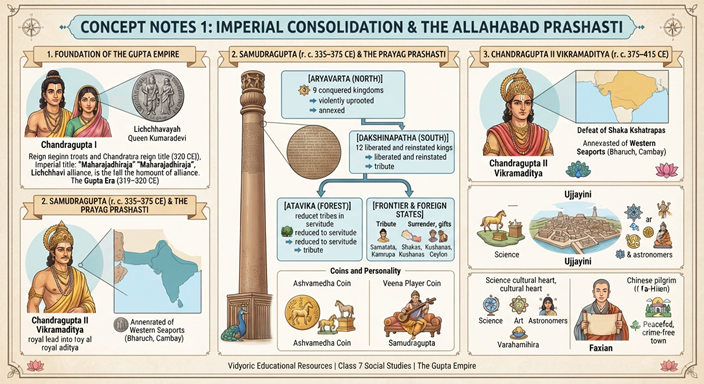
Figure 7.1: The Gupta Realm, Allahabad Pillar & Gold Dinar Coins

1. Foundation of the Gupta Empire

Following the decline of the Kushanas in the north and the Satavahanas in the Deccan, the Gupta dynasty emerged in Magadha around 319โ€“320 CE:

  • Chandragupta I (r. c. 319โ€“335 CE): The first ruler to adopt the imperial title Maharajadhiraja ('Great King of Kings'). His marriage to the Lichchhavi princess Kumaradevi brought immense political prestige. He founded the Gupta Era (319โ€“320 CE).

2. Samudragupta (r. c. 335โ€“375 CE) & The Prayag Prashasti

Celebrated by modern historians as the 'Napoleon of India' due to his undefeated military campaigns:

  • Harishena's Allahabad Inscription (Prayag Prashasti):
  • Engraved on an Ashokan monolithic pillar standing at Prayagraj (Allahabad).
  • Composed in elegant classical Sanskrit verse and prose (Champu kavya).
  • Outlines Samudragupta's distinct four-fold foreign policy:
                  SAMUDRAGUPTA'S FOUR-FOLD IMPERIAL POLICY
                                      โ”‚
       โ”Œโ”€โ”€โ”€โ”€โ”€โ”€โ”€โ”€โ”€โ”€โ”€โ”€โ”€โ”€โ”€โ”€โ”€โ”€โ”€โ”€โ”€โ”€โ”€โ”€โ”€โ”€โ”€โ”€โ”€โ”€โ”ผโ”€โ”€โ”€โ”€โ”€โ”€โ”€โ”€โ”€โ”€โ”€โ”€โ”€โ”€โ”€โ”€โ”€โ”€โ”€โ”€โ”€โ”€โ”€โ”€โ”€โ”€โ”€โ”€โ”€โ”€โ”
       โ–ผ                              โ–ผ                              โ–ผ
[ ARYAVARTA (NORTH) ]       [ DAKSHINAPATHA (SOUTH) ]     [ ATAVIKA (FOREST) ]
โ€ข 9 kings violently         โ€ข 12 kings defeated           โ€ข Forest tribes of
  uprooted (Prasabhoddharana) โ€ข Liberated and reinstated     Central India
โ€ข Kingdoms annexed directly   as tributaries (Anugraha)   โ€ข Reduced to servitude
  into Gupta realm          โ€ข Paid regular tribute        โ€ข Guarded highways
       โ”‚                                                             โ”‚
       โ””โ”€โ”€โ”€โ”€โ”€โ”€โ”€โ”€โ”€โ”€โ”€โ”€โ”€โ”€โ”€โ”€โ”€โ”€โ”€โ”€โ”€โ”€โ”€โ”€โ”€โ”€โ”€โ”€โ”€โ”€โ”ฌโ”€โ”€โ”€โ”€โ”€โ”€โ”€โ”€โ”€โ”€โ”€โ”€โ”€โ”€โ”€โ”€โ”€โ”€โ”€โ”€โ”€โ”€โ”€โ”€โ”€โ”€โ”€โ”€โ”€โ”€โ”˜
                                      โ–ผ
                        [ FRONTIER & FOREIGN STATES ]
                        โ€ข Samatata, Kamrupa, Nepal (Tribute)
                        โ€ข Shakas, Kushanas, Ceylon (Surrender,
                          diplomatic gifts, matrimonial alliances)
  • Coins and Personality:
  • Revived the Vedic horse sacrifice (Ashvamedha), minting gold coins showing the sacrificial horse.
  • Issued coins depicting himself seated cross-legged on a couch, playing the stringed Veena, testifying to his musical mastery.

3. Chandragupta II Vikramaditya (r. c. 375โ€“415 CE)

  • Defeated the Shaka Kshatrapas of Gujarat, annexing the thriving western seaports of Barygaza (Bharuch) and Cambay, securing direct maritime trade with the Mediterranean.
  • Assumed the historic title Vikramaditya ('Sun of Valor').
  • Maintained a second imperial capital at Ujjayini, which became the vibrant cultural and scientific heart of the empire.
  • Welcomed Chinese Buddhist pilgrim Faxian (Fa-Hien), who recorded that citizens lived peacefully without theft or harsh criminal punishments.
๐Ÿ“
Comprehensive High-Yield Mathematical Relations & Theorems

Complete step-by-step derivations, step traps, and LaTeX formula sheet breakdowns...

๐Ÿ”’

End of Free Notes Preview

Unlock the complete deck to access full LaTeX formula breakdowns, interactive diagrams, exam traps, and personal margin highlights!

๐Ÿ”‘ Sign In / Register Free
๐Ÿง  Review Due (Interval: 1 Day) Card 1 of 8 (SM-2 Active Recall)
QUESTION (FRONT) Space โ†ต to flip
Who was the first Gupta ruler to adopt the title "Maharajadhiraja" (Great King of Kings)?
ANSWER & EXPLANATION (BACK) Space โ†ต to flip
Chandragupta I, who founded the Gupta Era in 319โ€“320 CE.
๐Ÿ’ก
Tap Card to Flip & Check Your Answer Active recall prompt: Flip the card or press Space โ†ต to unlock the SM-2 recall difficulty rating.
๐Ÿ”’
Step 4 is Locked

Final Comprehensive Diagnostic Assessment (15 MCQs)

This ๐Ÿ“ LaTeX Concept Notes is part of the full verified curriculum for Part 1 โ€ข Chapter 7: The Gupta Era: An Age of Tireless Creativity. Unlock the full deck to gain permanent access to all 11 interactive stages, active recall cards, and diagnostic checkpoints.

Deck Access Price
100% Free with Account
Instant Access
โœ“ UPI & Cards Supported
๐Ÿ”‘ Sign In / Register to Unlock Free →
๐Ÿ”’
Step 5 is Locked

Final Comprehensive Diagnostic Assessment (15 MCQs)

This โšก Diagnostic Quiz is part of the full verified curriculum for Part 1 โ€ข Chapter 7: The Gupta Era: An Age of Tireless Creativity. Unlock the full deck to gain permanent access to all 11 interactive stages, active recall cards, and diagnostic checkpoints.

Deck Access Price
100% Free with Account
Instant Access
โœ“ UPI & Cards Supported
๐Ÿ”‘ Sign In / Register to Unlock Free →
๐Ÿ”’
Step 6 is Locked

Final Comprehensive Diagnostic Assessment (15 MCQs)

This Microlearning Step is part of the full verified curriculum for Part 1 โ€ข Chapter 7: The Gupta Era: An Age of Tireless Creativity. Unlock the full deck to gain permanent access to all 11 interactive stages, active recall cards, and diagnostic checkpoints.

Deck Access Price
100% Free with Account
Instant Access
โœ“ UPI & Cards Supported
๐Ÿ”‘ Sign In / Register to Unlock Free →
๐Ÿ”’
Step 7 is Locked

Final Comprehensive Diagnostic Assessment (15 MCQs)

This ๐ŸŽฅ Video Lesson is part of the full verified curriculum for Part 1 โ€ข Chapter 7: The Gupta Era: An Age of Tireless Creativity. Unlock the full deck to gain permanent access to all 11 interactive stages, active recall cards, and diagnostic checkpoints.

Deck Access Price
100% Free with Account
Instant Access
โœ“ UPI & Cards Supported
๐Ÿ”‘ Sign In / Register to Unlock Free →
๐Ÿ”’
Step 8 is Locked

Final Comprehensive Diagnostic Assessment (15 MCQs)

This ๐Ÿ“ LaTeX Concept Notes is part of the full verified curriculum for Part 1 โ€ข Chapter 7: The Gupta Era: An Age of Tireless Creativity. Unlock the full deck to gain permanent access to all 11 interactive stages, active recall cards, and diagnostic checkpoints.

Deck Access Price
100% Free with Account
Instant Access
โœ“ UPI & Cards Supported
๐Ÿ”‘ Sign In / Register to Unlock Free →
๐Ÿ”’
Step 9 is Locked

Final Comprehensive Diagnostic Assessment (15 MCQs)

This ๐Ÿง  Active Recall Flashcards is part of the full verified curriculum for Part 1 โ€ข Chapter 7: The Gupta Era: An Age of Tireless Creativity. Unlock the full deck to gain permanent access to all 11 interactive stages, active recall cards, and diagnostic checkpoints.

Deck Access Price
100% Free with Account
Instant Access
โœ“ UPI & Cards Supported
๐Ÿ”‘ Sign In / Register to Unlock Free →
๐Ÿ”’
Step 10 is Locked

Final Comprehensive Diagnostic Assessment (15 MCQs)

This ๐Ÿ“ LaTeX Concept Notes is part of the full verified curriculum for Part 1 โ€ข Chapter 7: The Gupta Era: An Age of Tireless Creativity. Unlock the full deck to gain permanent access to all 11 interactive stages, active recall cards, and diagnostic checkpoints.

Deck Access Price
100% Free with Account
Instant Access
โœ“ UPI & Cards Supported
๐Ÿ”‘ Sign In / Register to Unlock Free →
๐Ÿ”’
Step 11 is Locked

Final Comprehensive Diagnostic Assessment (15 MCQs)

This โšก Diagnostic Quiz is part of the full verified curriculum for Part 1 โ€ข Chapter 7: The Gupta Era: An Age of Tireless Creativity. Unlock the full deck to gain permanent access to all 11 interactive stages, active recall cards, and diagnostic checkpoints.

Deck Access Price
100% Free with Account
Instant Access
โœ“ UPI & Cards Supported
๐Ÿ”‘ Sign In / Register to Unlock Free →