Part 1 โ€ข Chapter 11: From Barter to Money
๐Ÿ‡ฎ๐Ÿ‡ณ National Curriculum Standard โ–พ
๐Ÿ› Vidyoric Certified โ€ข Dr. Meenakshi Sundaram
๐Ÿ”ฅ 0 days
โšก 0 Sparks +
Part 1 โ€ข Chapter 11: From Barter to Money

Video Lecture 1: The Magic Token โ€” Why Humanity Invented Money

STEP 1: VIDEO LESSON ๐Ÿ“ค Uploaded HTML5 Video

๐Ÿ“‘ Interactive Chapter Bookmarks

4 chapters
00:00
Introduction & Overview

Syllabus scope and core objectives

โ–ถ
01:50
The Farmers Dilemma

Detailed physical mechanism and derivations

โ–ถ
03:25
Flaws Of Barter

High-yield board tips and pitfalls

โ–ถ
05:16
Commodity Money
โ–ถ

๐ŸŽ™๏ธ Synchronized Transcript

๐Ÿ”
Imagine walking into a shop and trying to exchange three pairs of shoes for a bag of wheat. The farmer may not need shoes, or perhaps you do not need the entire quantity of wheat he offers. This problem explains why people gradually moved from barter to money.

Today, we can buy things using coins, notes, cards, and digital payments. But in ancient times, people often exchanged goods directly. This system was called **barter**.

Barter had several major difficulties.

The first was the **double coincidence of wants**. Both people had to want exactly what the other person offered at the same time. Finding such a match was difficult.

The second problem was the lack of a common measure of value. People had no standard way to decide how many pots were equal to one goat or how much grain was worth a basket of fish.

The third difficulty was storing wealth. Grain could rot, milk could spoil, and animals needed food and care. These goods were not always suitable for long-term storage.

The fourth problem was the indivisibility of goods. For example, if someone wanted to exchange a horse for three coats, it was difficult to divide the horse to make a smaller exchange.

To overcome these difficulties, societies began using **commodity money**. Certain goods became commonly accepted in exchange. Grain and cattle were used in ancient societies, cowrie shells were traded in many regions, and salt was also used as a medium of exchange.

However, commodity money had limitations. Some goods were difficult to transport or store. This encouraged the use of metals such as gold, silver, and copper.

Metals were durable, portable, divisible, and widely valued. They could be weighed and exchanged more easily than many everyday commodities.

Around 600 BCE, punch-marked coins began appearing in ancient India, particularly during the period of the Mahajanapadas. These early coins often carried symbols punched onto pieces of metal and were used in trade and economic activities.

Over time, money evolved from commodity exchange to metallic coins, paper currency, and eventually digital payments.

The invention of money made buying and selling easier. It helped people exchange goods, measure value, and store wealth more conveniently.

In the next step, we will explore the four main functions of money and understand how modern banking developed.
STEP 2 โ€ข CONCEPT NOTES โฑ๏ธ 3 min read
๐Ÿ“Œ 0 Notes

Concept Notes 1: The Barter System & The Genesis of Metallic Coinage
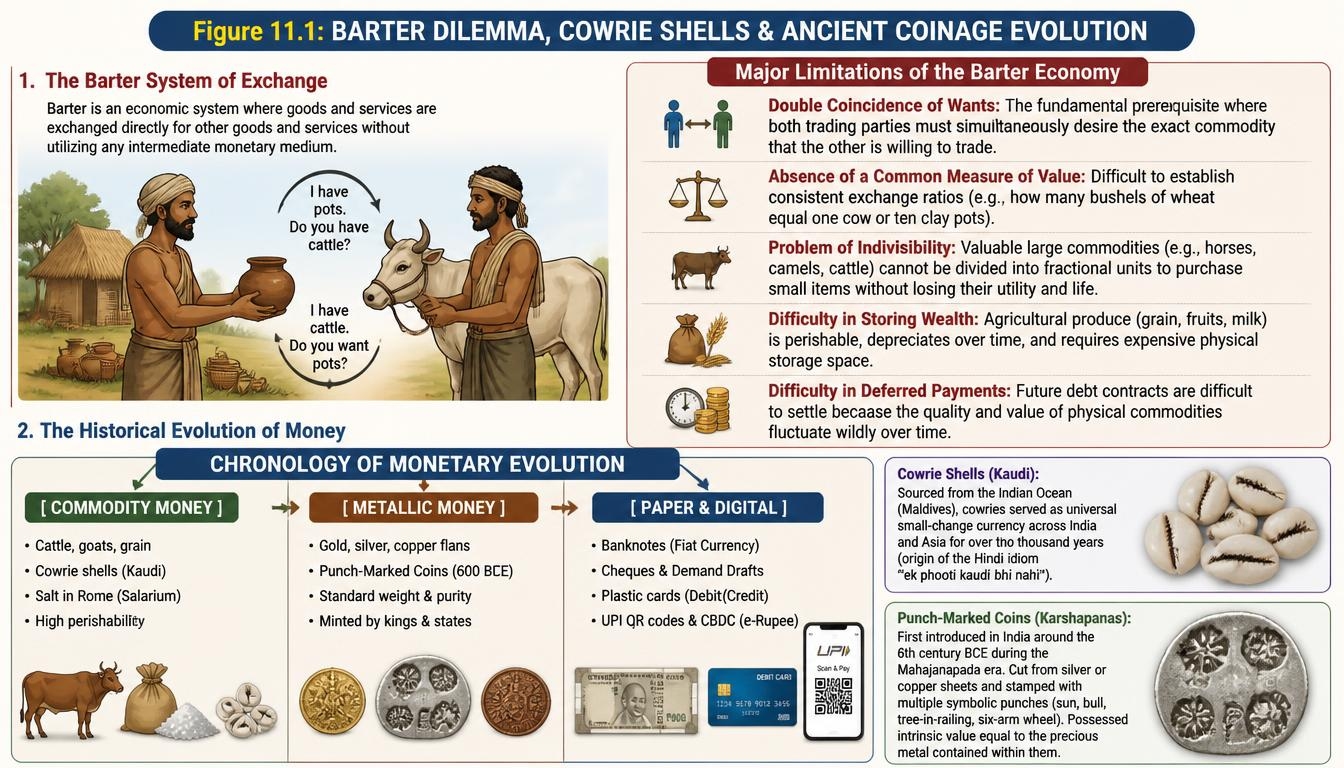
Figure 11.1: Barter Dilemma, Cowrie Shells & Ancient Coinage Evolution

1. The Barter System of Exchange

Barter is an economic system where goods and services are exchanged directly for other goods and services without utilizing any intermediate monetary medium:

  • Major Limitations of the Barter Economy:
  1. Double Coincidence of Wants: The fundamental prerequisite where both trading parties must simultaneously desire the exact commodity that the other is willing to trade.
  2. Absence of a Common Measure of Value: Difficult to establish consistent exchange ratios (e.g., how many bushels of wheat equal one cow or ten clay pots).
  3. Problem of Indivisibility: Valuable large commodities (e.g., horses, camels, cattle) cannot be divided into fractional units to purchase small items without losing their utility and life.
  4. Difficulty in Storing Wealth: Agricultural produce (grain, fruits, milk) is perishable, depreciates over time, and requires expensive physical storage space.
  5. Difficulty in Deferred Payments: Future debt contracts are difficult to settle because the quality and value of physical commodities fluctuate wildly over time.

2. The Historical Evolution of Money

                          CHRONOLOGY OF MONETARY EVOLUTION
                                         โ”‚
       โ”Œโ”€โ”€โ”€โ”€โ”€โ”€โ”€โ”€โ”€โ”€โ”€โ”€โ”€โ”€โ”€โ”€โ”€โ”€โ”€โ”€โ”€โ”€โ”€โ”€โ”€โ”€โ”€โ”€โ”€โ”€โ”€โ”€โ”€โ”ผโ”€โ”€โ”€โ”€โ”€โ”€โ”€โ”€โ”€โ”€โ”€โ”€โ”€โ”€โ”€โ”€โ”€โ”€โ”€โ”€โ”€โ”€โ”€โ”€โ”€โ”€โ”€โ”€โ”€โ”€โ”€โ”€โ”€โ”
       โ–ผ                                 โ–ผ                                 โ–ผ
[ COMMODITY MONEY ]             [ METALLIC MONEY ]              [ PAPER & DIGITAL ]
โ€ข Cattle, goats, grain          โ€ข Gold, silver, copper flans    โ€ข Banknotes (Fiat Currency)
โ€ข Cowrie shells (Kaudi)         โ€ข Punch-Marked Coins (600 BCE)  โ€ข Cheques & Demand Drafts
โ€ข Salt in Rome (Salarium)       โ€ข Standard weight & purity      โ€ข Plastic cards (Debit/Credit)
โ€ข High perishability            โ€ข Minted by kings & states      โ€ข UPI QR codes & CBDC (e-Rupee)
  • Cowrie Shells (Kaudi): Sourced from the Indian Ocean (Maldives), cowries served as universal small-change currency across India and Asia for over two thousand years (origin of the Hindi idiom "ek phooti kaudi bhi nahi").
  • Punch-Marked Coins (Karshapanas):
  • First introduced in India around the 6th century BCE during the Mahajanapada era.
  • Cut from silver or copper sheets and stamped with multiple symbolic punches (sun, bull, tree-in-railing, six-arm wheel).
  • Possessed intrinsic value equal to the precious metal contained within them.
๐Ÿ“
Comprehensive High-Yield Mathematical Relations & Theorems

Complete step-by-step derivations, step traps, and LaTeX formula sheet breakdowns...

๐Ÿ”’

End of Free Notes Preview

Unlock the complete deck to access full LaTeX formula breakdowns, interactive diagrams, exam traps, and personal margin highlights!

๐Ÿ”‘ Sign In / Register Free
๐Ÿง  Review Due (Interval: 1 Day) Card 1 of 8 (SM-2 Active Recall)
QUESTION (FRONT) Space โ†ต to flip
What is the Barter System of exchange?
ANSWER & EXPLANATION (BACK) Space โ†ต to flip
An economic system where goods and services are traded directly for other goods and services without using money as a medium.
๐Ÿ’ก
Tap Card to Flip & Check Your Answer Active recall prompt: Flip the card or press Space โ†ต to unlock the SM-2 recall difficulty rating.
๐Ÿ”’
Step 4 is Locked

Final Comprehensive Diagnostic Assessment (15 MCQs)

This ๐Ÿ“ LaTeX Concept Notes is part of the full verified curriculum for Part 1 โ€ข Chapter 11: From Barter to Money. Unlock the full deck to gain permanent access to all 11 interactive stages, active recall cards, and diagnostic checkpoints.

Deck Access Price
100% Free with Account
Instant Access
โœ“ UPI & Cards Supported
๐Ÿ”‘ Sign In / Register to Unlock Free →
๐Ÿ”’
Step 5 is Locked

Final Comprehensive Diagnostic Assessment (15 MCQs)

This โšก Diagnostic Quiz is part of the full verified curriculum for Part 1 โ€ข Chapter 11: From Barter to Money. Unlock the full deck to gain permanent access to all 11 interactive stages, active recall cards, and diagnostic checkpoints.

Deck Access Price
100% Free with Account
Instant Access
โœ“ UPI & Cards Supported
๐Ÿ”‘ Sign In / Register to Unlock Free →
๐Ÿ”’
Step 6 is Locked

Final Comprehensive Diagnostic Assessment (15 MCQs)

This Microlearning Step is part of the full verified curriculum for Part 1 โ€ข Chapter 11: From Barter to Money. Unlock the full deck to gain permanent access to all 11 interactive stages, active recall cards, and diagnostic checkpoints.

Deck Access Price
100% Free with Account
Instant Access
โœ“ UPI & Cards Supported
๐Ÿ”‘ Sign In / Register to Unlock Free →
๐Ÿ”’
Step 7 is Locked

Final Comprehensive Diagnostic Assessment (15 MCQs)

This ๐ŸŽฅ Video Lesson is part of the full verified curriculum for Part 1 โ€ข Chapter 11: From Barter to Money. Unlock the full deck to gain permanent access to all 11 interactive stages, active recall cards, and diagnostic checkpoints.

Deck Access Price
100% Free with Account
Instant Access
โœ“ UPI & Cards Supported
๐Ÿ”‘ Sign In / Register to Unlock Free →
๐Ÿ”’
Step 8 is Locked

Final Comprehensive Diagnostic Assessment (15 MCQs)

This ๐Ÿ“ LaTeX Concept Notes is part of the full verified curriculum for Part 1 โ€ข Chapter 11: From Barter to Money. Unlock the full deck to gain permanent access to all 11 interactive stages, active recall cards, and diagnostic checkpoints.

Deck Access Price
100% Free with Account
Instant Access
โœ“ UPI & Cards Supported
๐Ÿ”‘ Sign In / Register to Unlock Free →
๐Ÿ”’
Step 9 is Locked

Final Comprehensive Diagnostic Assessment (15 MCQs)

This ๐Ÿง  Active Recall Flashcards is part of the full verified curriculum for Part 1 โ€ข Chapter 11: From Barter to Money. Unlock the full deck to gain permanent access to all 11 interactive stages, active recall cards, and diagnostic checkpoints.

Deck Access Price
100% Free with Account
Instant Access
โœ“ UPI & Cards Supported
๐Ÿ”‘ Sign In / Register to Unlock Free →
๐Ÿ”’
Step 10 is Locked

Final Comprehensive Diagnostic Assessment (15 MCQs)

This ๐Ÿ“ LaTeX Concept Notes is part of the full verified curriculum for Part 1 โ€ข Chapter 11: From Barter to Money. Unlock the full deck to gain permanent access to all 11 interactive stages, active recall cards, and diagnostic checkpoints.

Deck Access Price
100% Free with Account
Instant Access
โœ“ UPI & Cards Supported
๐Ÿ”‘ Sign In / Register to Unlock Free →
๐Ÿ”’
Step 11 is Locked

Final Comprehensive Diagnostic Assessment (15 MCQs)

This โšก Diagnostic Quiz is part of the full verified curriculum for Part 1 โ€ข Chapter 11: From Barter to Money. Unlock the full deck to gain permanent access to all 11 interactive stages, active recall cards, and diagnostic checkpoints.

Deck Access Price
100% Free with Account
Instant Access
โœ“ UPI & Cards Supported
๐Ÿ”‘ Sign In / Register to Unlock Free →