Part 2 โ€ข Chapter 7: Infrastructure: Engine of India's Development
๐Ÿ‡ฎ๐Ÿ‡ณ National Curriculum Standard โ–พ
๐Ÿ› Vidyoric Certified โ€ข Dr. Meenakshi Sundaram
๐Ÿ”ฅ 0 days
โšก 0 Sparks +
Part 2 โ€ข Chapter 7: Infrastructure: Engine of India's Development

Video Lecture 1: Arteries of Progress โ€” How Infrastructure Powers India

STEP 1: VIDEO LESSON ๐Ÿ“ค Uploaded HTML5 Video

๐Ÿ“‘ Interactive Chapter Bookmarks

5 chapters
00:00
Introduction & Overview

Syllabus scope and core objectives

โ–ถ
01:11
Infrastructure Puzzle

Detailed physical mechanism and derivations

โ–ถ
03:20
Agriculture & Trade

High-yield board tips and pitfalls

โ–ถ
04:43
Engineering Marvels
โ–ถ
06:28
Connection Of Nation
โ–ถ

๐ŸŽ™๏ธ Synchronized Transcript

๐Ÿ”
Imagine waking up in the morning, switching on the lights, turning on a tap for drinking water, travelling to school by road or train, and accessing study materials through the internet. All these essential facilities are part of something called infrastructure.

Infrastructure refers to the basic facilities and services needed for a country to function and develop. It supports industries, agriculture, education, healthcare, transportation, and trade. Without proper infrastructure, economic activities become difficult and development slows down.

Infrastructure can be divided into two major types: physical infrastructure and social infrastructure.

Physical infrastructure includes the facilities that support economic activities. Examples include roads, railways, airports, seaports, electricity networks, and telecommunication systems.

Social infrastructure focuses on improving people's quality of life and developing human resources. It includes schools, colleges, hospitals, healthcare centres, sanitation facilities, and drinking water systems.

Both types are closely connected. For example, a good road network helps people in remote villages reach hospitals, schools, and markets more easily.

India has developed several important infrastructure projects to improve connectivity.

One major project is the Golden Quadrilateral. It connects four major metropolitan cities: Delhi, Mumbai, Chennai, and Kolkata. This highway network improves road transportation and helps goods and people move between important economic centres.

Another important initiative is the Pradhan Mantri Gram Sadak Yojana, commonly known as PMGSY. Its main objective is to provide all-weather road connectivity to eligible rural habitations.

These rural roads create new opportunities for village communities. Farmers can transport their crops to markets more easily, students can travel to schools, and patients can reach healthcare facilities more quickly.

Better connectivity also encourages businesses to expand into rural areas and creates employment opportunities.

Infrastructure is therefore not limited to large highways, airports, or modern buildings. It also includes the basic services that make everyday life safer, easier, and more productive.

In our next lesson, we will explore how Dedicated Freight Corridors improve goods transportation and how renewable energy projects, especially solar parks, contribute to India's development.
STEP 2 โ€ข CONCEPT NOTES โฑ๏ธ 3 min read
๐Ÿ“Œ 0 Notes

Concept Notes 1: Foundations of Infrastructure & Transport Networks
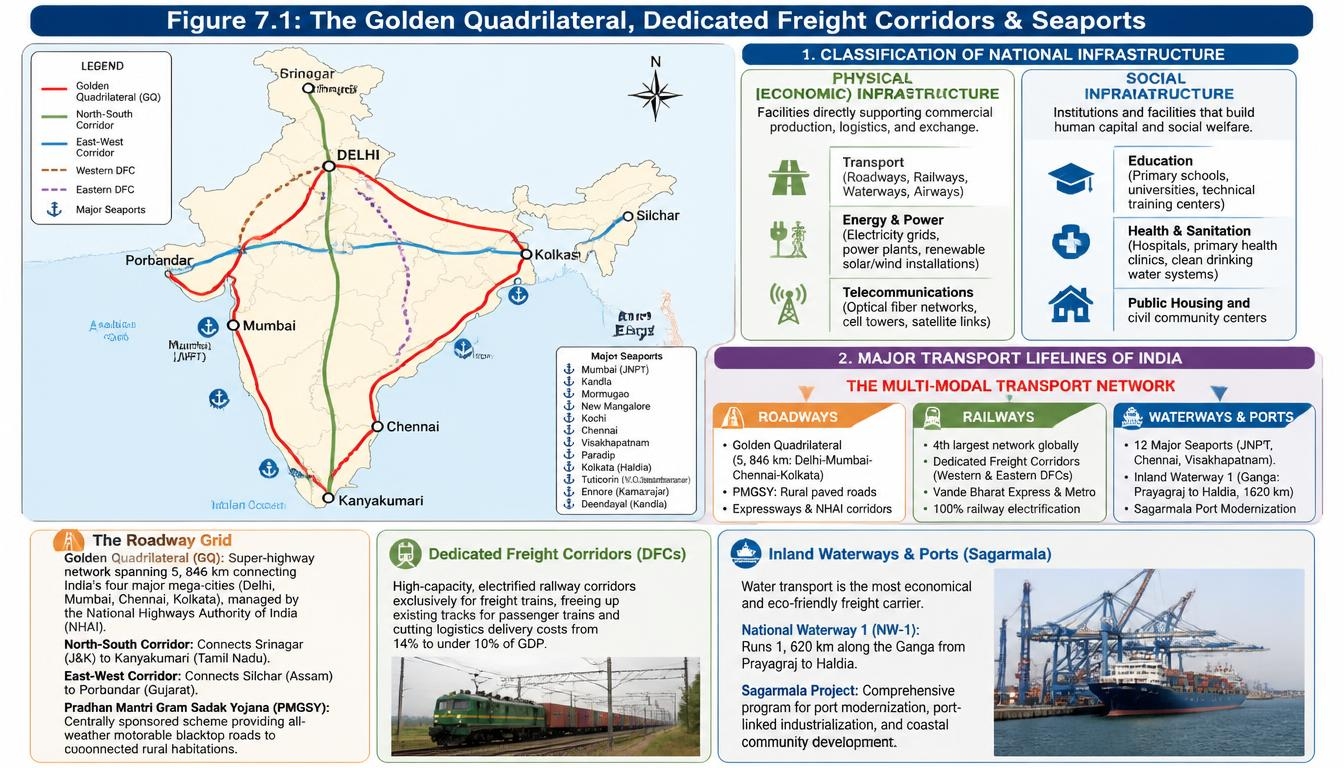
Figure 7.1: The Golden Quadrilateral, Dedicated Freight Corridors & Seaports

1. Classification of National Infrastructure

Infrastructure represents the foundational physical and organizational systems indispensable for the operational vitality of a modern economy:

  • Physical (Economic) Infrastructure: Facilities directly supporting commercial production, logistics, and exchange:
  • Transport (Roadways, Railways, Waterways, Airways).
  • Energy & Power (Electricity grids, power plants, renewable solar/wind installations).
  • Telecommunications (Optical fiber networks, cell towers, satellite links).
  • Social Infrastructure: Institutions and facilities that build human capital and social welfare:
  • Education (Primary schools, universities, technical training centers).
  • Health & Sanitation (Hospitals, primary health clinics, clean drinking water systems).
  • Public Housing and civil community centers.

2. Major Transport Lifelines of India

                      THE MULTI-MODAL TRANSPORT NETWORK
                                      โ”‚
       โ”Œโ”€โ”€โ”€โ”€โ”€โ”€โ”€โ”€โ”€โ”€โ”€โ”€โ”€โ”€โ”€โ”€โ”€โ”€โ”€โ”€โ”€โ”€โ”€โ”€โ”€โ”€โ”€โ”€โ”€โ”€โ”ผโ”€โ”€โ”€โ”€โ”€โ”€โ”€โ”€โ”€โ”€โ”€โ”€โ”€โ”€โ”€โ”€โ”€โ”€โ”€โ”€โ”€โ”€โ”€โ”€โ”€โ”€โ”€โ”€โ”€โ”€โ”
       โ–ผ                              โ–ผ                              โ–ผ
  [ ROADWAYS ]                  [ RAILWAYS ]                   [ WATERWAYS & PORTS ]
โ€ข Golden Quadrilateral          โ€ข 4th largest network globally โ€ข 12 Major Seaports (JNPT,
  (5,846 km: Delhi-Mumbai-      โ€ข Dedicated Freight Corridors    Chennai, Visakhapatnam)
   Chennai-Kolkata)               (Western & Eastern DFCs)     โ€ข Inland Waterway 1 (Ganga:
โ€ข PMGSY: Rural paved roads      โ€ข Vande Bharat Express & Metro   Prayagraj to Haldia, 1620 km)
โ€ข Expressways & NHAI corridors  โ€ข 100% railway electrification โ€ข Sagarmala Port Modernization
  1. The Roadway Grid:
  • Golden Quadrilateral (GQ): Super-highway network spanning 5,846 km connecting India's four major mega-cities (Delhi, Mumbai, Chennai, Kolkata), managed by the National Highways Authority of India (NHAI).
  • North-South Corridor: Connects Srinagar (J&K) to Kanyakumari (Tamil Nadu).
  • East-West Corridor: Connects Silchar (Assam) to Porbandar (Gujarat).
  • Pradhan Mantri Gram Sadak Yojana (PMGSY): Centrally sponsored scheme providing all-weather motorable blacktop roads to unconnected rural habitations.
  1. Dedicated Freight Corridors (DFCs):
  • High-capacity, electrified railway corridors exclusively for freight trains, freeing up existing tracks for passenger trains and cutting logistics delivery costs from 14% to under 10% of GDP.
  1. Inland Waterways & Ports (Sagarmala):
  • Water transport is the most economical and eco-friendly freight carrier.
  • National Waterway 1 (NW-1): Runs 1,620 km along the Ganga from Prayagraj to Haldia.
  • Sagarmala Project: Comprehensive program for port modernization, port-linked industrialization, and coastal community development.
๐Ÿ“
Comprehensive High-Yield Mathematical Relations & Theorems

Complete step-by-step derivations, step traps, and LaTeX formula sheet breakdowns...

๐Ÿ”’

End of Free Notes Preview

Unlock the complete deck to access full LaTeX formula breakdowns, interactive diagrams, exam traps, and personal margin highlights!

๐Ÿ”‘ Sign In / Register Free
๐Ÿง  Review Due (Interval: 1 Day) Card 1 of 8 (SM-2 Active Recall)
QUESTION (FRONT) Space โ†ต to flip
What is the fundamental difference between Physical and Social Infrastructure?
ANSWER & EXPLANATION (BACK) Space โ†ต to flip
Physical infrastructure supports economic production and logistics (roads, electricity, railways); social infrastructure builds human capital and well-being (schools, hospitals, clean drinking water).
๐Ÿ’ก
Tap Card to Flip & Check Your Answer Active recall prompt: Flip the card or press Space โ†ต to unlock the SM-2 recall difficulty rating.
๐Ÿ”’
Step 4 is Locked

Final Comprehensive Diagnostic Assessment (15 MCQs)

This ๐Ÿ“ LaTeX Concept Notes is part of the full verified curriculum for Part 2 โ€ข Chapter 7: Infrastructure: Engine of India's Development. Unlock the full deck to gain permanent access to all 11 interactive stages, active recall cards, and diagnostic checkpoints.

Deck Access Price
100% Free with Account
Instant Access
โœ“ UPI & Cards Supported
๐Ÿ”‘ Sign In / Register to Unlock Free →
๐Ÿ”’
Step 5 is Locked

Final Comprehensive Diagnostic Assessment (15 MCQs)

This โšก Diagnostic Quiz is part of the full verified curriculum for Part 2 โ€ข Chapter 7: Infrastructure: Engine of India's Development. Unlock the full deck to gain permanent access to all 11 interactive stages, active recall cards, and diagnostic checkpoints.

Deck Access Price
100% Free with Account
Instant Access
โœ“ UPI & Cards Supported
๐Ÿ”‘ Sign In / Register to Unlock Free →
๐Ÿ”’
Step 6 is Locked

Final Comprehensive Diagnostic Assessment (15 MCQs)

This Microlearning Step is part of the full verified curriculum for Part 2 โ€ข Chapter 7: Infrastructure: Engine of India's Development. Unlock the full deck to gain permanent access to all 11 interactive stages, active recall cards, and diagnostic checkpoints.

Deck Access Price
100% Free with Account
Instant Access
โœ“ UPI & Cards Supported
๐Ÿ”‘ Sign In / Register to Unlock Free →
๐Ÿ”’
Step 7 is Locked

Final Comprehensive Diagnostic Assessment (15 MCQs)

This ๐ŸŽฅ Video Lesson is part of the full verified curriculum for Part 2 โ€ข Chapter 7: Infrastructure: Engine of India's Development. Unlock the full deck to gain permanent access to all 11 interactive stages, active recall cards, and diagnostic checkpoints.

Deck Access Price
100% Free with Account
Instant Access
โœ“ UPI & Cards Supported
๐Ÿ”‘ Sign In / Register to Unlock Free →
๐Ÿ”’
Step 8 is Locked

Final Comprehensive Diagnostic Assessment (15 MCQs)

This ๐Ÿ“ LaTeX Concept Notes is part of the full verified curriculum for Part 2 โ€ข Chapter 7: Infrastructure: Engine of India's Development. Unlock the full deck to gain permanent access to all 11 interactive stages, active recall cards, and diagnostic checkpoints.

Deck Access Price
100% Free with Account
Instant Access
โœ“ UPI & Cards Supported
๐Ÿ”‘ Sign In / Register to Unlock Free →
๐Ÿ”’
Step 9 is Locked

Final Comprehensive Diagnostic Assessment (15 MCQs)

This ๐Ÿง  Active Recall Flashcards is part of the full verified curriculum for Part 2 โ€ข Chapter 7: Infrastructure: Engine of India's Development. Unlock the full deck to gain permanent access to all 11 interactive stages, active recall cards, and diagnostic checkpoints.

Deck Access Price
100% Free with Account
Instant Access
โœ“ UPI & Cards Supported
๐Ÿ”‘ Sign In / Register to Unlock Free →
๐Ÿ”’
Step 10 is Locked

Final Comprehensive Diagnostic Assessment (15 MCQs)

This ๐Ÿ“ LaTeX Concept Notes is part of the full verified curriculum for Part 2 โ€ข Chapter 7: Infrastructure: Engine of India's Development. Unlock the full deck to gain permanent access to all 11 interactive stages, active recall cards, and diagnostic checkpoints.

Deck Access Price
100% Free with Account
Instant Access
โœ“ UPI & Cards Supported
๐Ÿ”‘ Sign In / Register to Unlock Free →
๐Ÿ”’
Step 11 is Locked

Final Comprehensive Diagnostic Assessment (15 MCQs)

This โšก Diagnostic Quiz is part of the full verified curriculum for Part 2 โ€ข Chapter 7: Infrastructure: Engine of India's Development. Unlock the full deck to gain permanent access to all 11 interactive stages, active recall cards, and diagnostic checkpoints.

Deck Access Price
100% Free with Account
Instant Access
โœ“ UPI & Cards Supported
๐Ÿ”‘ Sign In / Register to Unlock Free →